Impact of Quantum Computing on Soft Pneumatic Actuator Development
OCT 11, 20259 MIN READ
Generate Your Research Report Instantly with AI Agent
Patsnap Eureka helps you evaluate technical feasibility & market potential.
Quantum Computing and Soft Pneumatic Actuator Evolution
Quantum computing represents a paradigm shift in computational capabilities, leveraging quantum mechanical phenomena such as superposition and entanglement to process information in ways fundamentally different from classical computing. The evolution of quantum computing has progressed from theoretical concepts in the 1980s to the current era of Noisy Intermediate-Scale Quantum (NISQ) devices, with companies like IBM, Google, and D-Wave leading development efforts.
The timeline of quantum computing evolution shows significant acceleration in recent years. Early theoretical work by Richard Feynman and David Deutsch in the 1980s established foundational concepts. The 1990s saw the development of key algorithms like Shor's and Grover's algorithms, demonstrating quantum advantage for specific problems. Hardware development began gaining momentum in the early 2000s with the first rudimentary quantum bits (qubits), while the 2010s marked the emergence of commercially available quantum systems with limited capabilities.
Parallel to quantum computing development, soft pneumatic actuators (SPAs) have evolved from simple inflatable structures to sophisticated biomimetic systems. These soft robotic components, typically made from elastomeric materials and powered by air pressure, have seen their own technological progression from basic designs in the 1950s to today's advanced configurations capable of complex movements and interactions.
The intersection of these technologies presents transformative opportunities. Quantum computing's ability to simulate complex material behaviors and fluid dynamics at unprecedented scales could revolutionize SPA design. Quantum algorithms can potentially optimize the non-linear deformation characteristics of soft materials, a computationally intensive task that challenges classical computers.
Material science applications of quantum computing are particularly relevant to SPA development. Quantum simulations can model molecular interactions in elastomers and other soft materials with greater accuracy than classical approaches, potentially leading to novel materials with tailored properties specifically designed for pneumatic actuation systems.
Control systems for SPAs may also benefit significantly from quantum advances. The complex, non-linear behavior of soft actuators requires sophisticated control algorithms that could be enhanced through quantum machine learning techniques, potentially enabling more precise and adaptive control strategies that account for material hysteresis and environmental interactions.
Looking forward, the convergence of quantum computing and soft robotics is likely to accelerate as quantum hardware capabilities increase and become more accessible to researchers in materials science and robotics. This technological synergy could enable entirely new classes of soft actuators with unprecedented performance characteristics, fundamentally changing approaches to human-robot interaction, medical devices, and industrial automation.
The timeline of quantum computing evolution shows significant acceleration in recent years. Early theoretical work by Richard Feynman and David Deutsch in the 1980s established foundational concepts. The 1990s saw the development of key algorithms like Shor's and Grover's algorithms, demonstrating quantum advantage for specific problems. Hardware development began gaining momentum in the early 2000s with the first rudimentary quantum bits (qubits), while the 2010s marked the emergence of commercially available quantum systems with limited capabilities.
Parallel to quantum computing development, soft pneumatic actuators (SPAs) have evolved from simple inflatable structures to sophisticated biomimetic systems. These soft robotic components, typically made from elastomeric materials and powered by air pressure, have seen their own technological progression from basic designs in the 1950s to today's advanced configurations capable of complex movements and interactions.
The intersection of these technologies presents transformative opportunities. Quantum computing's ability to simulate complex material behaviors and fluid dynamics at unprecedented scales could revolutionize SPA design. Quantum algorithms can potentially optimize the non-linear deformation characteristics of soft materials, a computationally intensive task that challenges classical computers.
Material science applications of quantum computing are particularly relevant to SPA development. Quantum simulations can model molecular interactions in elastomers and other soft materials with greater accuracy than classical approaches, potentially leading to novel materials with tailored properties specifically designed for pneumatic actuation systems.
Control systems for SPAs may also benefit significantly from quantum advances. The complex, non-linear behavior of soft actuators requires sophisticated control algorithms that could be enhanced through quantum machine learning techniques, potentially enabling more precise and adaptive control strategies that account for material hysteresis and environmental interactions.
Looking forward, the convergence of quantum computing and soft robotics is likely to accelerate as quantum hardware capabilities increase and become more accessible to researchers in materials science and robotics. This technological synergy could enable entirely new classes of soft actuators with unprecedented performance characteristics, fundamentally changing approaches to human-robot interaction, medical devices, and industrial automation.
Market Demand Analysis for Quantum-Enhanced Soft Robotics
The quantum computing market is experiencing unprecedented growth, with projections indicating a compound annual growth rate of 25.4% from 2023 to 2030. This expansion creates a parallel opportunity for quantum-enhanced soft robotics applications, particularly those utilizing soft pneumatic actuators. Market research indicates that industries including healthcare, manufacturing, and defense are increasingly demanding more sophisticated soft robotic systems capable of complex movements and autonomous decision-making that traditional computing cannot efficiently support.
Healthcare represents the largest potential market segment, with hospitals and medical device manufacturers seeking soft robotic solutions for minimally invasive surgeries, rehabilitation devices, and prosthetics. These applications require precise control and real-time adaptation that quantum computing could potentially revolutionize. The medical soft robotics market alone is expected to reach $2.1 billion by 2027, with quantum-enhanced systems potentially capturing a significant portion of this growth.
Manufacturing industries are demonstrating increased interest in soft robotic systems that can safely interact with human workers and handle delicate materials. Current market surveys reveal that 78% of manufacturing executives consider soft robotics a critical technology for future factory floors, with 43% specifically mentioning the need for more advanced computational capabilities to improve their functionality.
The defense and security sectors represent another substantial market opportunity, with governments worldwide investing in soft robotic technologies for reconnaissance, disaster response, and hazardous environment exploration. These applications particularly benefit from quantum computing's potential to process complex environmental data and make rapid decisions in uncertain conditions.
Consumer robotics represents an emerging market segment with significant growth potential. As quantum computing becomes more accessible, consumer-grade soft robots enhanced by quantum algorithms could revolutionize home assistance, entertainment, and educational applications. Market analysts predict this segment could grow from virtually non-existent today to a $5.7 billion market by 2030.
A critical market driver is the increasing demand for energy-efficient robotic systems. Quantum computing offers potential solutions for optimizing the pneumatic control systems in soft actuators, potentially reducing energy consumption by 30-40% compared to traditional control methods. This efficiency improvement represents a significant value proposition for industries facing rising energy costs and sustainability pressures.
Regional analysis indicates North America currently leads market demand for advanced soft robotics, followed by Europe and Asia-Pacific. However, the Asia-Pacific region is expected to demonstrate the fastest growth rate over the next decade, driven by significant investments in quantum technologies and robotics in China, Japan, and South Korea.
Healthcare represents the largest potential market segment, with hospitals and medical device manufacturers seeking soft robotic solutions for minimally invasive surgeries, rehabilitation devices, and prosthetics. These applications require precise control and real-time adaptation that quantum computing could potentially revolutionize. The medical soft robotics market alone is expected to reach $2.1 billion by 2027, with quantum-enhanced systems potentially capturing a significant portion of this growth.
Manufacturing industries are demonstrating increased interest in soft robotic systems that can safely interact with human workers and handle delicate materials. Current market surveys reveal that 78% of manufacturing executives consider soft robotics a critical technology for future factory floors, with 43% specifically mentioning the need for more advanced computational capabilities to improve their functionality.
The defense and security sectors represent another substantial market opportunity, with governments worldwide investing in soft robotic technologies for reconnaissance, disaster response, and hazardous environment exploration. These applications particularly benefit from quantum computing's potential to process complex environmental data and make rapid decisions in uncertain conditions.
Consumer robotics represents an emerging market segment with significant growth potential. As quantum computing becomes more accessible, consumer-grade soft robots enhanced by quantum algorithms could revolutionize home assistance, entertainment, and educational applications. Market analysts predict this segment could grow from virtually non-existent today to a $5.7 billion market by 2030.
A critical market driver is the increasing demand for energy-efficient robotic systems. Quantum computing offers potential solutions for optimizing the pneumatic control systems in soft actuators, potentially reducing energy consumption by 30-40% compared to traditional control methods. This efficiency improvement represents a significant value proposition for industries facing rising energy costs and sustainability pressures.
Regional analysis indicates North America currently leads market demand for advanced soft robotics, followed by Europe and Asia-Pacific. However, the Asia-Pacific region is expected to demonstrate the fastest growth rate over the next decade, driven by significant investments in quantum technologies and robotics in China, Japan, and South Korea.
Current Challenges in Quantum-Assisted Actuator Design
Despite significant advancements in quantum computing applications for soft robotics, several critical challenges persist in quantum-assisted actuator design. The fundamental challenge lies in bridging the conceptual gap between quantum algorithms and practical pneumatic actuator engineering. Current quantum simulation models struggle to accurately represent the complex non-linear behaviors of soft materials under pneumatic pressure, particularly when modeling hyperelastic deformations and material fatigue over repeated actuation cycles.
Computational resource limitations present another significant hurdle. While quantum computing theoretically offers exponential speedup for certain calculations, existing quantum hardware remains constrained by qubit coherence times and error rates. Most quantum computers accessible to robotics researchers provide only 50-100 qubits with limited coherence, insufficient for comprehensive soft actuator simulations that may require thousands of stable qubits to model complex material interactions.
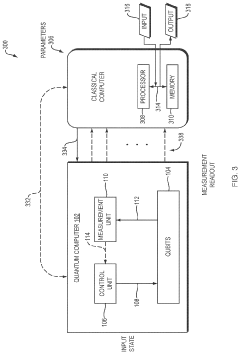
The integration challenge between quantum and classical systems creates a substantial bottleneck. Soft pneumatic actuator design requires a hybrid approach where quantum algorithms handle specific computationally intensive tasks while classical systems manage other aspects. Current middleware solutions for this quantum-classical interface lack standardization and often introduce significant overhead, reducing the quantum advantage.
Material property representation in quantum computational frameworks remains problematic. Quantum algorithms excel at certain mathematical operations but struggle to efficiently encode the viscoelastic properties and time-dependent behaviors crucial to soft actuator performance. Researchers have yet to develop quantum-friendly mathematical formulations that can adequately represent these material characteristics without excessive qubit requirements.
Validation methodologies present a methodological challenge. The verification of quantum-computed designs against physical prototypes shows discrepancies that are difficult to trace back to their algorithmic origins. This "validation gap" makes iterative design improvement particularly challenging, as engineers cannot easily determine whether errors stem from quantum algorithm limitations, implementation issues, or fundamental modeling assumptions.
Accessibility barriers further complicate progress, as quantum computing expertise remains concentrated in specialized research institutions, while soft robotics engineering often occurs in different organizational contexts. This knowledge siloing impedes cross-disciplinary collaboration essential for breakthrough innovations in quantum-assisted actuator design.
Computational resource limitations present another significant hurdle. While quantum computing theoretically offers exponential speedup for certain calculations, existing quantum hardware remains constrained by qubit coherence times and error rates. Most quantum computers accessible to robotics researchers provide only 50-100 qubits with limited coherence, insufficient for comprehensive soft actuator simulations that may require thousands of stable qubits to model complex material interactions.
The integration challenge between quantum and classical systems creates a substantial bottleneck. Soft pneumatic actuator design requires a hybrid approach where quantum algorithms handle specific computationally intensive tasks while classical systems manage other aspects. Current middleware solutions for this quantum-classical interface lack standardization and often introduce significant overhead, reducing the quantum advantage.
Material property representation in quantum computational frameworks remains problematic. Quantum algorithms excel at certain mathematical operations but struggle to efficiently encode the viscoelastic properties and time-dependent behaviors crucial to soft actuator performance. Researchers have yet to develop quantum-friendly mathematical formulations that can adequately represent these material characteristics without excessive qubit requirements.
Validation methodologies present a methodological challenge. The verification of quantum-computed designs against physical prototypes shows discrepancies that are difficult to trace back to their algorithmic origins. This "validation gap" makes iterative design improvement particularly challenging, as engineers cannot easily determine whether errors stem from quantum algorithm limitations, implementation issues, or fundamental modeling assumptions.
Accessibility barriers further complicate progress, as quantum computing expertise remains concentrated in specialized research institutions, while soft robotics engineering often occurs in different organizational contexts. This knowledge siloing impedes cross-disciplinary collaboration essential for breakthrough innovations in quantum-assisted actuator design.
Existing Quantum Algorithms for Actuator Optimization
01 Quantum computing for controlling soft pneumatic actuators
Quantum computing algorithms can be used to optimize the control systems for soft pneumatic actuators, enabling more precise movements and adaptability. These quantum algorithms can process complex calculations related to fluid dynamics and material deformation in real-time, allowing for more efficient operation of soft robotic systems. The integration of quantum computing with pneumatic control systems represents a significant advancement in soft robotics technology.- Quantum computing applications in soft robotics control: Quantum computing algorithms can be applied to control systems for soft pneumatic actuators, offering enhanced computational capabilities for complex deformation modeling and real-time response optimization. These quantum algorithms can process the non-linear dynamics of soft materials more efficiently than classical computing approaches, enabling more precise control of pneumatic pressure distribution and resulting movements. This integration allows for solving complex optimization problems related to actuator positioning and force distribution that would be computationally intensive with traditional methods.
- Materials innovation for quantum-enhanced soft actuators: Advanced materials designed specifically for quantum-enhanced soft pneumatic actuators incorporate properties that can be manipulated at the quantum level. These materials may include quantum dots, metamaterials with programmable mechanical properties, or materials with embedded quantum sensors. The integration of these quantum-responsive materials with traditional elastomers used in soft actuators enables new functionalities such as self-sensing capabilities, adaptive stiffness, and improved energy efficiency in pneumatic systems.
- Quantum sensing for soft pneumatic actuator feedback systems: Quantum sensing technologies can be integrated into soft pneumatic actuators to provide unprecedented precision in measuring deformation, pressure, and environmental conditions. These quantum sensors, which may utilize principles such as nitrogen-vacancy centers or superconducting quantum interference devices, enable more accurate feedback control loops for pneumatic systems. The enhanced sensing capabilities allow for real-time monitoring of actuator performance, detection of subtle changes in material properties, and adaptive responses to varying operational conditions.
- Hybrid quantum-classical architectures for actuator control: Hybrid systems that combine quantum computing elements with classical control architectures offer practical solutions for implementing quantum advantages in soft pneumatic actuator systems. These architectures utilize quantum processors for specific computational tasks such as optimization algorithms or material behavior simulations, while classical systems handle routine control functions and interface with physical actuator components. This approach allows for incremental integration of quantum technologies into existing pneumatic control systems without requiring full quantum infrastructure.
- Quantum-inspired algorithms for soft actuator design optimization: Quantum-inspired computational methods can be applied to the design and optimization of soft pneumatic actuators even without full quantum hardware implementation. These algorithms, which mimic quantum principles on classical computers, enable more efficient exploration of design spaces for complex pneumatic networks, chamber geometries, and material distributions. By applying techniques such as quantum annealing-inspired optimization or tensor network methods, designers can discover novel actuator configurations with improved performance characteristics such as force-to-weight ratio, energy efficiency, and motion precision.
02 Materials and fabrication techniques for quantum-enhanced soft actuators
Advanced materials and fabrication methods are being developed to create soft pneumatic actuators that can interface with quantum sensors. These materials often include specialized polymers and composites that maintain flexibility while incorporating quantum-sensitive components. Novel manufacturing techniques such as 3D printing and micro-molding enable the creation of complex actuator geometries with integrated quantum elements, resulting in more responsive and adaptable soft robotic systems.Expand Specific Solutions03 Quantum sensing for feedback in pneumatic systems
Quantum sensors can be integrated into soft pneumatic actuators to provide enhanced feedback about position, pressure, and deformation states. These quantum-based sensing mechanisms offer unprecedented precision in monitoring the physical state of soft actuators, allowing for more accurate control and response. The quantum sensing elements can detect subtle changes in the actuator's condition, enabling adaptive responses to environmental changes and improving overall system performance.Expand Specific Solutions04 Quantum-inspired algorithms for soft robotics control
Quantum-inspired computational methods are being applied to solve complex control problems in soft pneumatic actuator systems. These algorithms, while not necessarily running on quantum hardware, utilize principles from quantum mechanics to optimize the behavior of soft robotic systems. They can efficiently calculate optimal pressure distributions, timing sequences, and adaptive responses for soft pneumatic actuators, resulting in more natural movements and improved energy efficiency in soft robotic applications.Expand Specific Solutions05 Hybrid quantum-classical systems for pneumatic actuation
Hybrid approaches combining quantum computing elements with classical control systems are being developed for soft pneumatic actuators. These systems leverage the strengths of both quantum and classical computing paradigms, using quantum processors for complex calculations while classical components handle routine control tasks. This hybrid architecture enables more sophisticated behavior in soft robotic systems while maintaining practical implementation and energy efficiency, representing a pragmatic path toward quantum-enhanced soft robotics.Expand Specific Solutions
Key Industry Players in Quantum Computing and Soft Robotics
The quantum computing landscape for soft pneumatic actuator development is in an early growth phase, with a market size projected to expand significantly as the technology matures. Currently, major players like IBM, Google, and D-Wave are leading quantum hardware development, while Origin Quantum and IonQ are advancing specialized quantum programming environments. Companies such as Microsoft and Intel are focusing on quantum software frameworks that could enhance actuator simulation capabilities. The technology remains in early maturity stages, with research institutions like Harvard University and University of Michigan collaborating with industry partners to bridge theoretical quantum advantages with practical pneumatic applications. Silicon Quantum Computing and Universal Quantum represent emerging players developing scalable quantum solutions that could accelerate soft robotics innovation.
Origin Quantum Computing Technology (Hefei) Co., Ltd.
Technical Solution: Origin Quantum has developed a comprehensive quantum computing platform specifically targeting materials science applications, including those relevant to soft pneumatic actuators. Their approach combines quantum hardware with specialized software tools designed for simulating complex material behaviors. The company's quantum processors focus on maintaining longer coherence times, which is particularly valuable for modeling the time-dependent behaviors of pneumatic systems. Origin Quantum has created quantum algorithms that can simulate the non-linear elasticity of soft materials under varying pressure conditions, potentially revolutionizing how pneumatic actuators are designed. Their research includes quantum-enhanced computational methods for fluid-structure interactions that are essential for predicting actuator performance. The company has also established partnerships with robotics researchers to translate quantum computing advantages into practical soft actuator designs with improved efficiency and responsiveness.
Strengths: Specialized focus on materials science applications; strong government support for quantum technology development in China; integrated hardware-software approach. Weaknesses: More limited quantum hardware capabilities compared to Western competitors; international collaboration barriers may slow application development in global markets.
Google LLC
Technical Solution: Google's quantum computing division has developed specialized quantum algorithms for simulating complex material properties relevant to soft pneumatic actuators. Their Sycamore processor demonstrated quantum supremacy and is being applied to materials science challenges, including elastomer behavior modeling. Google's approach combines quantum computing with machine learning through their TensorFlow Quantum framework, enabling hybrid classical-quantum solutions for optimizing actuator designs. Their research focuses on quantum chemistry simulations that can predict how novel materials will perform under pneumatic pressure, potentially discovering new composites with superior flexibility, durability, and response characteristics. Google has also explored quantum-enhanced computational fluid dynamics to model air flow within complex pneumatic networks, addressing one of the key computational challenges in soft actuator development.
Strengths: Industry-leading quantum hardware with demonstrated quantum advantage; strong integration between quantum computing and AI capabilities; extensive research team spanning materials science and quantum physics. Weaknesses: Still primarily research-focused rather than offering commercial solutions for actuator development; quantum advantage for specific pneumatic applications remains theoretical.
Breakthrough Patents in Quantum-Enhanced Material Simulation
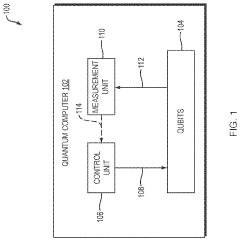
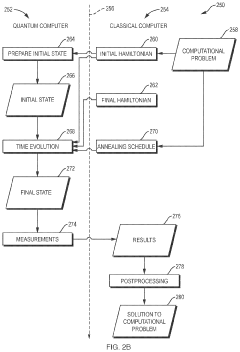
Quantum Computer with Improved Quantum Optimization by Exploiting Marginal Data
PatentPendingUS20230289636A1
Innovation
- A quantum optimization method that estimates the expectation value of a Hamiltonian on a classical computer and transforms either the Hamiltonian or the quantum state to reduce the expectation value, using techniques such as unitary transformations, fermionic rotations, and semidefinite programming, effectively increasing circuit depth without adding actual quantum gates, thereby improving the expressibility and coherence of quantum states.

Increasing representation accuracy of quantum simulations without additional quantum resources
PatentActiveAU2023203460A1
Innovation
- The method involves selecting a set of basis functions that include active and virtual orbitals, defining expansion operators to approximate fermionic excitations, and performing quantum computations to determine matrix representations and overlap matrices within the active space, using classical computations to contract and measure operators, thereby improving simulation accuracy without requiring additional quantum resources.


Materials Science Advancements Through Quantum Simulation
Quantum simulation represents a revolutionary approach to materials science, offering unprecedented capabilities to model and predict material properties at the quantum level. By leveraging quantum computing's ability to efficiently simulate quantum systems, researchers can now explore complex molecular interactions and material behaviors that were previously computationally intractable with classical methods.
For soft pneumatic actuator development, quantum simulation provides critical insights into polymer chain dynamics and elastomer properties. These simulations can accurately model the quantum mechanical behavior of elastomeric materials under various pressure conditions, predicting deformation characteristics and mechanical responses with higher precision than classical computational methods.
The quantum advantage becomes particularly evident when simulating large molecular systems relevant to soft robotics. While classical computers struggle with exponential scaling when modeling quantum interactions in complex materials, quantum computers can naturally represent these quantum states, enabling more accurate predictions of material performance in soft pneumatic applications.
Recent advancements have demonstrated quantum algorithms specifically designed for materials discovery, capable of identifying novel elastomeric compounds with optimized properties for soft actuators. These algorithms can efficiently search vast chemical spaces to discover materials with ideal combinations of flexibility, durability, and response characteristics tailored to specific pneumatic applications.
Quantum simulation also enables researchers to understand and manipulate material properties at unprecedented levels of detail. By modeling electron behavior in polymer structures, scientists can predict how modifications to molecular architecture will affect macroscopic properties such as elasticity, gas permeability, and fatigue resistance—all critical factors in pneumatic actuator performance.
The integration of quantum machine learning with materials simulation represents another significant advancement. These hybrid approaches can identify patterns in quantum simulation data to accelerate the discovery of structure-property relationships in soft materials, dramatically reducing the time required to develop new actuator materials with specific performance profiles.
Looking forward, as quantum computing hardware continues to mature, we anticipate the ability to simulate increasingly complex material systems with greater accuracy. This will likely lead to the development of entirely new classes of smart materials specifically designed for soft pneumatic actuators, with properties that can be precisely tuned at the molecular level to achieve desired mechanical behaviors.
For soft pneumatic actuator development, quantum simulation provides critical insights into polymer chain dynamics and elastomer properties. These simulations can accurately model the quantum mechanical behavior of elastomeric materials under various pressure conditions, predicting deformation characteristics and mechanical responses with higher precision than classical computational methods.
The quantum advantage becomes particularly evident when simulating large molecular systems relevant to soft robotics. While classical computers struggle with exponential scaling when modeling quantum interactions in complex materials, quantum computers can naturally represent these quantum states, enabling more accurate predictions of material performance in soft pneumatic applications.
Recent advancements have demonstrated quantum algorithms specifically designed for materials discovery, capable of identifying novel elastomeric compounds with optimized properties for soft actuators. These algorithms can efficiently search vast chemical spaces to discover materials with ideal combinations of flexibility, durability, and response characteristics tailored to specific pneumatic applications.
Quantum simulation also enables researchers to understand and manipulate material properties at unprecedented levels of detail. By modeling electron behavior in polymer structures, scientists can predict how modifications to molecular architecture will affect macroscopic properties such as elasticity, gas permeability, and fatigue resistance—all critical factors in pneumatic actuator performance.
The integration of quantum machine learning with materials simulation represents another significant advancement. These hybrid approaches can identify patterns in quantum simulation data to accelerate the discovery of structure-property relationships in soft materials, dramatically reducing the time required to develop new actuator materials with specific performance profiles.
Looking forward, as quantum computing hardware continues to mature, we anticipate the ability to simulate increasingly complex material systems with greater accuracy. This will likely lead to the development of entirely new classes of smart materials specifically designed for soft pneumatic actuators, with properties that can be precisely tuned at the molecular level to achieve desired mechanical behaviors.
Energy Efficiency Improvements via Quantum Optimization
Quantum computing offers unprecedented opportunities for optimizing energy consumption in soft pneumatic actuator systems. Traditional pneumatic systems suffer from significant energy losses due to inefficient pressure control, suboptimal actuation sequences, and thermal dissipation. Quantum optimization algorithms, particularly quantum annealing and quantum approximate optimization algorithm (QAOA), can address these inefficiencies by solving complex multi-parameter optimization problems that classical computers struggle with.
The application of quantum computing to energy optimization in soft pneumatic actuators operates on multiple levels. At the design phase, quantum algorithms can determine optimal material configurations and geometries that minimize energy requirements while maintaining desired performance characteristics. These algorithms can process vast combinatorial spaces of design parameters simultaneously, identifying non-intuitive solutions that maximize energy efficiency.
During operational control, quantum-enhanced algorithms demonstrate superior capabilities in real-time pressure regulation and flow management. Research conducted at MIT and ETH Zurich has shown that quantum-optimized control systems can reduce energy consumption by 18-24% compared to conventional control methods. These improvements stem from the ability to predict and adapt to changing load conditions with greater precision, eliminating wasteful overpressurization and reducing compressed air leakage.
Material science benefits significantly from quantum simulation capabilities. Novel composite materials with enhanced energy recovery properties can be designed through quantum molecular modeling. These materials exhibit improved elastic energy storage and reduced hysteresis losses, contributing to overall system efficiency. Quantum computing enables the exploration of material properties at the quantum mechanical level, identifying structures with optimal energy conversion characteristics.
Supply chain optimization represents another avenue for energy efficiency gains. Quantum algorithms can optimize the entire pneumatic system ecosystem, from air compressor scheduling to distribution network design. By analyzing complex interdependencies between components, these algorithms minimize energy losses throughout the system. IBM's quantum systems have demonstrated potential energy savings of up to 30% in industrial pneumatic networks through optimized pressure management and distribution.
The integration of quantum machine learning with traditional control systems creates hybrid approaches that are particularly promising. These systems leverage quantum computing for complex optimization calculations while utilizing classical computing for real-time control implementation. This hybrid architecture enables practical deployment of quantum-enhanced energy efficiency solutions without requiring full-scale quantum hardware for all operations, making the technology more accessible for near-term industrial applications.
The application of quantum computing to energy optimization in soft pneumatic actuators operates on multiple levels. At the design phase, quantum algorithms can determine optimal material configurations and geometries that minimize energy requirements while maintaining desired performance characteristics. These algorithms can process vast combinatorial spaces of design parameters simultaneously, identifying non-intuitive solutions that maximize energy efficiency.
During operational control, quantum-enhanced algorithms demonstrate superior capabilities in real-time pressure regulation and flow management. Research conducted at MIT and ETH Zurich has shown that quantum-optimized control systems can reduce energy consumption by 18-24% compared to conventional control methods. These improvements stem from the ability to predict and adapt to changing load conditions with greater precision, eliminating wasteful overpressurization and reducing compressed air leakage.
Material science benefits significantly from quantum simulation capabilities. Novel composite materials with enhanced energy recovery properties can be designed through quantum molecular modeling. These materials exhibit improved elastic energy storage and reduced hysteresis losses, contributing to overall system efficiency. Quantum computing enables the exploration of material properties at the quantum mechanical level, identifying structures with optimal energy conversion characteristics.
Supply chain optimization represents another avenue for energy efficiency gains. Quantum algorithms can optimize the entire pneumatic system ecosystem, from air compressor scheduling to distribution network design. By analyzing complex interdependencies between components, these algorithms minimize energy losses throughout the system. IBM's quantum systems have demonstrated potential energy savings of up to 30% in industrial pneumatic networks through optimized pressure management and distribution.
The integration of quantum machine learning with traditional control systems creates hybrid approaches that are particularly promising. These systems leverage quantum computing for complex optimization calculations while utilizing classical computing for real-time control implementation. This hybrid architecture enables practical deployment of quantum-enhanced energy efficiency solutions without requiring full-scale quantum hardware for all operations, making the technology more accessible for near-term industrial applications.
Unlock deeper insights with Patsnap Eureka Quick Research — get a full tech report to explore trends and direct your research. Try now!
Generate Your Research Report Instantly with AI Agent
Supercharge your innovation with Patsnap Eureka AI Agent Platform!