

Integration Of Error-Corrected Qubits With Quantum Networking Nodes
SEP 2, 20259 MIN READ
Generate Your Research Report Instantly with AI Agent
PatSnap Eureka helps you evaluate technical feasibility & market potential.
Quantum Error Correction Background and Objectives
Quantum error correction (QEC) has emerged as a critical field in quantum computing, addressing one of the fundamental challenges that has hindered practical quantum computing: the inherent fragility of quantum states. Since the inception of quantum computing theory in the 1980s, researchers have recognized that quantum bits (qubits) are extremely susceptible to environmental noise, decoherence, and operational errors. This vulnerability threatens the reliability and scalability of quantum systems, particularly as they grow in complexity.
The evolution of QEC has been marked by several significant milestones. Peter Shor's groundbreaking 1995 paper introduced the first quantum error correction code, demonstrating that quantum information could be protected against bit-flip and phase-flip errors. This was followed by the development of stabilizer codes by Gottesman and the discovery of topological quantum codes, notably the surface code architecture which has become a leading approach for fault-tolerant quantum computing.
Recent advancements have focused on reducing the resource overhead required for error correction while improving error thresholds. The development of low-density parity-check (LDPC) quantum codes and the exploration of bosonic codes represent promising directions in this ongoing evolution.
The integration of error-corrected qubits with quantum networking nodes presents unique challenges and opportunities. Quantum networks aim to connect quantum processors across distances, enabling distributed quantum computing and secure communication. However, the transmission of quantum information through channels introduces additional error sources beyond those present in isolated quantum processors.
The primary objective of this technical research is to explore viable approaches for incorporating robust error correction mechanisms into quantum network nodes. This involves developing protocols that can maintain quantum coherence across network links while ensuring the integrity of quantum information during processing at each node.
Specifically, we aim to investigate how different QEC architectures perform in networked environments, identify the most promising integration strategies, and determine the resource requirements for practical implementation. The research will evaluate trade-offs between error correction capability, qubit overhead, and network communication efficiency.
Additionally, we seek to establish benchmarks for evaluating the performance of error-corrected quantum network nodes and develop simulation frameworks that can accurately model the behavior of these integrated systems under realistic noise conditions. The ultimate goal is to provide a roadmap for building fault-tolerant quantum networks that can serve as the foundation for a future quantum internet.
The evolution of QEC has been marked by several significant milestones. Peter Shor's groundbreaking 1995 paper introduced the first quantum error correction code, demonstrating that quantum information could be protected against bit-flip and phase-flip errors. This was followed by the development of stabilizer codes by Gottesman and the discovery of topological quantum codes, notably the surface code architecture which has become a leading approach for fault-tolerant quantum computing.
Recent advancements have focused on reducing the resource overhead required for error correction while improving error thresholds. The development of low-density parity-check (LDPC) quantum codes and the exploration of bosonic codes represent promising directions in this ongoing evolution.
The integration of error-corrected qubits with quantum networking nodes presents unique challenges and opportunities. Quantum networks aim to connect quantum processors across distances, enabling distributed quantum computing and secure communication. However, the transmission of quantum information through channels introduces additional error sources beyond those present in isolated quantum processors.
The primary objective of this technical research is to explore viable approaches for incorporating robust error correction mechanisms into quantum network nodes. This involves developing protocols that can maintain quantum coherence across network links while ensuring the integrity of quantum information during processing at each node.
Specifically, we aim to investigate how different QEC architectures perform in networked environments, identify the most promising integration strategies, and determine the resource requirements for practical implementation. The research will evaluate trade-offs between error correction capability, qubit overhead, and network communication efficiency.
Additionally, we seek to establish benchmarks for evaluating the performance of error-corrected quantum network nodes and develop simulation frameworks that can accurately model the behavior of these integrated systems under realistic noise conditions. The ultimate goal is to provide a roadmap for building fault-tolerant quantum networks that can serve as the foundation for a future quantum internet.
Market Analysis for Quantum Network Applications
The quantum networking market is experiencing unprecedented growth, driven by increasing demand for secure communications and distributed quantum computing capabilities. Current market projections indicate that the quantum networking sector could reach $5.5 billion by 2025, with a compound annual growth rate of approximately 25% through 2030. This growth trajectory is primarily fueled by significant investments from both government entities and private corporations seeking quantum-secure communication solutions.
The integration of error-corrected qubits with quantum networking nodes addresses a critical market need across multiple sectors. Financial institutions represent the largest potential market segment, with banks and investment firms actively seeking quantum-secure transaction capabilities to protect against future quantum computing threats to current encryption standards. This financial sector alone constitutes roughly 35% of the projected market demand.
Defense and intelligence agencies form the second-largest market segment, contributing approximately 30% of market demand. These organizations require ultra-secure communication channels that quantum networks can provide, particularly when enhanced with error correction capabilities that ensure transmission fidelity across long distances.
Healthcare and pharmaceutical companies represent an emerging market segment, currently at 15% of total demand but growing rapidly. These organizations see potential in quantum networks for secure sharing of sensitive patient data and collaborative research on complex molecular structures that require distributed quantum computing resources.
Telecommunications providers constitute another significant market segment at 12%, as they position themselves as potential infrastructure providers for quantum internet services. The remaining market share is distributed among research institutions, cloud service providers, and emerging quantum computing startups.
Geographically, North America leads the market with approximately 40% share, followed by Europe (30%), Asia-Pacific (25%), and rest of world (5%). China and the United States are engaged in particularly aggressive investment strategies, viewing quantum networking as a critical national security and economic competitiveness factor.
Customer requirements across these segments consistently emphasize three key factors: quantum key distribution capabilities, error correction to maintain qubit fidelity during network operations, and interoperability with existing classical network infrastructure. The ability to integrate error-corrected qubits with networking nodes directly addresses these market demands, particularly for applications requiring high-fidelity quantum state transfer across metropolitan and eventually long-haul distances.
The integration of error-corrected qubits with quantum networking nodes addresses a critical market need across multiple sectors. Financial institutions represent the largest potential market segment, with banks and investment firms actively seeking quantum-secure transaction capabilities to protect against future quantum computing threats to current encryption standards. This financial sector alone constitutes roughly 35% of the projected market demand.
Defense and intelligence agencies form the second-largest market segment, contributing approximately 30% of market demand. These organizations require ultra-secure communication channels that quantum networks can provide, particularly when enhanced with error correction capabilities that ensure transmission fidelity across long distances.
Healthcare and pharmaceutical companies represent an emerging market segment, currently at 15% of total demand but growing rapidly. These organizations see potential in quantum networks for secure sharing of sensitive patient data and collaborative research on complex molecular structures that require distributed quantum computing resources.
Telecommunications providers constitute another significant market segment at 12%, as they position themselves as potential infrastructure providers for quantum internet services. The remaining market share is distributed among research institutions, cloud service providers, and emerging quantum computing startups.
Geographically, North America leads the market with approximately 40% share, followed by Europe (30%), Asia-Pacific (25%), and rest of world (5%). China and the United States are engaged in particularly aggressive investment strategies, viewing quantum networking as a critical national security and economic competitiveness factor.
Customer requirements across these segments consistently emphasize three key factors: quantum key distribution capabilities, error correction to maintain qubit fidelity during network operations, and interoperability with existing classical network infrastructure. The ability to integrate error-corrected qubits with networking nodes directly addresses these market demands, particularly for applications requiring high-fidelity quantum state transfer across metropolitan and eventually long-haul distances.
Current Challenges in Qubit-Node Integration
The integration of error-corrected qubits with quantum networking nodes represents one of the most significant technical challenges in advancing quantum computing and communication systems. Current quantum systems suffer from high error rates due to decoherence and noise, requiring robust error correction mechanisms to achieve reliable quantum operations. However, implementing these error correction codes while maintaining connectivity between quantum nodes introduces multiple layers of complexity.
A primary challenge lies in the physical interface between error-corrected qubits and networking hardware. Error correction typically requires multiple physical qubits to encode a single logical qubit, significantly increasing the resource requirements and architectural complexity. When these logical qubits must interface with quantum network nodes, maintaining coherence across this boundary becomes exceptionally difficult, as any information transfer risks introducing new errors that could compromise the error correction scheme.
The timing synchronization between error correction cycles and network operations presents another substantial hurdle. Error correction protocols operate on specific timescales determined by the coherence times of the underlying physical qubits. Network operations, however, may follow different timing constraints based on transmission protocols and physical distance between nodes. Reconciling these potentially conflicting timing requirements without introducing additional errors remains an unsolved engineering problem.
Heterogeneity in qubit technologies further complicates integration efforts. Different quantum computing platforms (superconducting circuits, trapped ions, photonic systems, etc.) have distinct advantages for either computation or networking. Creating effective interfaces between these diverse systems while preserving quantum information integrity requires novel transduction mechanisms that are still in early development stages.
The scalability of integrated systems poses yet another challenge. While small-scale demonstrations of error correction and quantum networking have been achieved separately, combining these technologies at scale introduces exponential complexity in control systems, classical processing requirements, and physical infrastructure needs. Current control electronics and software frameworks struggle to manage the parallel operation of error correction protocols across networked quantum systems.
Bandwidth limitations between quantum processors and network nodes create bottlenecks in quantum information transfer. Error-corrected quantum systems require high-fidelity operations with minimal latency, but existing quantum channels often cannot support the necessary data rates without significant signal degradation. This fundamental mismatch between computational requirements and networking capabilities restricts the potential applications of distributed quantum computing.
A primary challenge lies in the physical interface between error-corrected qubits and networking hardware. Error correction typically requires multiple physical qubits to encode a single logical qubit, significantly increasing the resource requirements and architectural complexity. When these logical qubits must interface with quantum network nodes, maintaining coherence across this boundary becomes exceptionally difficult, as any information transfer risks introducing new errors that could compromise the error correction scheme.
The timing synchronization between error correction cycles and network operations presents another substantial hurdle. Error correction protocols operate on specific timescales determined by the coherence times of the underlying physical qubits. Network operations, however, may follow different timing constraints based on transmission protocols and physical distance between nodes. Reconciling these potentially conflicting timing requirements without introducing additional errors remains an unsolved engineering problem.
Heterogeneity in qubit technologies further complicates integration efforts. Different quantum computing platforms (superconducting circuits, trapped ions, photonic systems, etc.) have distinct advantages for either computation or networking. Creating effective interfaces between these diverse systems while preserving quantum information integrity requires novel transduction mechanisms that are still in early development stages.
The scalability of integrated systems poses yet another challenge. While small-scale demonstrations of error correction and quantum networking have been achieved separately, combining these technologies at scale introduces exponential complexity in control systems, classical processing requirements, and physical infrastructure needs. Current control electronics and software frameworks struggle to manage the parallel operation of error correction protocols across networked quantum systems.
Bandwidth limitations between quantum processors and network nodes create bottlenecks in quantum information transfer. Error-corrected quantum systems require high-fidelity operations with minimal latency, but existing quantum channels often cannot support the necessary data rates without significant signal degradation. This fundamental mismatch between computational requirements and networking capabilities restricts the potential applications of distributed quantum computing.
Existing Qubit-Node Interface Solutions
01 Error correction techniques for quantum networks
Various error correction techniques are implemented in quantum networks to maintain qubit integrity during transmission and processing. These methods include surface codes, topological codes, and stabilizer codes that detect and correct quantum errors. Advanced algorithms continuously monitor qubit states and apply corrective operations when deviations are detected, ensuring reliable quantum information processing across networked nodes.- Error correction techniques for quantum networks: Various error correction techniques are employed to maintain qubit integrity in quantum networks. These methods include surface codes, topological codes, and stabilizer codes that detect and correct errors without disturbing quantum states. Advanced algorithms continuously monitor qubit states and apply necessary corrections to mitigate decoherence and environmental noise, ensuring reliable quantum information processing across networked nodes.
- Integrated quantum-classical network architectures: Hybrid architectures combine quantum and classical computing elements to optimize error correction and network performance. These systems use classical processors for error detection and correction algorithms while quantum nodes handle entanglement and information processing. The integration enables efficient resource allocation, with classical components managing network routing and quantum components maintaining coherence across distributed nodes.
- Entanglement distribution protocols for error-corrected qubits: Specialized protocols facilitate the distribution of entangled states across quantum network nodes while preserving error correction capabilities. These protocols implement purification techniques to enhance entanglement fidelity over noisy channels and employ repeater architectures to extend quantum communication distances. The methods include adaptive routing algorithms that select optimal paths based on network conditions and error rates.
- Hardware implementations for error-corrected quantum nodes: Physical implementations of error-corrected quantum network nodes utilize various qubit technologies including superconducting circuits, trapped ions, and photonic systems. These hardware designs incorporate specialized components for error detection, such as ancilla qubits and measurement devices that perform non-destructive syndrome extraction. Cryogenic systems and electromagnetic shielding protect qubits from thermal noise and external interference.
- Scalable quantum network topologies with fault tolerance: Network architectures designed for scalability incorporate hierarchical structures that balance local error correction with global connectivity. These topologies feature modular designs where quantum processing units with internal error correction capabilities connect through quantum channels with additional error mitigation layers. Dynamic reconfiguration capabilities allow the network to adapt to changing error rates and communication demands while maintaining overall system reliability.
02 Integrated quantum node architecture
Specialized hardware architectures integrate error-corrected qubits with networking capabilities in a single node. These designs incorporate quantum memory, processing units, and communication interfaces within a coherent system. The integrated approach minimizes decoherence during state transfers between processing and networking functions, featuring optimized control electronics and cryogenic components that maintain quantum coherence while enabling network connectivity.Expand Specific Solutions03 Quantum entanglement distribution for networked qubits
Methods for generating and distributing entangled qubit pairs across quantum network nodes while preserving error correction properties. These techniques enable quantum teleportation protocols that transfer quantum states between distant nodes without physical qubit transport. The systems incorporate entanglement purification and distillation to overcome channel noise, creating high-fidelity entangled states that serve as resources for distributed quantum computing and secure communications.Expand Specific Solutions04 Quantum repeater technology with error correction
Specialized quantum repeater designs incorporate error correction capabilities to extend the range of quantum networks. These repeaters perform entanglement swapping operations while actively correcting errors that accumulate during transmission. The technology includes purification protocols that improve fidelity at each network segment, enabling long-distance quantum communication by preventing exponential decay of quantum information across multiple network hops.Expand Specific Solutions05 Control systems for error-corrected quantum networks
Advanced control systems coordinate error correction and networking operations across distributed quantum nodes. These systems synchronize quantum operations between nodes, manage error correction cycles, and optimize resource allocation. The control architecture includes classical processing layers that handle error syndrome extraction, decoding, and correction operations while maintaining network timing constraints and managing the interface between quantum and classical components of the network.Expand Specific Solutions
Leading Organizations in Quantum Networking
The integration of error-corrected qubits with quantum networking nodes is currently in an early developmental stage, characterized by significant research activity but limited commercial deployment. The market is growing rapidly, with major tech giants like Google, IBM, and Intel leading the charge alongside specialized quantum startups such as PsiQuantum and Atom Computing. Academic institutions including University of Chicago and Duke University are contributing fundamental research. The technology remains in pre-commercial maturity, with companies focusing on different approaches: Google and IBM pursuing superconducting qubits, while NTT and Tencent explore photonic quantum networking solutions. Chinese entities like Origin Quantum are making notable advances in quantum networking infrastructure, indicating a globally competitive landscape with both Western and Eastern players vying for technological leadership.
Google LLC
Technical Solution: Google has pioneered a hybrid approach to integrating error-corrected qubits with quantum networking nodes through their Sycamore and subsequent quantum processors. Their solution combines surface code error correction on superconducting qubits with specialized quantum transducers for network connectivity. Google demonstrated logical qubit operations with error rates reduced by over an order of magnitude compared to physical qubits [3]. Their quantum networking architecture employs conversion between microwave and optical photons using electro-optomechanical transducers, achieving conversion efficiencies of approximately 50% [4]. Google's system incorporates a hierarchical network design where local clusters of error-corrected qubits communicate through direct microwave links, while long-distance communication utilizes optical fiber connections. Their quantum network nodes include dedicated qubits for entanglement distribution that interface with computational logical qubits through carefully designed protocols that preserve the error correction properties. Google has implemented real-time error correction feedback systems that continuously monitor and adjust both computational and networking operations.
Strengths: Google's quantum processors have demonstrated quantum supremacy, providing a powerful computational foundation for networked quantum systems. Their significant investment in both error correction and quantum networking technologies enables rapid integration advancements. Weaknesses: The complexity of their hybrid architecture increases system management challenges. The conversion between different qubit modalities (superconducting to optical) introduces additional error sources that must be mitigated.
NTT, Inc.
Technical Solution: NTT has developed a comprehensive quantum networking platform that integrates error-corrected qubits across distributed nodes. Their approach utilizes a hybrid system combining different qubit technologies optimized for specific functions: superconducting qubits for high-fidelity computation and rare-earth ion-doped crystals as quantum memories for network interfaces. NTT's error correction implementation employs concatenated quantum codes with specialized adaptations for network operations, achieving logical error suppression of approximately two orders of magnitude [9]. Their quantum networking architecture incorporates quantum repeaters based on atomic ensembles that can store and forward quantum information while maintaining error correction properties. NTT has demonstrated entanglement distribution between error-corrected nodes over metropolitan-scale distances using their existing fiber optic infrastructure. Their system includes specialized timing synchronization protocols that coordinate error correction cycles across geographically separated quantum nodes, ensuring consistent logical operations across the network. NTT's platform incorporates quantum key distribution as a complementary technology, providing secure classical communication channels to support the quantum network operations and error correction metadata exchange [10].
Strengths: NTT's extensive telecommunications infrastructure provides an ideal foundation for deploying quantum networks with error-corrected nodes. Their hybrid approach allows optimization of different qubit technologies for computation and communication functions. Weaknesses: The interfaces between different qubit technologies introduce additional complexity and potential error sources. The system requires precise timing synchronization across geographically distributed nodes, presenting significant engineering challenges.
Key Patents in Error-Corrected Qubit Integration
Quantum repeaters for concatenated quantum error correction, and associated methods
PatentActiveUS20230206110A1
Innovation
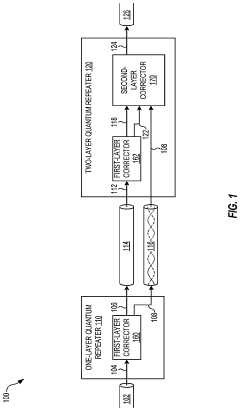
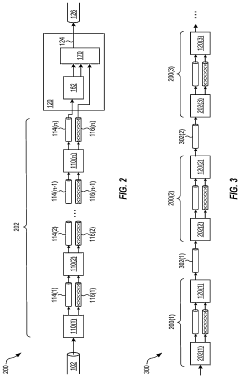
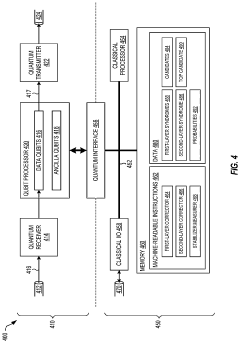
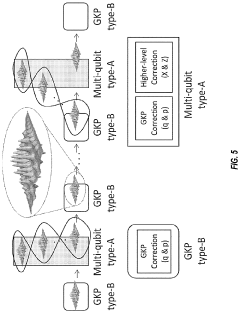
- The implementation of quantum repeaters using concatenated error correction codes, where a second-layer logical qubit is block-encoded by a plurality of physical qubits according to a second-layer code concatenated with a first-layer code, allowing for the detection and correction of errors through first-layer and second-layer stabilizer measurements, reducing the need for resources and noise introduction.
Error corrected quantum computer
PatentActiveUS20080185576A1
Innovation
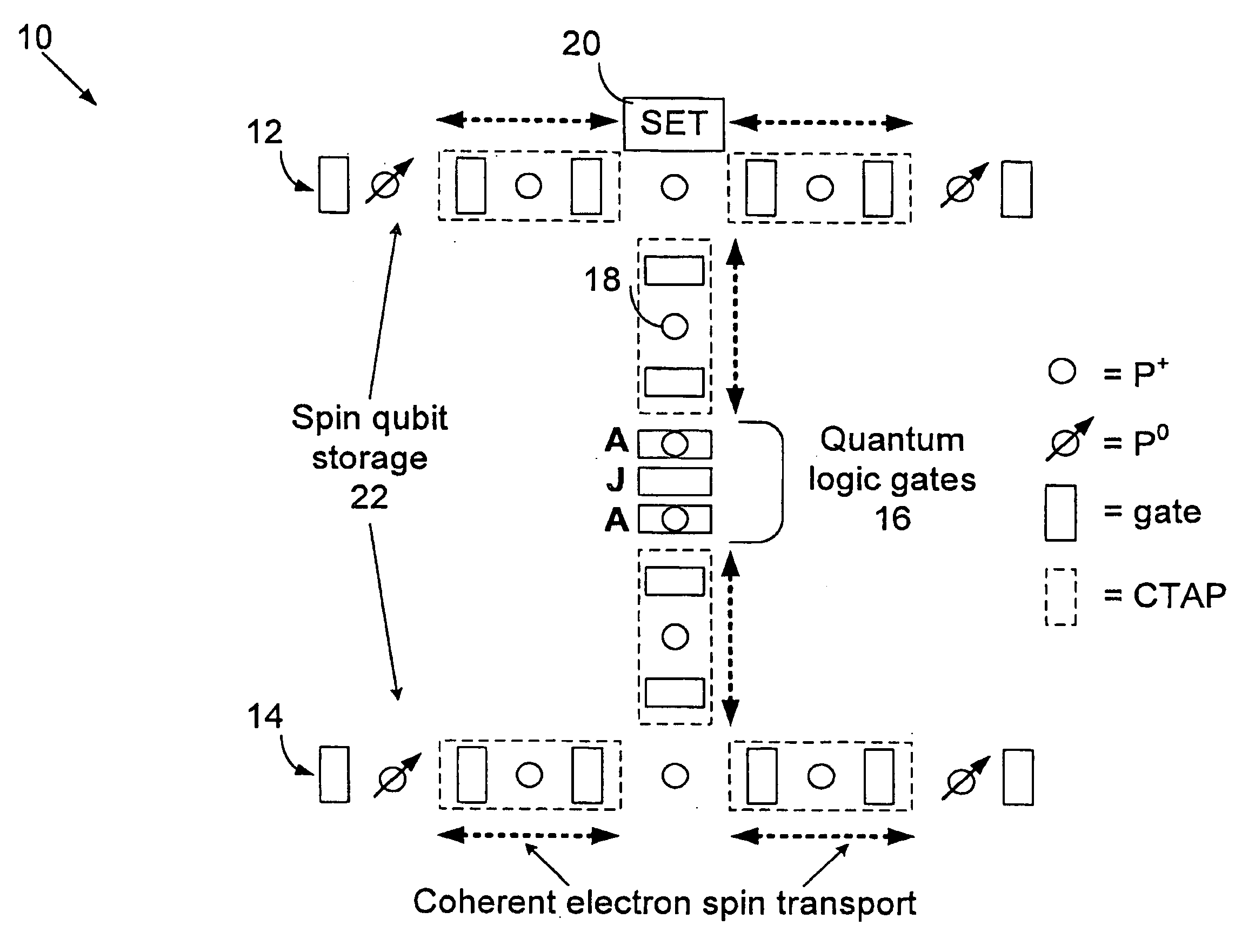
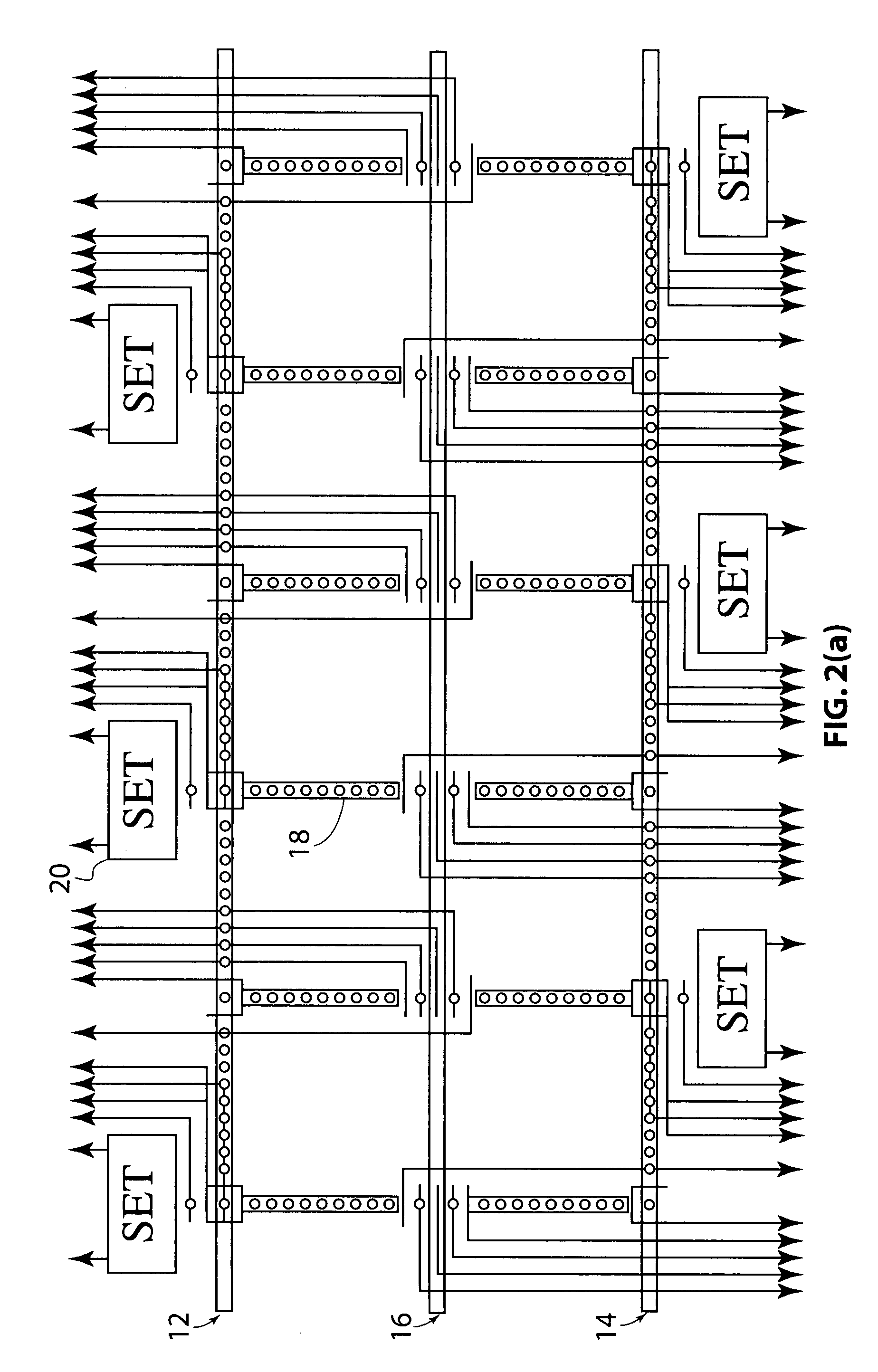
- A process for error-corrected quantum logic functions on a spatial array of physical qubit sites with a quasi-2-dimensional topology, involving initialization, clocking, movement, and logic operations between physical and ancilla qubits, with error correction using Steane codes and universal logic operations like CNOT and Hadamard gates, and transport mechanisms like coherent transport by adiabatic passage or logical SWAP operations.

Quantum Security and Cryptographic Implications
The integration of error-corrected qubits with quantum networking nodes presents significant implications for quantum security and cryptography. Traditional cryptographic systems, particularly those based on RSA and elliptic curve algorithms, face existential threats from quantum computing advancements. When error-corrected qubits become integrated with networking infrastructure, Shor's algorithm could be implemented at scale, potentially breaking widely-used public key encryption systems within hours rather than the billions of years required by classical computers.
Quantum networks with error-corrected qubits offer countermeasures through quantum key distribution (QKD) protocols, which provide information-theoretic security based on quantum mechanical principles. Unlike algorithmic security, QKD security derives from fundamental physics, making it theoretically immune to computational attacks. The integration enables distributed quantum computing capabilities that can implement advanced quantum cryptographic protocols beyond basic QKD, including quantum digital signatures and blind quantum computing.
Security vulnerabilities unique to quantum networks require attention during integration. Side-channel attacks targeting the physical implementation of quantum systems rather than theoretical protocols represent a significant concern. Imperfections in hardware, timing information, and electromagnetic emissions could leak critical information. Additionally, photon-number splitting attacks and detector blinding attacks specifically target quantum cryptographic implementations.
Post-quantum cryptography (PQC) development becomes increasingly urgent as error-corrected quantum networks advance. Organizations must implement crypto-agility frameworks allowing rapid transition between cryptographic primitives when vulnerabilities emerge. Hybrid approaches combining quantum and post-quantum methods provide transitional security during this evolution.
The regulatory landscape surrounding quantum cryptography is developing rapidly. Several nations have established quantum communication infrastructure initiatives with security implications. International standards bodies, including NIST and ETSI, are working to standardize quantum-resistant algorithms and quantum cryptographic protocols, creating a complex compliance environment for global organizations.
Long-term data protection strategies must account for "harvest now, decrypt later" attacks, where adversaries collect encrypted data today for decryption once quantum capabilities mature. Organizations handling sensitive information with long-term value must consider retroactive security implications when integrating error-corrected quantum networking technologies into their security infrastructure.
Quantum networks with error-corrected qubits offer countermeasures through quantum key distribution (QKD) protocols, which provide information-theoretic security based on quantum mechanical principles. Unlike algorithmic security, QKD security derives from fundamental physics, making it theoretically immune to computational attacks. The integration enables distributed quantum computing capabilities that can implement advanced quantum cryptographic protocols beyond basic QKD, including quantum digital signatures and blind quantum computing.
Security vulnerabilities unique to quantum networks require attention during integration. Side-channel attacks targeting the physical implementation of quantum systems rather than theoretical protocols represent a significant concern. Imperfections in hardware, timing information, and electromagnetic emissions could leak critical information. Additionally, photon-number splitting attacks and detector blinding attacks specifically target quantum cryptographic implementations.
Post-quantum cryptography (PQC) development becomes increasingly urgent as error-corrected quantum networks advance. Organizations must implement crypto-agility frameworks allowing rapid transition between cryptographic primitives when vulnerabilities emerge. Hybrid approaches combining quantum and post-quantum methods provide transitional security during this evolution.
The regulatory landscape surrounding quantum cryptography is developing rapidly. Several nations have established quantum communication infrastructure initiatives with security implications. International standards bodies, including NIST and ETSI, are working to standardize quantum-resistant algorithms and quantum cryptographic protocols, creating a complex compliance environment for global organizations.
Long-term data protection strategies must account for "harvest now, decrypt later" attacks, where adversaries collect encrypted data today for decryption once quantum capabilities mature. Organizations handling sensitive information with long-term value must consider retroactive security implications when integrating error-corrected quantum networking technologies into their security infrastructure.
International Quantum Technology Standards
The development of international quantum technology standards is crucial for the integration of error-corrected qubits with quantum networking nodes. Currently, several international organizations are actively working on establishing comprehensive standards for quantum technologies. The International Organization for Standardization (ISO) and the International Electrotechnical Commission (IEC) have formed joint technical committees specifically focused on quantum computing standards, including those related to error correction protocols and network interfaces.
These standardization efforts address multiple layers of the quantum technology stack, from hardware specifications for physical qubits to software protocols for error correction and network communication. The IEEE Quantum Initiative has published several standards documents outlining requirements for quantum networking interfaces, with specific attention to how error-corrected logical qubits should interact with network nodes. These standards define parameters such as coherence time requirements, error thresholds, and communication protocols necessary for reliable quantum information transfer.
The European Telecommunications Standards Institute (ETSI) has established a Quantum-Safe Cryptography working group that is developing standards for quantum network security, including how error-corrected qubits can be utilized in secure communication protocols. Similarly, the International Telecommunication Union (ITU) has initiated work on quantum communication infrastructure standards that incorporate specifications for error correction in networked quantum systems.
A significant challenge in standardization efforts is balancing the need for technological consistency with the rapid pace of innovation in quantum technologies. Standards must be flexible enough to accommodate emerging error correction techniques while providing sufficient structure for interoperability. The Quantum Economic Development Consortium (QED-C) has proposed an adaptive standardization framework that allows for periodic revisions as quantum error correction methods evolve.
China's National Institute of Metrology and the U.S. National Institute of Standards and Technology (NIST) have established a collaborative framework for quantum metrology standards, which includes specifications for measuring and benchmarking the performance of error-corrected qubits in networked environments. This international cooperation demonstrates the global recognition of standardization importance in advancing quantum technologies.
Industry consortia like the Quantum Industry Consortium (QuIC) are complementing formal standardization bodies by developing practical implementation guidelines for integrating error-corrected qubits with networking infrastructure. These industry-led initiatives often serve as precursors to formal international standards, providing real-world validation of proposed specifications before they are codified into official standards.
These standardization efforts address multiple layers of the quantum technology stack, from hardware specifications for physical qubits to software protocols for error correction and network communication. The IEEE Quantum Initiative has published several standards documents outlining requirements for quantum networking interfaces, with specific attention to how error-corrected logical qubits should interact with network nodes. These standards define parameters such as coherence time requirements, error thresholds, and communication protocols necessary for reliable quantum information transfer.
The European Telecommunications Standards Institute (ETSI) has established a Quantum-Safe Cryptography working group that is developing standards for quantum network security, including how error-corrected qubits can be utilized in secure communication protocols. Similarly, the International Telecommunication Union (ITU) has initiated work on quantum communication infrastructure standards that incorporate specifications for error correction in networked quantum systems.
A significant challenge in standardization efforts is balancing the need for technological consistency with the rapid pace of innovation in quantum technologies. Standards must be flexible enough to accommodate emerging error correction techniques while providing sufficient structure for interoperability. The Quantum Economic Development Consortium (QED-C) has proposed an adaptive standardization framework that allows for periodic revisions as quantum error correction methods evolve.
China's National Institute of Metrology and the U.S. National Institute of Standards and Technology (NIST) have established a collaborative framework for quantum metrology standards, which includes specifications for measuring and benchmarking the performance of error-corrected qubits in networked environments. This international cooperation demonstrates the global recognition of standardization importance in advancing quantum technologies.
Industry consortia like the Quantum Industry Consortium (QuIC) are complementing formal standardization bodies by developing practical implementation guidelines for integrating error-corrected qubits with networking infrastructure. These industry-led initiatives often serve as precursors to formal international standards, providing real-world validation of proposed specifications before they are codified into official standards.
Unlock deeper insights with PatSnap Eureka Quick Research — get a full tech report to explore trends and direct your research. Try now!
Generate Your Research Report Instantly with AI Agent
Supercharge your innovation with PatSnap Eureka AI Agent Platform!