

Maximize CDI Adoption in Alternative Desalination Processes
APR 21, 20269 MIN READ
Generate Your Research Report Instantly with AI Agent
PatSnap Eureka helps you evaluate technical feasibility & market potential.
CDI Technology Background and Desalination Goals
Capacitive Deionization (CDI) technology represents a revolutionary approach to water desalination that leverages electrochemical principles to remove dissolved salts from water. Unlike conventional desalination methods such as reverse osmosis or thermal distillation, CDI operates through the electrosorption of ions onto porous carbon electrodes when an electric potential is applied. This process creates an electric double layer at the electrode-electrolyte interface, effectively capturing and storing ions within the electrode structure.
The fundamental mechanism of CDI involves applying a low voltage across two porous carbon electrodes, typically ranging from 1.0 to 1.4 volts. When saline water flows between these electrodes, cations migrate toward the negatively charged cathode while anions move toward the positively charged anode. The ions are then electrostatically adsorbed onto the electrode surfaces, producing deionized water as the effluent. The process is reversible, allowing for electrode regeneration and concentrated brine production when the polarity is reversed or the voltage is removed.
CDI technology has evolved significantly since its initial development in the 1960s, with major breakthroughs occurring in electrode materials, system architecture, and operational efficiency. Modern CDI systems incorporate advanced carbon materials such as activated carbon, carbon nanotubes, and graphene-based composites, which offer enhanced surface area, improved conductivity, and superior ion adsorption capacity. Recent innovations include membrane CDI (MCDI), which integrates ion-exchange membranes to prevent co-ion expulsion and improve charge efficiency.
The primary goals driving CDI adoption in alternative desalination processes center on addressing the limitations of conventional desalination technologies while meeting growing global water security demands. Energy efficiency stands as a paramount objective, as CDI systems typically consume 0.5-2.0 kWh per cubic meter of treated water for brackish water desalination, significantly lower than reverse osmosis systems operating under similar conditions.
Environmental sustainability represents another critical goal, as CDI processes operate at ambient temperature and pressure, eliminating the need for high-pressure pumps or thermal energy input. This characteristic reduces the overall carbon footprint and enables integration with renewable energy sources such as solar or wind power. Additionally, CDI systems produce minimal chemical waste and do not require pretreatment chemicals or membrane replacement, addressing environmental concerns associated with conventional desalination methods.
Operational flexibility and scalability constitute essential objectives for CDI implementation in diverse applications. The technology aims to provide cost-effective solutions for brackish water treatment, industrial water recycling, and distributed desalination systems in remote or resource-constrained environments. The modular nature of CDI systems enables easy scaling and customization for specific water quality requirements and production capacities.
The fundamental mechanism of CDI involves applying a low voltage across two porous carbon electrodes, typically ranging from 1.0 to 1.4 volts. When saline water flows between these electrodes, cations migrate toward the negatively charged cathode while anions move toward the positively charged anode. The ions are then electrostatically adsorbed onto the electrode surfaces, producing deionized water as the effluent. The process is reversible, allowing for electrode regeneration and concentrated brine production when the polarity is reversed or the voltage is removed.
CDI technology has evolved significantly since its initial development in the 1960s, with major breakthroughs occurring in electrode materials, system architecture, and operational efficiency. Modern CDI systems incorporate advanced carbon materials such as activated carbon, carbon nanotubes, and graphene-based composites, which offer enhanced surface area, improved conductivity, and superior ion adsorption capacity. Recent innovations include membrane CDI (MCDI), which integrates ion-exchange membranes to prevent co-ion expulsion and improve charge efficiency.
The primary goals driving CDI adoption in alternative desalination processes center on addressing the limitations of conventional desalination technologies while meeting growing global water security demands. Energy efficiency stands as a paramount objective, as CDI systems typically consume 0.5-2.0 kWh per cubic meter of treated water for brackish water desalination, significantly lower than reverse osmosis systems operating under similar conditions.
Environmental sustainability represents another critical goal, as CDI processes operate at ambient temperature and pressure, eliminating the need for high-pressure pumps or thermal energy input. This characteristic reduces the overall carbon footprint and enables integration with renewable energy sources such as solar or wind power. Additionally, CDI systems produce minimal chemical waste and do not require pretreatment chemicals or membrane replacement, addressing environmental concerns associated with conventional desalination methods.
Operational flexibility and scalability constitute essential objectives for CDI implementation in diverse applications. The technology aims to provide cost-effective solutions for brackish water treatment, industrial water recycling, and distributed desalination systems in remote or resource-constrained environments. The modular nature of CDI systems enables easy scaling and customization for specific water quality requirements and production capacities.
Market Demand for Alternative Desalination Solutions
The global desalination market is experiencing unprecedented growth driven by escalating water scarcity challenges and increasing population demands. Traditional thermal desalination and reverse osmosis technologies dominate current installations, yet their high energy consumption and environmental concerns create substantial market opportunities for alternative solutions. Capacitive deionization represents a promising technology positioned to capture significant market share in specific application segments.
Industrial water treatment applications demonstrate particularly strong demand for CDI-based solutions. Manufacturing facilities, pharmaceutical companies, and electronics manufacturers require consistent access to high-quality water while managing operational costs and environmental compliance. These sectors increasingly prioritize energy-efficient technologies that can deliver reliable performance with lower carbon footprints compared to conventional desalination methods.
Municipal water utilities in water-stressed regions are actively seeking diversified desalination portfolios to enhance supply security. Small to medium-scale communities, particularly in developing nations, represent a substantial untapped market where CDI's modular design and lower infrastructure requirements provide competitive advantages over large-scale reverse osmosis installations.
The agricultural sector presents another significant demand driver, especially for precision irrigation systems requiring brackish water treatment. Farmers and agricultural cooperatives are increasingly adopting decentralized water treatment solutions that can operate efficiently at smaller scales while maintaining cost-effectiveness throughout seasonal demand variations.
Emerging market segments include remote industrial operations, offshore platforms, and disaster relief applications where portable, energy-efficient desalination capabilities are essential. These applications particularly value CDI's potential for integration with renewable energy sources and reduced maintenance requirements compared to pressure-driven membrane technologies.
Market demand is further amplified by regulatory pressures promoting sustainable water management practices and carbon emission reductions. Government incentives and environmental regulations increasingly favor technologies that demonstrate superior energy efficiency and reduced environmental impact, creating favorable conditions for CDI adoption across multiple application sectors.
Industrial water treatment applications demonstrate particularly strong demand for CDI-based solutions. Manufacturing facilities, pharmaceutical companies, and electronics manufacturers require consistent access to high-quality water while managing operational costs and environmental compliance. These sectors increasingly prioritize energy-efficient technologies that can deliver reliable performance with lower carbon footprints compared to conventional desalination methods.
Municipal water utilities in water-stressed regions are actively seeking diversified desalination portfolios to enhance supply security. Small to medium-scale communities, particularly in developing nations, represent a substantial untapped market where CDI's modular design and lower infrastructure requirements provide competitive advantages over large-scale reverse osmosis installations.
The agricultural sector presents another significant demand driver, especially for precision irrigation systems requiring brackish water treatment. Farmers and agricultural cooperatives are increasingly adopting decentralized water treatment solutions that can operate efficiently at smaller scales while maintaining cost-effectiveness throughout seasonal demand variations.
Emerging market segments include remote industrial operations, offshore platforms, and disaster relief applications where portable, energy-efficient desalination capabilities are essential. These applications particularly value CDI's potential for integration with renewable energy sources and reduced maintenance requirements compared to pressure-driven membrane technologies.
Market demand is further amplified by regulatory pressures promoting sustainable water management practices and carbon emission reductions. Government incentives and environmental regulations increasingly favor technologies that demonstrate superior energy efficiency and reduced environmental impact, creating favorable conditions for CDI adoption across multiple application sectors.
Current CDI Status and Implementation Challenges
Capacitive Deionization technology has demonstrated significant potential in water treatment applications, yet its adoption in alternative desalination processes remains limited compared to conventional methods like reverse osmosis and thermal distillation. Current CDI implementations are primarily concentrated in brackish water treatment facilities and small-scale industrial applications, with limited penetration into large-scale seawater desalination markets.
The technology faces several fundamental implementation barriers that constrain widespread adoption. Energy efficiency remains a critical concern, particularly when processing high-salinity feedwater typical in seawater desalination. While CDI systems demonstrate superior energy performance for low to moderate salinity water, their effectiveness diminishes significantly as salt concentrations exceed 10,000 ppm, limiting their competitiveness against established desalination technologies.
Electrode material limitations present another substantial challenge. Current carbon-based electrodes suffer from capacity degradation over extended operational cycles, reducing long-term economic viability. The electrodes also exhibit sensitivity to fouling from organic compounds and scaling from divalent ions, necessitating frequent maintenance and replacement cycles that increase operational costs.
System scalability represents a major technical hurdle for CDI deployment in large-scale desalination facilities. Most existing CDI installations operate at relatively small capacities, typically processing less than 1000 cubic meters per day. Scaling up to industrial desalination requirements demands significant engineering modifications to electrode configurations, flow distribution systems, and power management infrastructure.
Economic competitiveness remains challenging due to high capital costs associated with electrode materials and specialized power electronics. The initial investment per unit capacity often exceeds that of conventional desalination technologies, while operational cost advantages are primarily realized in specific salinity ranges and operational conditions.
Technical integration challenges also impede adoption in existing desalination infrastructure. CDI systems require different pretreatment protocols, monitoring systems, and maintenance procedures compared to conventional technologies. This necessitates substantial modifications to existing facilities and retraining of operational personnel, creating additional barriers to implementation.
Despite these challenges, recent technological advances in electrode materials, system design, and hybrid configurations are beginning to address some limitations, creating opportunities for expanded CDI adoption in specialized desalination applications where its unique advantages can be fully leveraged.
The technology faces several fundamental implementation barriers that constrain widespread adoption. Energy efficiency remains a critical concern, particularly when processing high-salinity feedwater typical in seawater desalination. While CDI systems demonstrate superior energy performance for low to moderate salinity water, their effectiveness diminishes significantly as salt concentrations exceed 10,000 ppm, limiting their competitiveness against established desalination technologies.
Electrode material limitations present another substantial challenge. Current carbon-based electrodes suffer from capacity degradation over extended operational cycles, reducing long-term economic viability. The electrodes also exhibit sensitivity to fouling from organic compounds and scaling from divalent ions, necessitating frequent maintenance and replacement cycles that increase operational costs.
System scalability represents a major technical hurdle for CDI deployment in large-scale desalination facilities. Most existing CDI installations operate at relatively small capacities, typically processing less than 1000 cubic meters per day. Scaling up to industrial desalination requirements demands significant engineering modifications to electrode configurations, flow distribution systems, and power management infrastructure.
Economic competitiveness remains challenging due to high capital costs associated with electrode materials and specialized power electronics. The initial investment per unit capacity often exceeds that of conventional desalination technologies, while operational cost advantages are primarily realized in specific salinity ranges and operational conditions.
Technical integration challenges also impede adoption in existing desalination infrastructure. CDI systems require different pretreatment protocols, monitoring systems, and maintenance procedures compared to conventional technologies. This necessitates substantial modifications to existing facilities and retraining of operational personnel, creating additional barriers to implementation.
Despite these challenges, recent technological advances in electrode materials, system design, and hybrid configurations are beginning to address some limitations, creating opportunities for expanded CDI adoption in specialized desalination applications where its unique advantages can be fully leveraged.
Current CDI Integration Solutions
01 Electrode materials and structures for CDI systems
Development of advanced electrode materials with enhanced capacitive properties is crucial for CDI adoption. This includes the use of carbon-based materials, nanostructured electrodes, and composite materials that provide high surface area and improved ion adsorption capacity. The electrode design and architecture significantly impact the deionization efficiency and energy consumption of CDI systems.- Electrode materials and structures for CDI systems: Development of advanced electrode materials with enhanced capacitive properties for deionization applications. This includes the use of carbon-based materials, composite electrodes, and nanostructured materials to improve ion adsorption capacity and efficiency. The electrode design focuses on maximizing surface area and optimizing pore structure to enhance the deionization performance and energy efficiency of CDI systems.
- CDI system configuration and module design: Innovations in the overall system architecture and module configuration for capacitive deionization applications. This encompasses the arrangement of electrode pairs, flow channel design, and stack configuration to optimize water treatment efficiency. The designs focus on improving ion removal rates, reducing energy consumption, and enabling scalable implementation for various water purification applications.
- Regeneration and operation methods for CDI: Techniques for electrode regeneration and operational strategies to maintain long-term performance of capacitive deionization systems. This includes methods for desorbing captured ions, voltage cycling protocols, and continuous operation modes. The approaches aim to extend electrode lifespan, improve energy recovery during regeneration cycles, and maintain consistent deionization efficiency throughout the operational lifetime of the system.
- Hybrid CDI systems and integration technologies: Development of hybrid systems that combine capacitive deionization with other water treatment technologies to enhance overall performance. This includes integration with membrane processes, coupling with renewable energy sources, and combination with other electrochemical treatment methods. These hybrid approaches aim to address limitations of standalone CDI systems and expand application ranges for various water quality conditions.
- Application-specific CDI adaptations: Customized capacitive deionization solutions tailored for specific water treatment applications and industries. This includes adaptations for brackish water desalination, industrial wastewater treatment, and portable water purification systems. The modifications address specific water quality requirements, scaling considerations, and operational constraints unique to different application scenarios, enabling broader adoption of CDI technology across various sectors.
02 CDI system configuration and operational methods
Various system configurations and operational strategies have been developed to optimize CDI performance. These include flow-through designs, batch processing methods, and continuous operation modes. The integration of multiple electrode pairs, flow distribution systems, and control mechanisms enables efficient water treatment. Different operational parameters such as voltage application, flow rates, and regeneration cycles are optimized to enhance deionization performance.Expand Specific Solutions03 Hybrid CDI technologies and integration with other treatment methods
Combining CDI with other water treatment technologies creates hybrid systems with enhanced capabilities. Integration approaches include coupling CDI with membrane processes, combining with chemical treatment methods, or incorporating pre-treatment and post-treatment stages. These hybrid systems address limitations of standalone CDI and expand application ranges for various water quality conditions and treatment objectives.Expand Specific Solutions04 Energy recovery and efficiency optimization in CDI
Energy efficiency improvements and recovery mechanisms are essential for commercial CDI adoption. Technologies focus on reducing energy consumption during the charging phase and recovering energy during electrode regeneration. Methods include optimized voltage control, energy storage integration, and innovative charging-discharging protocols that minimize power requirements while maintaining high deionization rates.Expand Specific Solutions05 CDI applications for specific water treatment scenarios
CDI technology has been adapted for various specialized water treatment applications including desalination, industrial wastewater treatment, and water softening. Specific implementations address unique challenges such as brackish water treatment, removal of specific contaminants, and portable or decentralized water purification systems. These applications demonstrate the versatility and scalability of CDI technology for different water quality requirements and treatment scales.Expand Specific Solutions
Major Players in CDI and Desalination Industry
The alternative desalination industry is experiencing rapid growth driven by increasing water scarcity and environmental concerns, with the market expanding significantly as traditional thermal desalination faces sustainability challenges. The competitive landscape shows a maturing technology sector where Capacitive Deionization (CDI) adoption is gaining momentum across diverse applications. Leading research institutions including MIT, Zhejiang University, King Fahd University of Petroleum & Minerals, and Huazhong University of Science & Technology are advancing CDI fundamentals, while companies like Voltea BV, Shell-USA Inc., and Dow Global Technologies LLC are commercializing solutions. The technology maturity varies significantly, with established players like Voltea demonstrating commercial viability in niche applications, while research-intensive organizations such as Korea Institute of Energy Research and Lawrence Livermore National Security LLC focus on breakthrough innovations. This multi-stakeholder ecosystem indicates CDI technology is transitioning from laboratory research to commercial deployment phases.
Dow Global Technologies LLC
Technical Solution: Dow has developed advanced ion exchange resins and selective separation membranes specifically designed for capacitive deionization applications. Their technology focuses on enhancing electrode materials with functionalized carbon composites that demonstrate superior salt adsorption capacity and cycling stability. The company's approach integrates proprietary polymer chemistry with nanomaterial engineering to create electrodes with optimized pore structures and surface chemistry, enabling efficient ion removal in alternative desalination processes including brackish water treatment and industrial wastewater purification.
Strengths: Strong materials science expertise and established manufacturing capabilities for scalable production. Weaknesses: Higher material costs compared to conventional carbon electrodes may limit adoption in cost-sensitive applications.
Massachusetts Institute of Technology
Technical Solution: MIT researchers have pioneered shock electrodialysis and asymmetric capacitive deionization technologies that significantly improve desalination efficiency. Their innovations include development of Faradaic electrodes using Prussian blue analogues and other battery materials that enhance salt removal capacity beyond conventional EDL-based systems. The research focuses on hybrid CDI processes that combine capacitive and Faradaic mechanisms, achieving higher desalination rates and improved energy efficiency for treating various water sources including seawater and industrial brines.
Strengths: Cutting-edge research capabilities and breakthrough innovations in electrode materials and process design. Weaknesses: Technology primarily at laboratory scale with limited commercial deployment and manufacturing readiness.
Core CDI Patents and Technical Innovations
Capacitive deionization using hybrid polar electrodes
PatentInactiveTW200942494A
Innovation
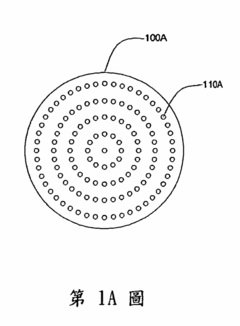
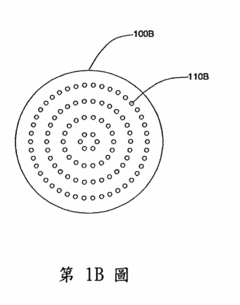
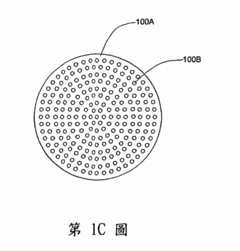
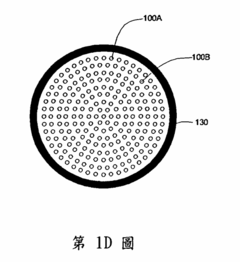
- A hybrid flow-through capacitor module incorporating both unipolar and bipolar electrodes, optimized fluid dynamics through perforated electrode plates, and supercapacitors for energy recovery, enabling balanced operating voltage and current while reducing energy costs and cycle times.
Desalination process using capacitive deionization
PatentInactiveIN201641018077A
Innovation
- The use of capacitive deionization technology based on ion sorption on high surface area materials like activated carbon, carbon nanotubes, and graphene to remove dissolved ions from water by applying a potential difference, leveraging the principles of electro-sorption and double-layer capacitance.
Environmental Impact Assessment of CDI Systems
Capacitive Deionization (CDI) systems present a significantly more favorable environmental profile compared to conventional desalination technologies, particularly reverse osmosis and thermal distillation processes. The environmental advantages stem from CDI's inherently lower energy consumption, which typically ranges from 0.5 to 2.0 kWh per cubic meter of treated water, substantially below the 3-5 kWh/m³ required by reverse osmosis systems. This reduced energy demand directly translates to lower carbon emissions, especially in regions where electricity generation relies heavily on fossil fuels.
The absence of chemical additives in CDI operations eliminates the environmental risks associated with chemical storage, handling, and disposal that plague traditional desalination methods. Unlike reverse osmosis systems that require antiscalants, biocides, and cleaning chemicals, CDI systems operate through purely electrochemical processes, reducing the potential for groundwater contamination and soil degradation around treatment facilities.
Brine management represents another critical environmental advantage of CDI technology. Traditional desalination processes produce highly concentrated brine streams that pose significant disposal challenges and marine ecosystem threats. CDI systems generate substantially lower volumes of concentrate with reduced salinity levels, minimizing the environmental impact on receiving water bodies and reducing the infrastructure requirements for brine disposal.
The modular nature of CDI systems enables distributed treatment approaches that reduce the environmental footprint associated with large-scale centralized facilities. Smaller, decentralized CDI installations require less extensive pipeline infrastructure, reducing habitat disruption and construction-related environmental impacts. Additionally, the lower operating pressures in CDI systems eliminate the need for high-pressure pumping equipment, further reducing noise pollution and mechanical environmental disturbances.
Life cycle assessments indicate that CDI systems demonstrate superior environmental performance across multiple impact categories, including acidification potential, eutrophication potential, and resource depletion. The carbon electrode materials used in CDI systems are increasingly sourced from sustainable materials, with emerging research focusing on bio-derived activated carbons that enhance the overall sustainability profile of the technology.
However, environmental considerations must also address the end-of-life management of CDI electrodes and the potential environmental impacts of electrode manufacturing processes, which require continued optimization to maximize the environmental benefits of widespread CDI adoption.
The absence of chemical additives in CDI operations eliminates the environmental risks associated with chemical storage, handling, and disposal that plague traditional desalination methods. Unlike reverse osmosis systems that require antiscalants, biocides, and cleaning chemicals, CDI systems operate through purely electrochemical processes, reducing the potential for groundwater contamination and soil degradation around treatment facilities.
Brine management represents another critical environmental advantage of CDI technology. Traditional desalination processes produce highly concentrated brine streams that pose significant disposal challenges and marine ecosystem threats. CDI systems generate substantially lower volumes of concentrate with reduced salinity levels, minimizing the environmental impact on receiving water bodies and reducing the infrastructure requirements for brine disposal.
The modular nature of CDI systems enables distributed treatment approaches that reduce the environmental footprint associated with large-scale centralized facilities. Smaller, decentralized CDI installations require less extensive pipeline infrastructure, reducing habitat disruption and construction-related environmental impacts. Additionally, the lower operating pressures in CDI systems eliminate the need for high-pressure pumping equipment, further reducing noise pollution and mechanical environmental disturbances.
Life cycle assessments indicate that CDI systems demonstrate superior environmental performance across multiple impact categories, including acidification potential, eutrophication potential, and resource depletion. The carbon electrode materials used in CDI systems are increasingly sourced from sustainable materials, with emerging research focusing on bio-derived activated carbons that enhance the overall sustainability profile of the technology.
However, environmental considerations must also address the end-of-life management of CDI electrodes and the potential environmental impacts of electrode manufacturing processes, which require continued optimization to maximize the environmental benefits of widespread CDI adoption.
Economic Feasibility Analysis for CDI Deployment
The economic feasibility of CDI deployment in alternative desalination processes hinges on several critical cost factors that determine its competitive positioning against conventional technologies. Capital expenditure analysis reveals that CDI systems typically require lower initial investment compared to reverse osmosis plants, primarily due to simplified infrastructure requirements and reduced need for high-pressure components. The modular nature of CDI technology enables scalable deployment strategies, allowing operators to optimize capacity investments based on demand projections.
Operational expenditure considerations demonstrate CDI's potential advantages in specific market segments. Energy consumption patterns show favorable economics for brackish water treatment applications, where CDI systems can achieve energy efficiencies of 1-4 kWh per cubic meter, significantly lower than RO systems processing similar feed water. However, the economic advantage diminishes when treating higher salinity sources, where energy requirements increase substantially due to extended charging cycles and reduced water recovery rates.
Lifecycle cost analysis indicates that electrode replacement represents the most significant recurring expense in CDI operations. Current electrode technologies typically require replacement every 2-3 years, contributing 20-30% of total operational costs. Advanced carbon aerogel and graphene-based electrodes show promise for extending operational lifespans, potentially reducing long-term maintenance expenses and improving overall economic viability.
Market penetration scenarios suggest that CDI deployment becomes economically attractive in niche applications where conventional desalination faces operational constraints. Remote installations, intermittent operation requirements, and environmentally sensitive locations present favorable economic conditions for CDI adoption. The technology's ability to operate without chemical additives reduces regulatory compliance costs and eliminates brine disposal challenges in certain jurisdictions.
Financial modeling incorporating current technology costs projects break-even points for CDI systems at treatment capacities below 1000 cubic meters per day, assuming brackish water sources with total dissolved solids concentrations under 3000 ppm. Sensitivity analysis reveals that electrode cost reductions of 40-50% would expand economic viability to larger-scale applications and higher salinity ranges.
Operational expenditure considerations demonstrate CDI's potential advantages in specific market segments. Energy consumption patterns show favorable economics for brackish water treatment applications, where CDI systems can achieve energy efficiencies of 1-4 kWh per cubic meter, significantly lower than RO systems processing similar feed water. However, the economic advantage diminishes when treating higher salinity sources, where energy requirements increase substantially due to extended charging cycles and reduced water recovery rates.
Lifecycle cost analysis indicates that electrode replacement represents the most significant recurring expense in CDI operations. Current electrode technologies typically require replacement every 2-3 years, contributing 20-30% of total operational costs. Advanced carbon aerogel and graphene-based electrodes show promise for extending operational lifespans, potentially reducing long-term maintenance expenses and improving overall economic viability.
Market penetration scenarios suggest that CDI deployment becomes economically attractive in niche applications where conventional desalination faces operational constraints. Remote installations, intermittent operation requirements, and environmentally sensitive locations present favorable economic conditions for CDI adoption. The technology's ability to operate without chemical additives reduces regulatory compliance costs and eliminates brine disposal challenges in certain jurisdictions.
Financial modeling incorporating current technology costs projects break-even points for CDI systems at treatment capacities below 1000 cubic meters per day, assuming brackish water sources with total dissolved solids concentrations under 3000 ppm. Sensitivity analysis reveals that electrode cost reductions of 40-50% would expand economic viability to larger-scale applications and higher salinity ranges.
Unlock deeper insights with PatSnap Eureka Quick Research — get a full tech report to explore trends and direct your research. Try now!
Generate Your Research Report Instantly with AI Agent
Supercharge your innovation with PatSnap Eureka AI Agent Platform!