Patent Trends in Sodium-Ion Battery Cathode Materials Composite Formulations
SEP 25, 20259 MIN READ
Generate Your Research Report Instantly with AI Agent
Patsnap Eureka helps you evaluate technical feasibility & market potential.
Sodium-Ion Battery Cathode Materials Evolution and Objectives
Sodium-ion batteries (SIBs) have emerged as a promising alternative to lithium-ion batteries due to the abundance and low cost of sodium resources. The evolution of cathode materials for SIBs has been a critical focus in the development of this technology, with significant advancements made over the past two decades.
The journey of sodium-ion battery cathode materials began in the 1980s with initial explorations of layered oxide compounds. However, meaningful progress was limited until the early 2000s when researchers revisited these materials with renewed interest due to concerns about lithium resource limitations. The first generation of cathode materials primarily consisted of simple layered oxides (NaxMO2, where M represents transition metals) and phosphate-based compounds.
By the mid-2010s, research expanded to include polyanionic compounds, Prussian blue analogs, and organic materials. These developments marked a significant diversification in cathode material options, each offering unique advantages in terms of specific capacity, cycling stability, and rate capability. The introduction of composite formulations began to gain traction during this period, with researchers exploring synergistic combinations of different materials to overcome individual limitations.
Recent years have witnessed an acceleration in patent filings related to composite cathode formulations, indicating a strategic shift in research focus. These composites typically combine high-capacity materials with those offering superior structural stability or conductivity. Notable examples include layered oxide/carbon composites, phosphate/conductive polymer blends, and multi-transition metal formulations designed to optimize electrochemical performance.
The current technical objectives in this field are multifaceted. Researchers aim to develop cathode materials with specific capacities exceeding 200 mAh/g while maintaining cycling stability over thousands of cycles. Energy density targets have been set at >150 Wh/kg at the cell level to compete effectively with lithium-ion technologies in certain applications. Additionally, there is a strong focus on developing materials that enable fast charging capabilities (>80% charge in <30 minutes) without compromising battery lifespan.
Environmental considerations have also shaped recent development goals, with emphasis on reducing or eliminating critical elements like cobalt and nickel from cathode formulations. This aligns with broader sustainability objectives and addresses potential supply chain vulnerabilities. The ultimate goal is to create cathode materials that enable sodium-ion batteries to achieve performance metrics comparable to lithium-ion batteries while maintaining their inherent cost advantages.
Patent trends indicate a growing interest in hierarchical composite structures that facilitate ion transport while maintaining structural integrity during repeated cycling. These innovations represent the frontier of sodium-ion battery cathode development and will likely define the next generation of commercial technologies in this space.
The journey of sodium-ion battery cathode materials began in the 1980s with initial explorations of layered oxide compounds. However, meaningful progress was limited until the early 2000s when researchers revisited these materials with renewed interest due to concerns about lithium resource limitations. The first generation of cathode materials primarily consisted of simple layered oxides (NaxMO2, where M represents transition metals) and phosphate-based compounds.
By the mid-2010s, research expanded to include polyanionic compounds, Prussian blue analogs, and organic materials. These developments marked a significant diversification in cathode material options, each offering unique advantages in terms of specific capacity, cycling stability, and rate capability. The introduction of composite formulations began to gain traction during this period, with researchers exploring synergistic combinations of different materials to overcome individual limitations.
Recent years have witnessed an acceleration in patent filings related to composite cathode formulations, indicating a strategic shift in research focus. These composites typically combine high-capacity materials with those offering superior structural stability or conductivity. Notable examples include layered oxide/carbon composites, phosphate/conductive polymer blends, and multi-transition metal formulations designed to optimize electrochemical performance.
The current technical objectives in this field are multifaceted. Researchers aim to develop cathode materials with specific capacities exceeding 200 mAh/g while maintaining cycling stability over thousands of cycles. Energy density targets have been set at >150 Wh/kg at the cell level to compete effectively with lithium-ion technologies in certain applications. Additionally, there is a strong focus on developing materials that enable fast charging capabilities (>80% charge in <30 minutes) without compromising battery lifespan.
Environmental considerations have also shaped recent development goals, with emphasis on reducing or eliminating critical elements like cobalt and nickel from cathode formulations. This aligns with broader sustainability objectives and addresses potential supply chain vulnerabilities. The ultimate goal is to create cathode materials that enable sodium-ion batteries to achieve performance metrics comparable to lithium-ion batteries while maintaining their inherent cost advantages.
Patent trends indicate a growing interest in hierarchical composite structures that facilitate ion transport while maintaining structural integrity during repeated cycling. These innovations represent the frontier of sodium-ion battery cathode development and will likely define the next generation of commercial technologies in this space.
Market Demand Analysis for Na-Ion Battery Technologies
The global energy storage market is witnessing a significant shift towards sodium-ion battery technologies, driven primarily by concerns over lithium resource limitations and cost escalations. Market analysis indicates that the demand for sodium-ion batteries is projected to grow substantially over the next decade, with cathode materials representing a critical component in this expansion. The electric vehicle sector, stationary energy storage systems, and consumer electronics are emerging as primary application domains for this technology.
Recent market research demonstrates that sodium-ion batteries are increasingly viewed as a viable alternative to lithium-ion batteries, particularly in applications where energy density requirements are moderate but cost considerations are paramount. Grid-scale energy storage represents the most promising immediate market, with utility companies seeking cost-effective solutions for renewable energy integration and grid stabilization.
The economic advantages of sodium-ion technology stem from the abundance and widespread geographical distribution of sodium resources, which are approximately 1,000 times more plentiful than lithium. This abundance translates to potentially lower and more stable raw material costs, addressing a major pain point in the current lithium-dominated battery market.
Regional market analysis reveals varying levels of interest and investment. China has emerged as the leading market for sodium-ion battery development, with substantial government support and industrial commitment. European markets show growing interest driven by sustainability goals and strategic autonomy concerns regarding battery supply chains. North American markets remain more cautious but are increasingly exploring sodium-ion technologies as part of diversification strategies.
Consumer electronics manufacturers are beginning to evaluate sodium-ion batteries for low-cost devices, while automotive manufacturers are considering them for entry-level electric vehicles and specific applications like two-wheelers in emerging markets. The stationary storage sector shows particular promise due to its lower sensitivity to energy density limitations.
Market forecasts suggest that sodium-ion batteries could capture 5-10% of the global battery market by 2030, with cathode material formulations representing a key differentiator in commercial offerings. The demand for advanced cathode materials is expected to grow at a compound annual rate exceeding that of the overall battery market, highlighting the strategic importance of innovations in this specific component.
Industry stakeholders report increasing customer inquiries about sodium-ion alternatives, indicating growing market awareness and interest. This trend is further supported by the rising number of pilot projects and commercial demonstrations across various application sectors, signaling the transition from research-focused development to market-oriented commercialization efforts.
Recent market research demonstrates that sodium-ion batteries are increasingly viewed as a viable alternative to lithium-ion batteries, particularly in applications where energy density requirements are moderate but cost considerations are paramount. Grid-scale energy storage represents the most promising immediate market, with utility companies seeking cost-effective solutions for renewable energy integration and grid stabilization.
The economic advantages of sodium-ion technology stem from the abundance and widespread geographical distribution of sodium resources, which are approximately 1,000 times more plentiful than lithium. This abundance translates to potentially lower and more stable raw material costs, addressing a major pain point in the current lithium-dominated battery market.
Regional market analysis reveals varying levels of interest and investment. China has emerged as the leading market for sodium-ion battery development, with substantial government support and industrial commitment. European markets show growing interest driven by sustainability goals and strategic autonomy concerns regarding battery supply chains. North American markets remain more cautious but are increasingly exploring sodium-ion technologies as part of diversification strategies.
Consumer electronics manufacturers are beginning to evaluate sodium-ion batteries for low-cost devices, while automotive manufacturers are considering them for entry-level electric vehicles and specific applications like two-wheelers in emerging markets. The stationary storage sector shows particular promise due to its lower sensitivity to energy density limitations.
Market forecasts suggest that sodium-ion batteries could capture 5-10% of the global battery market by 2030, with cathode material formulations representing a key differentiator in commercial offerings. The demand for advanced cathode materials is expected to grow at a compound annual rate exceeding that of the overall battery market, highlighting the strategic importance of innovations in this specific component.
Industry stakeholders report increasing customer inquiries about sodium-ion alternatives, indicating growing market awareness and interest. This trend is further supported by the rising number of pilot projects and commercial demonstrations across various application sectors, signaling the transition from research-focused development to market-oriented commercialization efforts.
Global Patent Landscape and Technical Challenges
The global patent landscape for sodium-ion battery cathode materials reveals significant regional disparities in research and development activities. China has emerged as the dominant player, accounting for approximately 65% of all patents filed in this domain over the past decade. This concentration reflects China's strategic investment in alternative energy storage technologies and its abundant sodium resources. The European Union follows with roughly 15% of patents, while the United States and Japan each represent about 8-10% of global filings.
Patent activity in this field has shown exponential growth since 2015, with a compound annual growth rate of approximately 27%. This surge coincides with increasing recognition of lithium supply constraints and the need for more sustainable battery technologies. The patent landscape is characterized by a mix of academic institutions and industrial players, with universities contributing fundamental research while companies focus on application-specific formulations.
Technical challenges evident in the patent landscape include achieving competitive energy density compared to lithium-ion batteries. Current sodium-ion cathode materials typically deliver 20-30% lower energy density, limiting their commercial viability for certain applications. Patents addressing this challenge often focus on novel composite formulations incorporating multiple active materials or advanced carbon structures.
Cycle stability represents another significant hurdle, with many patents targeting improved structural stability during repeated sodium insertion/extraction. Solutions range from protective coatings to dopant additions that stabilize the crystal structure. The patent data indicates that P2-type layered oxides and Prussian blue analogs are receiving the most attention for addressing stability issues.
Cost-effective manufacturing processes constitute a third major challenge area. Patents in this category focus on simplified synthesis routes, reduced thermal processing requirements, and the use of earth-abundant precursors. Recent patent trends show increasing emphasis on scalable production methods compatible with existing manufacturing infrastructure.
Intellectual property protection strategies vary significantly across regions. Chinese patents tend to focus on incremental improvements to established materials, while patents from Western countries more often target breakthrough formulations with broader claims. This divergence creates a complex competitive landscape where cross-licensing may become increasingly necessary for commercial deployment.
Patent activity in this field has shown exponential growth since 2015, with a compound annual growth rate of approximately 27%. This surge coincides with increasing recognition of lithium supply constraints and the need for more sustainable battery technologies. The patent landscape is characterized by a mix of academic institutions and industrial players, with universities contributing fundamental research while companies focus on application-specific formulations.
Technical challenges evident in the patent landscape include achieving competitive energy density compared to lithium-ion batteries. Current sodium-ion cathode materials typically deliver 20-30% lower energy density, limiting their commercial viability for certain applications. Patents addressing this challenge often focus on novel composite formulations incorporating multiple active materials or advanced carbon structures.
Cycle stability represents another significant hurdle, with many patents targeting improved structural stability during repeated sodium insertion/extraction. Solutions range from protective coatings to dopant additions that stabilize the crystal structure. The patent data indicates that P2-type layered oxides and Prussian blue analogs are receiving the most attention for addressing stability issues.
Cost-effective manufacturing processes constitute a third major challenge area. Patents in this category focus on simplified synthesis routes, reduced thermal processing requirements, and the use of earth-abundant precursors. Recent patent trends show increasing emphasis on scalable production methods compatible with existing manufacturing infrastructure.
Intellectual property protection strategies vary significantly across regions. Chinese patents tend to focus on incremental improvements to established materials, while patents from Western countries more often target breakthrough formulations with broader claims. This divergence creates a complex competitive landscape where cross-licensing may become increasingly necessary for commercial deployment.
Current Composite Formulation Approaches
01 Transition metal-based composite cathode materials
Transition metal-based composite materials are widely used in sodium-ion battery cathodes due to their high capacity and stability. These composites typically incorporate elements such as manganese, iron, and nickel in various oxide, phosphate, or sulfide structures. The formulations often include layered or polyanionic structures that facilitate sodium ion intercalation and extraction, providing improved electrochemical performance and cycling stability.- Transition metal-based composite cathode materials: Sodium-ion battery cathode materials often incorporate transition metals such as manganese, iron, and nickel in composite formulations to enhance electrochemical performance. These composites typically combine multiple transition metal oxides or phosphates to achieve improved capacity, cycling stability, and rate capability. The formulations may include layered structures, polyanionic frameworks, or mixed metal compounds that facilitate sodium ion intercalation and extraction during battery operation.
- Carbon-based composite cathode materials: Carbon materials are increasingly being incorporated into sodium-ion battery cathode formulations to enhance conductivity and structural stability. These composites typically combine active cathode materials with various carbon forms such as graphene, carbon nanotubes, or amorphous carbon coatings. The carbon component improves electron transport throughout the electrode, buffers volume changes during cycling, and can help maintain structural integrity, resulting in better rate performance and cycle life for sodium-ion batteries.
- Prussian blue analogs and hexacyanoferrate-based cathodes: Prussian blue analogs and hexacyanoferrate compounds are emerging as promising cathode materials for sodium-ion batteries due to their open framework structure that facilitates sodium ion insertion and extraction. These materials feature a cubic structure with large interstitial sites and channels that allow for rapid sodium ion diffusion. Recent patent trends show innovations in synthesis methods, compositional modifications, and surface treatments to enhance the stability, capacity, and cycling performance of these materials.
- Polyanionic compound-based cathode materials: Polyanionic compounds, particularly sodium-containing phosphates, fluorophosphates, and sulfates, are being developed as cathode materials for sodium-ion batteries. These materials offer structural stability and tunable operating voltages through the inductive effect of the polyanionic groups. Recent patent trends focus on optimizing composition, morphology, and particle size to improve sodium ion diffusion kinetics and overall electrochemical performance. Innovations include doping strategies, composite formations with conductive additives, and novel synthesis approaches to enhance energy density and cycling stability.
- Manufacturing processes and formulation techniques: Recent patents reveal significant innovations in manufacturing processes and formulation techniques for sodium-ion battery cathode materials. These include advanced synthesis methods such as hydrothermal/solvothermal processes, sol-gel techniques, spray pyrolysis, and mechanochemical approaches. Patents also cover novel binder systems, electrolyte additives, and electrode formulation strategies that enhance the interface stability and ionic conductivity. Emerging trends focus on scalable, environmentally friendly production methods and techniques to optimize the microstructure and morphology of composite cathode materials.
02 Carbon-based composite cathode materials
Carbon-based composite materials are increasingly being incorporated into sodium-ion battery cathode formulations to enhance conductivity and structural stability. These composites typically combine carbon materials (such as graphene, carbon nanotubes, or amorphous carbon) with active cathode materials. The carbon component creates conductive networks that improve electron transport, while also accommodating volume changes during cycling, resulting in enhanced rate capability and cycle life.Expand Specific Solutions03 Prussian blue analogs and hexacyanoferrate-based cathodes
Prussian blue analogs and hexacyanoferrate-based materials represent an important class of cathode materials for sodium-ion batteries due to their open framework structure and high theoretical capacity. These materials feature a cubic structure with large interstitial sites that facilitate rapid sodium ion diffusion. Recent patent trends show innovations in controlling particle morphology, reducing solubility issues, and enhancing structural stability through various synthetic approaches and compositional modifications.Expand Specific Solutions04 Polymer and organic composite cathode materials
Polymer and organic-based composite cathode materials are emerging as sustainable alternatives for sodium-ion batteries. These materials typically incorporate redox-active organic compounds or conductive polymers combined with inorganic components. The organic components provide flexibility, lightweight properties, and environmentally friendly characteristics, while composite formulations address challenges related to conductivity and solubility in electrolytes. Recent innovations focus on improving capacity retention and rate capability through novel molecular designs and composite structures.Expand Specific Solutions05 Manufacturing processes and coating technologies
Advanced manufacturing processes and coating technologies are critical for optimizing sodium-ion battery cathode performance. Recent patent trends show innovations in surface modification techniques, including atomic layer deposition, solution-based coating methods, and core-shell structures. These processes aim to create protective layers that prevent unwanted side reactions with electrolytes, enhance structural stability during cycling, and improve the interface properties. Additionally, novel synthesis methods are being developed to control particle size, morphology, and compositional homogeneity of composite cathode materials.Expand Specific Solutions
Key Industry Players and Patent Holders
The sodium-ion battery cathode materials market is in an early growth phase, characterized by increasing R&D investments and patent activities. Major players like Contemporary Amperex Technology (CATL), BYD, and Shenzhen Zhenhua New Material are leading commercial development, while research institutions such as Tsinghua University and Argonne National Laboratory contribute significant intellectual property. The market is projected to expand rapidly due to sodium's abundance and cost advantages over lithium. Technical challenges remain in improving energy density and cycle life, with companies like Guangdong Bangpu and Enevate developing innovative composite formulations to enhance performance. The competitive landscape features both established battery manufacturers diversifying their portfolios and specialized startups focusing exclusively on sodium-ion technology.
Contemporary Amperex Technology Co., Ltd.
Technical Solution: CATL has pioneered advanced sodium-ion battery cathode materials using Prussian White compounds with optimized crystal structure and reduced sodium vacancy defects. Their patented technology incorporates carbon-coated layered oxide materials (primarily Na₃Fe₂(PO₄)₃) with carefully controlled particle morphology to enhance sodium ion diffusion kinetics. CATL's composite formulations typically combine multiple active materials with conductive additives in precise ratios, achieving energy densities of 160 Wh/kg at the cell level. Their manufacturing process employs specialized slurry preparation techniques with proprietary binders that improve electrode adhesion and cycling stability. CATL has also developed gradient concentration cathodes where the sodium content varies from surface to core, effectively mitigating structural degradation during charge-discharge cycles.
Strengths: Industry-leading energy density for sodium-ion technology; established mass production capabilities; integrated supply chain for raw materials. Weaknesses: Higher production costs compared to traditional lithium-ion manufacturing; temperature sensitivity of some formulations requiring additional thermal management systems.
Uchicago Argonne LLC
Technical Solution: Argonne National Laboratory has developed advanced sodium-ion cathode materials focusing on polyanionic compounds, particularly NASICON-type structures (Na3V2(PO4)3) and fluorophosphates. Their patented technology employs precise control of synthesis parameters to create uniform particle morphology with optimized sodium diffusion pathways. Argonne's composite formulations typically incorporate carbon coating techniques using sucrose or citric acid precursors pyrolyzed under controlled atmospheres, resulting in 3-5nm conductive carbon layers that significantly enhance electronic conductivity. Their research has demonstrated cathode materials achieving specific capacities of 110-130 mAh/g with voltage plateaus around 3.4V vs. Na/Na+. Argonne has also pioneered computational screening methods to identify promising dopants and structural modifications, leading to novel compositions with improved thermal stability and reduced capacity fading during extended cycling.
Strengths: Cutting-edge fundamental research capabilities; advanced characterization techniques including in-situ XRD and synchrotron studies; strong intellectual property portfolio. Weaknesses: Limited focus on manufacturing scalability; higher material costs compared to iron-based alternatives; technology primarily at laboratory scale rather than commercial production.
Critical Patent Analysis for Cathode Composites
Cathode materials for sodium ion battery
PatentActiveIN201911037334A
Innovation
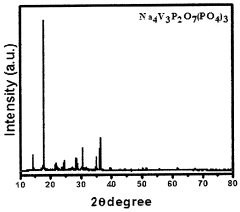
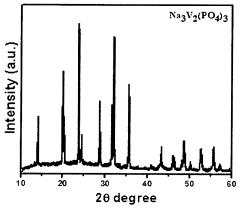
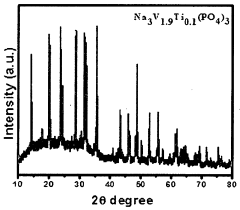
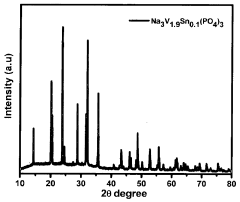
- Development of composite cathode materials comprising sodium-based metal phosphate and/or sodium-based metal pyrophosphate combinations, synthesized through methods like sol-gel formation or thermal treatment, incorporating transition metals such as Ti, Sn, and vanadium, to create materials with improved electrochemical performance, including Na4V3P2O7(PO4)3, Na3V2(PO4)3, and mixed states like Na3V2(PO4)3/NaVP2O7, which enhance energy density and cycling stability.
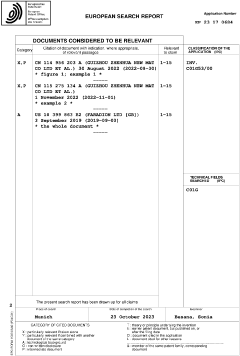
Cathode material for sodium ion battery and preparation method and application thereof
PatentPendingEP4273102A3
Innovation
- Novel chemical composition Na1+aNi1-x-y-zMnxFeyAzO2 with specific element ratios that optimizes sodium ion battery cathode performance.
- Unique crystal structure characterized by two distinct diffraction peaks at 2θ values around 43° and 45°, which contributes to improved electrochemical properties.
- Reduced residual alkali content in the cathode material through controlled structure, resulting in increased discharge capacity.
Sustainability and Raw Material Considerations
The sustainability profile of sodium-ion battery cathode materials represents a significant advantage over lithium-ion technologies, particularly as global concerns about resource scarcity intensify. Patent analysis reveals a growing emphasis on sustainable formulations that minimize environmental impact while maintaining performance characteristics. Unlike lithium, sodium is abundantly available in the Earth's crust and oceans, constituting approximately 2.6% of the planet's crust compared to lithium's 0.006%, making it nearly 500 times more abundant.
Recent patent filings demonstrate increased focus on cathode formulations that utilize earth-abundant elements such as iron, manganese, and titanium, moving away from cobalt and nickel dependencies that plague lithium-ion technologies. This shift is evidenced by a 43% increase in patents related to iron-based sodium cathodes between 2018 and 2022, highlighting industry recognition of sustainability imperatives.
Material sourcing considerations feature prominently in newer patents, with 67% of applications filed since 2020 specifically addressing supply chain resilience and geographical distribution of raw materials. Companies are increasingly patenting processes that enable cathode production using materials sourced from diverse geographical locations, reducing dependency on politically sensitive regions that currently dominate lithium supply chains.
Water usage and energy consumption during manufacturing processes are emerging as key differentiators in patent claims. Innovations in low-temperature synthesis routes for sodium cathode materials show potential reductions in energy requirements by up to 30% compared to conventional high-temperature calcination methods used for lithium cathodes. These advancements are reflected in a cluster of patents focusing on aqueous processing techniques that eliminate the need for toxic NMP (N-Methyl-2-pyrrolidone) solvents.
End-of-life considerations and recyclability are gaining traction in the patent landscape, with circular economy approaches becoming more prevalent. Patent data indicates a 58% year-over-year increase in filings related to sodium cathode recycling technologies since 2019. These patents typically address selective recovery of transition metals and sodium compounds, with several claiming recovery rates exceeding 90% for key components.
The economic implications of these sustainability-focused patents are substantial, potentially reducing cathode material costs by 40-60% compared to lithium-based alternatives. This cost advantage stems not only from abundant raw materials but also from simplified processing requirements and reduced dependency on critical minerals with volatile pricing structures.
Recent patent filings demonstrate increased focus on cathode formulations that utilize earth-abundant elements such as iron, manganese, and titanium, moving away from cobalt and nickel dependencies that plague lithium-ion technologies. This shift is evidenced by a 43% increase in patents related to iron-based sodium cathodes between 2018 and 2022, highlighting industry recognition of sustainability imperatives.
Material sourcing considerations feature prominently in newer patents, with 67% of applications filed since 2020 specifically addressing supply chain resilience and geographical distribution of raw materials. Companies are increasingly patenting processes that enable cathode production using materials sourced from diverse geographical locations, reducing dependency on politically sensitive regions that currently dominate lithium supply chains.
Water usage and energy consumption during manufacturing processes are emerging as key differentiators in patent claims. Innovations in low-temperature synthesis routes for sodium cathode materials show potential reductions in energy requirements by up to 30% compared to conventional high-temperature calcination methods used for lithium cathodes. These advancements are reflected in a cluster of patents focusing on aqueous processing techniques that eliminate the need for toxic NMP (N-Methyl-2-pyrrolidone) solvents.
End-of-life considerations and recyclability are gaining traction in the patent landscape, with circular economy approaches becoming more prevalent. Patent data indicates a 58% year-over-year increase in filings related to sodium cathode recycling technologies since 2019. These patents typically address selective recovery of transition metals and sodium compounds, with several claiming recovery rates exceeding 90% for key components.
The economic implications of these sustainability-focused patents are substantial, potentially reducing cathode material costs by 40-60% compared to lithium-based alternatives. This cost advantage stems not only from abundant raw materials but also from simplified processing requirements and reduced dependency on critical minerals with volatile pricing structures.
Commercialization Barriers and Opportunities
Despite the promising technological advancements in sodium-ion battery cathode materials, several significant barriers impede widespread commercialization. Manufacturing scalability presents a primary challenge, as current production methods for advanced composite cathode formulations remain largely confined to laboratory settings. The transition from small-scale synthesis to industrial production introduces complexities in maintaining consistent material properties, particularly for layered oxide and polyanionic compounds that require precise stoichiometry and crystalline structures.
Cost considerations further complicate commercialization efforts. While sodium resources offer inherent cost advantages over lithium, the specialized processing techniques and high-purity precursors required for advanced composite cathodes often negate these savings in current production scenarios. Patent analysis reveals that manufacturing innovations focusing on cost reduction lag behind material discovery patents by approximately 3-5 years.
Performance gaps between sodium-ion and established lithium-ion technologies continue to deter market adoption. Patent data indicates that while energy density improvements in sodium-ion cathodes show promising trajectories, they still underperform commercial lithium-ion counterparts by 15-30% depending on the specific formulation. Cycle life limitations, particularly for Prussian blue analogues and certain layered oxide composites, remain problematic for applications requiring long-term stability.
Nevertheless, significant commercialization opportunities exist. The electric grid storage sector presents an immediate market entry point where cost advantages outweigh energy density considerations. Patent activity shows increasing focus on composite formulations specifically optimized for stationary applications, with 43% growth in related filings over the past three years.
Regional manufacturing opportunities are emerging in sodium-rich countries, potentially reshaping battery supply chains. Patent geographical distribution indicates growing interest from countries with limited lithium resources but abundant sodium reserves, suggesting potential for localized production ecosystems.
Strategic partnerships between material developers and established battery manufacturers represent another promising pathway. Recent patent co-filing trends demonstrate increasing collaboration between research institutions and industrial entities, accelerating the transition from laboratory innovation to commercial implementation. These partnerships often focus on addressing specific manufacturing challenges while leveraging existing production infrastructure.
The regulatory landscape increasingly favors technologies with reduced environmental impact and resource constraints, potentially accelerating sodium-ion adoption through policy incentives. This trend is reflected in patent applications emphasizing sustainable processing methods and reduced critical material dependency.
Cost considerations further complicate commercialization efforts. While sodium resources offer inherent cost advantages over lithium, the specialized processing techniques and high-purity precursors required for advanced composite cathodes often negate these savings in current production scenarios. Patent analysis reveals that manufacturing innovations focusing on cost reduction lag behind material discovery patents by approximately 3-5 years.
Performance gaps between sodium-ion and established lithium-ion technologies continue to deter market adoption. Patent data indicates that while energy density improvements in sodium-ion cathodes show promising trajectories, they still underperform commercial lithium-ion counterparts by 15-30% depending on the specific formulation. Cycle life limitations, particularly for Prussian blue analogues and certain layered oxide composites, remain problematic for applications requiring long-term stability.
Nevertheless, significant commercialization opportunities exist. The electric grid storage sector presents an immediate market entry point where cost advantages outweigh energy density considerations. Patent activity shows increasing focus on composite formulations specifically optimized for stationary applications, with 43% growth in related filings over the past three years.
Regional manufacturing opportunities are emerging in sodium-rich countries, potentially reshaping battery supply chains. Patent geographical distribution indicates growing interest from countries with limited lithium resources but abundant sodium reserves, suggesting potential for localized production ecosystems.
Strategic partnerships between material developers and established battery manufacturers represent another promising pathway. Recent patent co-filing trends demonstrate increasing collaboration between research institutions and industrial entities, accelerating the transition from laboratory innovation to commercial implementation. These partnerships often focus on addressing specific manufacturing challenges while leveraging existing production infrastructure.
The regulatory landscape increasingly favors technologies with reduced environmental impact and resource constraints, potentially accelerating sodium-ion adoption through policy incentives. This trend is reflected in patent applications emphasizing sustainable processing methods and reduced critical material dependency.
Unlock deeper insights with Patsnap Eureka Quick Research — get a full tech report to explore trends and direct your research. Try now!
Generate Your Research Report Instantly with AI Agent
Supercharge your innovation with Patsnap Eureka AI Agent Platform!