Research on Sodium-Ion Battery Cathode Materials with Layered Oxide Structures
SEP 25, 20259 MIN READ
Generate Your Research Report Instantly with AI Agent
Patsnap Eureka helps you evaluate technical feasibility & market potential.
Layered Oxide Na-ion Battery Evolution & Objectives
Sodium-ion batteries (SIBs) have emerged as a promising alternative to lithium-ion batteries due to the abundance and low cost of sodium resources. The development of layered oxide cathode materials for SIBs can be traced back to the 1980s, when researchers first explored the intercalation chemistry of sodium in layered transition metal oxides. However, significant progress in this field only began to accelerate in the early 2010s, driven by concerns about lithium resource limitations and the increasing demand for large-scale energy storage systems.
The evolution of layered oxide cathode materials for SIBs has followed several distinct phases. Initially, research focused on P2-type structures (where sodium ions occupy prismatic sites between oxygen layers), which demonstrated promising sodium storage capabilities but suffered from structural instability during cycling. This was followed by exploration of O3-type structures (where sodium ions occupy octahedral sites), which offered higher initial capacity but often experienced rapid capacity fading.
Recent technological advancements have centered on developing mixed-phase structures and optimizing the composition of transition metals within the oxide framework. The incorporation of multiple transition metals (such as Ni, Mn, Fe, Co, and Ti) has proven effective in stabilizing the crystal structure and enhancing electrochemical performance. Additionally, surface coating and doping strategies have been employed to mitigate undesirable side reactions and improve cycling stability.
The current technological trajectory is moving toward the development of sodium-rich layered oxides with higher energy density and P2-O3 biphasic materials that combine the advantages of both structural types. Computational methods and advanced characterization techniques have accelerated the discovery and optimization of new compositions, enabling more systematic approaches to material design.
The primary objectives of research in this field include achieving energy densities comparable to commercial lithium-ion batteries (>200 Wh/kg at the material level), extending cycle life beyond 1000 cycles with minimal capacity degradation, and ensuring structural stability across wide temperature ranges. Additionally, researchers aim to develop materials that can be synthesized using environmentally friendly processes and are compatible with existing battery manufacturing infrastructure.
Another critical goal is to understand and control the complex phase transitions that occur during sodium insertion/extraction, as these transitions often lead to capacity fading and voltage hysteresis. By addressing these challenges, layered oxide cathode materials could enable the commercialization of sodium-ion batteries for applications ranging from grid-scale energy storage to electric vehicles, particularly in market segments where cost considerations outweigh the need for maximum energy density.
The evolution of layered oxide cathode materials for SIBs has followed several distinct phases. Initially, research focused on P2-type structures (where sodium ions occupy prismatic sites between oxygen layers), which demonstrated promising sodium storage capabilities but suffered from structural instability during cycling. This was followed by exploration of O3-type structures (where sodium ions occupy octahedral sites), which offered higher initial capacity but often experienced rapid capacity fading.
Recent technological advancements have centered on developing mixed-phase structures and optimizing the composition of transition metals within the oxide framework. The incorporation of multiple transition metals (such as Ni, Mn, Fe, Co, and Ti) has proven effective in stabilizing the crystal structure and enhancing electrochemical performance. Additionally, surface coating and doping strategies have been employed to mitigate undesirable side reactions and improve cycling stability.
The current technological trajectory is moving toward the development of sodium-rich layered oxides with higher energy density and P2-O3 biphasic materials that combine the advantages of both structural types. Computational methods and advanced characterization techniques have accelerated the discovery and optimization of new compositions, enabling more systematic approaches to material design.
The primary objectives of research in this field include achieving energy densities comparable to commercial lithium-ion batteries (>200 Wh/kg at the material level), extending cycle life beyond 1000 cycles with minimal capacity degradation, and ensuring structural stability across wide temperature ranges. Additionally, researchers aim to develop materials that can be synthesized using environmentally friendly processes and are compatible with existing battery manufacturing infrastructure.
Another critical goal is to understand and control the complex phase transitions that occur during sodium insertion/extraction, as these transitions often lead to capacity fading and voltage hysteresis. By addressing these challenges, layered oxide cathode materials could enable the commercialization of sodium-ion batteries for applications ranging from grid-scale energy storage to electric vehicles, particularly in market segments where cost considerations outweigh the need for maximum energy density.
Market Analysis for Na-ion Battery Technologies
The sodium-ion battery market is experiencing significant growth as a promising alternative to lithium-ion batteries, driven by increasing concerns over lithium supply chain vulnerabilities and cost fluctuations. Current market projections indicate that the global sodium-ion battery market could reach $500 million by 2025, with a compound annual growth rate exceeding 20% through 2030 as commercial applications expand.
The primary market drivers for sodium-ion batteries with layered oxide cathode materials include the abundant and geographically widespread nature of sodium resources, which are approximately 1,000 times more plentiful than lithium in the earth's crust. This abundance translates to potentially lower raw material costs, with sodium carbonate priced at roughly one-third the cost of lithium carbonate.
Energy storage systems represent the largest current market segment for sodium-ion batteries, particularly for grid-scale applications where energy density constraints are less critical than cost considerations. This segment is projected to grow at 25% annually through 2028, as utilities seek cost-effective solutions for renewable energy integration.
The electric transportation sector presents another significant market opportunity, particularly for applications where moderate energy density is acceptable. Two-wheelers, three-wheelers, and short-range electric vehicles in emerging markets like India and Southeast Asia are showing increasing interest in sodium-ion technology, with several manufacturers announcing pilot production lines.
Consumer electronics manufacturers are also exploring sodium-ion batteries for low-cost devices, though this segment faces stronger competition from established lithium-ion technologies due to energy density requirements. Market penetration in this sector is expected to remain limited to approximately 5% by 2027.
Regionally, China is leading sodium-ion battery development and commercialization, with over 30 companies actively developing related technologies and materials. The Chinese government has included sodium-ion batteries in its national energy storage strategy, providing substantial funding and policy support. Europe follows with increasing research investments, while North America shows growing commercial interest primarily in grid storage applications.
Market challenges include competition from continuously improving lithium-ion technologies and the need for manufacturing scale to achieve cost advantages. However, the recent volatility in lithium prices has accelerated interest in sodium alternatives, with several major battery manufacturers announcing dedicated sodium-ion production lines for 2023-2024.
The layered oxide cathode materials segment specifically is attracting significant investment due to its promising performance characteristics and compatibility with existing lithium-ion manufacturing infrastructure, potentially allowing for faster market adoption and reduced capital expenditure for producers transitioning between technologies.
The primary market drivers for sodium-ion batteries with layered oxide cathode materials include the abundant and geographically widespread nature of sodium resources, which are approximately 1,000 times more plentiful than lithium in the earth's crust. This abundance translates to potentially lower raw material costs, with sodium carbonate priced at roughly one-third the cost of lithium carbonate.
Energy storage systems represent the largest current market segment for sodium-ion batteries, particularly for grid-scale applications where energy density constraints are less critical than cost considerations. This segment is projected to grow at 25% annually through 2028, as utilities seek cost-effective solutions for renewable energy integration.
The electric transportation sector presents another significant market opportunity, particularly for applications where moderate energy density is acceptable. Two-wheelers, three-wheelers, and short-range electric vehicles in emerging markets like India and Southeast Asia are showing increasing interest in sodium-ion technology, with several manufacturers announcing pilot production lines.
Consumer electronics manufacturers are also exploring sodium-ion batteries for low-cost devices, though this segment faces stronger competition from established lithium-ion technologies due to energy density requirements. Market penetration in this sector is expected to remain limited to approximately 5% by 2027.
Regionally, China is leading sodium-ion battery development and commercialization, with over 30 companies actively developing related technologies and materials. The Chinese government has included sodium-ion batteries in its national energy storage strategy, providing substantial funding and policy support. Europe follows with increasing research investments, while North America shows growing commercial interest primarily in grid storage applications.
Market challenges include competition from continuously improving lithium-ion technologies and the need for manufacturing scale to achieve cost advantages. However, the recent volatility in lithium prices has accelerated interest in sodium alternatives, with several major battery manufacturers announcing dedicated sodium-ion production lines for 2023-2024.
The layered oxide cathode materials segment specifically is attracting significant investment due to its promising performance characteristics and compatibility with existing lithium-ion manufacturing infrastructure, potentially allowing for faster market adoption and reduced capital expenditure for producers transitioning between technologies.
Current Status and Challenges in Layered Oxide Cathodes
Layered oxide cathode materials have emerged as one of the most promising candidates for sodium-ion batteries (SIBs) due to their high theoretical capacity, structural stability, and relatively simple synthesis processes. Currently, the global research landscape shows significant advancements in NaxMO2 compounds (where M represents transition metals like Fe, Mn, Ni, Co, etc.), with P2-type and O3-type structures receiving particular attention.
The P2-type Na0.7MnO2 has demonstrated excellent cycling stability with capacity retention of over 80% after 500 cycles, while O3-type NaNi0.5Mn0.5O2 has shown promising initial discharge capacities exceeding 180 mAh/g. However, these materials still face substantial challenges that limit their commercial viability. The most critical issue is the structural instability during repeated sodium insertion/extraction processes, leading to capacity fading and shortened battery lifespan.
Another significant challenge is the limited sodium diffusion kinetics within layered oxide structures. Unlike lithium ions, sodium ions have a larger ionic radius (1.02 Å vs. 0.76 Å), which creates steric hindrance during intercalation/deintercalation processes. This results in lower rate capability compared to lithium-ion counterparts, restricting their application in high-power devices.
Moisture sensitivity presents another major obstacle. Many layered oxide cathodes readily react with atmospheric moisture, forming sodium hydroxide and degrading the crystal structure. This necessitates stringent manufacturing conditions and special packaging requirements, increasing production costs.
The geographical distribution of research efforts shows concentration in East Asia, particularly China, Japan, and South Korea, which collectively account for approximately 65% of published research. European institutions contribute about 20%, while North American research centers represent roughly 15% of global output in this field.
Electronic conductivity limitations also persist across most layered oxide cathodes. The inherent semiconducting or insulating nature of these materials results in poor electron transport, necessitating conductive additives that reduce the overall energy density of batteries.
Resource availability and sustainability concerns are emerging as the field advances toward commercialization. While sodium resources are abundant compared to lithium, some transition metals used in high-performance cathodes (particularly cobalt and nickel) face supply chain vulnerabilities and ethical sourcing issues.
Recent developments have focused on partial substitution strategies and surface modifications to address these challenges, but a comprehensive solution that simultaneously addresses all limitations remains elusive, highlighting the need for continued fundamental research in this domain.
The P2-type Na0.7MnO2 has demonstrated excellent cycling stability with capacity retention of over 80% after 500 cycles, while O3-type NaNi0.5Mn0.5O2 has shown promising initial discharge capacities exceeding 180 mAh/g. However, these materials still face substantial challenges that limit their commercial viability. The most critical issue is the structural instability during repeated sodium insertion/extraction processes, leading to capacity fading and shortened battery lifespan.
Another significant challenge is the limited sodium diffusion kinetics within layered oxide structures. Unlike lithium ions, sodium ions have a larger ionic radius (1.02 Å vs. 0.76 Å), which creates steric hindrance during intercalation/deintercalation processes. This results in lower rate capability compared to lithium-ion counterparts, restricting their application in high-power devices.
Moisture sensitivity presents another major obstacle. Many layered oxide cathodes readily react with atmospheric moisture, forming sodium hydroxide and degrading the crystal structure. This necessitates stringent manufacturing conditions and special packaging requirements, increasing production costs.
The geographical distribution of research efforts shows concentration in East Asia, particularly China, Japan, and South Korea, which collectively account for approximately 65% of published research. European institutions contribute about 20%, while North American research centers represent roughly 15% of global output in this field.
Electronic conductivity limitations also persist across most layered oxide cathodes. The inherent semiconducting or insulating nature of these materials results in poor electron transport, necessitating conductive additives that reduce the overall energy density of batteries.
Resource availability and sustainability concerns are emerging as the field advances toward commercialization. While sodium resources are abundant compared to lithium, some transition metals used in high-performance cathodes (particularly cobalt and nickel) face supply chain vulnerabilities and ethical sourcing issues.
Recent developments have focused on partial substitution strategies and surface modifications to address these challenges, but a comprehensive solution that simultaneously addresses all limitations remains elusive, highlighting the need for continued fundamental research in this domain.
State-of-the-Art Layered Oxide Cathode Solutions
01 Layered transition metal oxides for sodium-ion battery cathodes
Layered transition metal oxides, particularly those with NaxMO2 structure (where M represents transition metals like Ni, Co, Mn, Fe), serve as promising cathode materials for sodium-ion batteries due to their high theoretical capacity and structural stability. These materials feature sodium ions intercalated between layers of transition metal oxide octahedra, allowing for efficient sodium ion insertion and extraction during charge-discharge cycles. Various synthesis methods and compositional optimizations have been developed to enhance their electrochemical performance and cycling stability.- Layered transition metal oxides as cathode materials: Layered transition metal oxides, particularly those with the general formula NaxMO2 (where M represents transition metals like Fe, Mn, Co, Ni), serve as promising cathode materials for sodium-ion batteries. These materials feature a structure where sodium ions can be intercalated between layers of transition metal oxide, allowing for efficient ion storage and transport. The layered structure provides pathways for sodium ion diffusion, contributing to good electrochemical performance.
- Doping and element substitution strategies: Doping and partial substitution of elements in layered oxide cathode materials can significantly enhance their electrochemical performance. By introducing dopants such as Ti, Al, Mg, or Zn into the crystal structure, the stability and conductivity of the cathode material can be improved. These modifications help to prevent structural collapse during cycling, reduce voltage decay, and enhance the rate capability and cycling stability of sodium-ion batteries.
- Novel synthesis methods for improved performance: Advanced synthesis methods have been developed to optimize the performance of layered oxide cathode materials. These include sol-gel processes, hydrothermal/solvothermal synthesis, solid-state reactions with precise temperature control, and spray pyrolysis. These methods allow for better control over particle size, morphology, crystallinity, and homogeneity, which directly impact the electrochemical properties of the cathode materials, including capacity, rate capability, and cycle life.
- Surface modification and coating techniques: Surface modification and coating of layered oxide cathode materials can effectively address issues related to electrode-electrolyte interface stability. By applying protective coatings such as carbon, metal oxides, or phosphates, the cathode material is shielded from direct contact with the electrolyte, reducing unwanted side reactions. These surface treatments minimize dissolution of transition metals, suppress structural degradation, and improve the overall cycling stability and rate performance of sodium-ion batteries.
- Composite and nanostructured cathode materials: Developing composite and nanostructured layered oxide cathode materials represents an effective approach to enhance sodium-ion battery performance. By creating nanostructured materials or composites with conductive additives like graphene, carbon nanotubes, or conductive polymers, electron transport within the cathode is facilitated. These designs also shorten sodium ion diffusion paths, accommodate volume changes during cycling, and provide synergistic effects that improve capacity retention, rate capability, and cycling stability.
02 P2-type layered oxide cathode materials
P2-type layered oxide structures, characterized by prismatic sodium coordination and two-layer stacking sequences, demonstrate excellent sodium ion diffusion kinetics and structural stability. These materials typically contain transition metals like Mn, Fe, Co, and Ni, with their electrochemical properties being tunable through elemental substitution and doping strategies. P2-type cathodes offer advantages including high rate capability and good cycling performance, though they may suffer from structural transitions during deep sodium extraction. Recent developments focus on mitigating phase transitions and improving capacity retention through compositional engineering.Expand Specific Solutions03 O3-type layered oxide cathode materials
O3-type layered oxide cathodes feature octahedral sodium coordination with three-layer stacking sequences, offering high initial capacity and energy density for sodium-ion batteries. These materials typically contain various transition metals in different ratios to optimize performance. While O3-type structures provide higher initial sodium content than P2-type materials, they often suffer from multiple phase transitions during cycling, leading to capacity fading. Research focuses on stabilizing the structure through elemental substitution, surface coating, and morphology control to enhance cycling stability and rate performance.Expand Specific Solutions04 Doping and elemental substitution strategies
Doping and elemental substitution in layered oxide cathode materials significantly enhance their electrochemical performance for sodium-ion batteries. Introduction of elements such as Ti, Al, Mg, Zn, or rare earth elements into the transition metal layers can stabilize the crystal structure, suppress phase transitions, and improve sodium ion diffusion kinetics. Partial substitution of oxygen with other anions like fluorine can also strengthen the structural integrity and enhance cycling stability. These strategies effectively mitigate capacity fading, improve rate capability, and extend cycle life by reducing lattice strain during sodium insertion/extraction processes.Expand Specific Solutions05 Surface modification and composite structures
Surface modification and development of composite structures represent effective approaches to enhance the performance of layered oxide cathode materials for sodium-ion batteries. Surface coating with materials such as carbon, metal oxides, phosphates, or fluorides can protect the cathode surface from direct contact with the electrolyte, reducing side reactions and improving interfacial stability. Nanostructuring and creating composite architectures with conductive materials enhance electron transport and structural integrity. These strategies effectively address issues like poor conductivity, dissolution of active materials, and structural degradation, leading to improved cycling stability, rate capability, and overall battery performance.Expand Specific Solutions
Key Industry Players in Na-ion Battery Research
The sodium-ion battery cathode materials market with layered oxide structures is in an early growth phase, characterized by increasing R&D investments and emerging commercial applications. The market is projected to expand significantly as companies seek alternatives to lithium-ion batteries. Key players include established companies like Shenzhen Zhenhua New Material and Beijing Zhongke Haina Technology, which have already achieved commercial milestones with ten-ton sales by 2022. Research institutions such as CNRS, CSIR, and universities like Central South University are advancing fundamental technologies. The competitive landscape shows a mix of battery manufacturers (Faradion, Liyang HiNa), materials specialists, and automotive companies (Nissan, Toyota) developing proprietary technologies to secure positions in this emerging field.
Centre National de la Recherche Scientifique
Technical Solution: CNRS has pioneered fundamental research on layered oxide cathode materials for sodium-ion batteries, focusing on P2-type Na2/3[FexMnyNiz]O2 and O3-type NaNi1/3Mn1/3Co1/3O2 structures. Their research has elucidated the sodium storage mechanisms and structural evolution during cycling using advanced characterization techniques like operando XRD and neutron diffraction. CNRS researchers have developed novel synthesis approaches including hydrothermal methods and optimized solid-state reactions to control particle morphology and sodium content precisely. Their materials achieve specific capacities of 120-160 mAh/g with operating voltages of 2.8-3.3V vs. Na/Na+[9]. CNRS has made significant contributions in understanding the role of transition metal ordering, oxygen redox activity, and interlayer spacing on electrochemical performance. Their research has identified key structural stabilization strategies through elemental doping (Al, Ti, Mg) and surface modifications to mitigate phase transitions during cycling[10].
Strengths: Cutting-edge fundamental understanding of sodium storage mechanisms; innovative synthesis approaches; comprehensive structural characterization capabilities; strong academic-industrial collaboration network. Weaknesses: Focus on fundamental research rather than commercial optimization; materials often require further engineering for practical applications; limited large-scale manufacturing experience compared to industrial players.
Liyang HiNa Battery Technology Co., Ltd.
Technical Solution: HiNa Battery has developed proprietary P2-type layered oxide cathode materials with the general formula NaxTMO2 (where TM represents transition metals like Mn, Fe, Ni). Their technology focuses on optimizing sodium storage mechanisms in the interlayer spaces of the oxide structure. The company employs a modified solid-state synthesis route with precise control of sodium content and oxygen stoichiometry to enhance structural stability. Their cathode materials achieve specific capacities of 120-150 mAh/g with voltage plateaus around 3.0-3.2V[3]. HiNa's innovation includes gradient concentration of transition metals within particles to mitigate surface reactivity and enhance cycling stability. They've also developed carbon-coating techniques to improve electronic conductivity and protective surface treatments to minimize electrolyte decomposition at high voltages[4].
Strengths: Excellent rate capability allowing fast charging; superior thermal stability compared to lithium-ion equivalents; cost-effective manufacturing using earth-abundant elements; demonstrated scale-up to commercial production. Weaknesses: Capacity fading during extended cycling; voltage hysteresis issues; sensitivity to atmospheric conditions requiring controlled processing environments.
Critical Patents and Research on Na-ion Cathode Materials
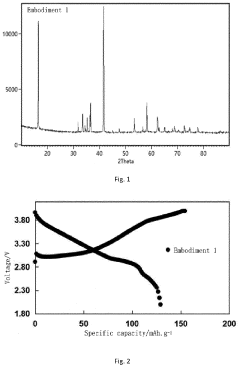
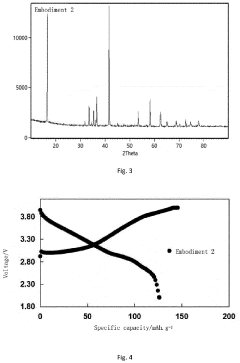
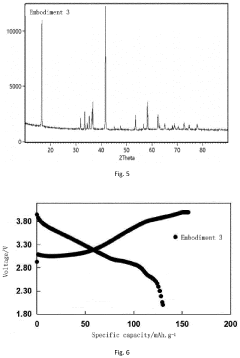
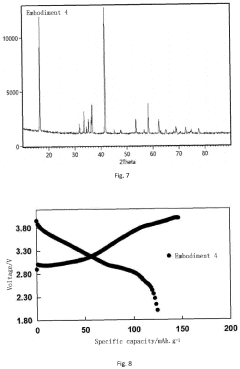
Zinc-containing cathode material for sodium ion battery and preparation method and application thereof
PatentPendingEP4276073A1
Innovation
- A zinc-containing cathode material with a specific chemical formula (Na1+aMdZnxO2+c) is developed, where zinc replaces some rare metals, stabilizing the crystal structure, reducing residual alkali content, and enhancing air stability and rate performance by providing vacancies for sodium ion intercalation.
Development of new air-stable o3-na xmo 2 type layered metal oxides for sodium ion batteries
PatentWO2022182313A3
Innovation
- Development of new metal-doped layered sodium (lithium, potassium) metal oxides containing nickel, iron and manganese as cathode active materials with enhanced air stability.
- Introduction of a novel synthesis method for O3-NaxMO2 type layered metal oxides that improves air stability while maintaining good electrochemical properties.
- Versatile application of the developed materials in multiple alkali-ion battery systems (sodium, lithium, potassium) and supercapacitors.
Sustainability and Resource Advantages of Na-ion Technology
Sodium-ion battery technology represents a significant advancement in sustainable energy storage solutions, primarily due to its inherent resource advantages compared to lithium-ion counterparts. The abundance of sodium resources is perhaps the most compelling sustainability factor, with sodium being the sixth most abundant element in the Earth's crust (2.8% by mass), approximately 1000 times more abundant than lithium. This abundance translates directly into lower extraction costs and reduced geopolitical supply risks.
The geographical distribution of sodium resources further enhances sustainability, as sodium is widely available across the globe, unlike lithium which is concentrated in specific regions such as the "Lithium Triangle" of South America. This widespread availability reduces transportation-related carbon emissions and minimizes supply chain vulnerabilities that could otherwise impede large-scale deployment of energy storage technologies.
From an environmental perspective, sodium extraction processes generally have lower ecological impacts compared to lithium mining operations. Traditional lithium extraction requires significant water consumption in already water-stressed regions, while sodium can be sourced from seawater or abundant mineral deposits with comparatively less environmental disruption. The carbon footprint associated with sodium resource processing is estimated to be 18-30% lower than equivalent lithium processing operations.
Economic sustainability is another critical advantage of sodium-ion technology. The cost of raw sodium materials is approximately one-twentieth that of lithium, providing significant economic incentives for commercial adoption. This cost advantage becomes increasingly important as global demand for energy storage solutions continues to grow exponentially, particularly in grid-scale applications and emerging markets where cost sensitivity is high.
The layered oxide structures being researched for sodium-ion battery cathodes often utilize more abundant transition metals like iron and manganese rather than cobalt and nickel, which face significant supply constraints and ethical sourcing challenges. This substitution further enhances the sustainability profile of sodium-ion technology while potentially addressing critical material supply risks that currently plague lithium-ion battery production.
End-of-life considerations also favor sodium-ion technology, as the materials used in these batteries generally pose fewer recycling challenges and environmental hazards. The absence of toxic or rare elements in many sodium-ion cathode formulations simplifies recycling processes and reduces the environmental impact of battery disposal, contributing to a more circular economy approach to energy storage solutions.
The geographical distribution of sodium resources further enhances sustainability, as sodium is widely available across the globe, unlike lithium which is concentrated in specific regions such as the "Lithium Triangle" of South America. This widespread availability reduces transportation-related carbon emissions and minimizes supply chain vulnerabilities that could otherwise impede large-scale deployment of energy storage technologies.
From an environmental perspective, sodium extraction processes generally have lower ecological impacts compared to lithium mining operations. Traditional lithium extraction requires significant water consumption in already water-stressed regions, while sodium can be sourced from seawater or abundant mineral deposits with comparatively less environmental disruption. The carbon footprint associated with sodium resource processing is estimated to be 18-30% lower than equivalent lithium processing operations.
Economic sustainability is another critical advantage of sodium-ion technology. The cost of raw sodium materials is approximately one-twentieth that of lithium, providing significant economic incentives for commercial adoption. This cost advantage becomes increasingly important as global demand for energy storage solutions continues to grow exponentially, particularly in grid-scale applications and emerging markets where cost sensitivity is high.
The layered oxide structures being researched for sodium-ion battery cathodes often utilize more abundant transition metals like iron and manganese rather than cobalt and nickel, which face significant supply constraints and ethical sourcing challenges. This substitution further enhances the sustainability profile of sodium-ion technology while potentially addressing critical material supply risks that currently plague lithium-ion battery production.
End-of-life considerations also favor sodium-ion technology, as the materials used in these batteries generally pose fewer recycling challenges and environmental hazards. The absence of toxic or rare elements in many sodium-ion cathode formulations simplifies recycling processes and reduces the environmental impact of battery disposal, contributing to a more circular economy approach to energy storage solutions.
Performance Benchmarking Against Li-ion Alternatives
When comparing sodium-ion battery cathode materials with layered oxide structures against their lithium-ion counterparts, several key performance metrics reveal both advantages and limitations. Energy density remains a primary challenge, with current sodium-ion cathodes delivering approximately 120-160 Wh/kg at the material level, compared to 180-250 Wh/kg for commercial lithium-ion cathodes. This 30-40% energy density gap stems primarily from sodium's higher atomic weight and less negative redox potential.
Cycle life performance shows promising results, with advanced layered oxide Na-ion cathodes achieving 80% capacity retention after 1000 cycles at 1C rates. While this approaches the performance of LiFePO₄ cathodes, it still lags behind the best NMC and NCA lithium-ion formulations that can maintain 90% capacity after similar cycling protocols.
Rate capability presents a mixed picture. Certain sodium layered oxides, particularly those with P2-type structures, demonstrate excellent high-rate performance, delivering up to 70% of their theoretical capacity at 10C rates. This compares favorably with many lithium-ion cathodes, suggesting potential advantages for high-power applications.
Cost analysis strongly favors sodium-ion technology, with raw material costs for Na-layered oxide cathodes estimated at 30-50% lower than lithium equivalents. The absence of cobalt and reduced nickel content in many sodium formulations provides significant economic advantages, particularly as lithium prices continue to experience volatility.
Safety comparisons indicate that sodium layered oxide cathodes generally exhibit higher thermal stability than their lithium counterparts, with DSC measurements showing delayed onset of exothermic reactions by 20-30°C. This translates to potentially improved safety margins, though comprehensive battery-level safety testing remains limited.
Environmental impact assessments reveal reduced carbon footprints for sodium-ion cathode production, with lifecycle analyses suggesting 15-25% lower CO₂ emissions compared to lithium-ion equivalents. This advantage stems from both material sourcing and processing requirements.
Manufacturing compatibility represents a significant strength, as sodium layered oxide cathodes can be produced using existing lithium-ion manufacturing infrastructure with minimal modifications. This compatibility substantially reduces barriers to commercial adoption and scaling.
Overall, while energy density limitations remain a significant challenge, sodium-ion cathodes with layered oxide structures demonstrate competitive or superior performance in several key metrics, positioning them as viable alternatives for applications where cost, safety, and sustainability take precedence over maximum energy density.
Cycle life performance shows promising results, with advanced layered oxide Na-ion cathodes achieving 80% capacity retention after 1000 cycles at 1C rates. While this approaches the performance of LiFePO₄ cathodes, it still lags behind the best NMC and NCA lithium-ion formulations that can maintain 90% capacity after similar cycling protocols.
Rate capability presents a mixed picture. Certain sodium layered oxides, particularly those with P2-type structures, demonstrate excellent high-rate performance, delivering up to 70% of their theoretical capacity at 10C rates. This compares favorably with many lithium-ion cathodes, suggesting potential advantages for high-power applications.
Cost analysis strongly favors sodium-ion technology, with raw material costs for Na-layered oxide cathodes estimated at 30-50% lower than lithium equivalents. The absence of cobalt and reduced nickel content in many sodium formulations provides significant economic advantages, particularly as lithium prices continue to experience volatility.
Safety comparisons indicate that sodium layered oxide cathodes generally exhibit higher thermal stability than their lithium counterparts, with DSC measurements showing delayed onset of exothermic reactions by 20-30°C. This translates to potentially improved safety margins, though comprehensive battery-level safety testing remains limited.
Environmental impact assessments reveal reduced carbon footprints for sodium-ion cathode production, with lifecycle analyses suggesting 15-25% lower CO₂ emissions compared to lithium-ion equivalents. This advantage stems from both material sourcing and processing requirements.
Manufacturing compatibility represents a significant strength, as sodium layered oxide cathodes can be produced using existing lithium-ion manufacturing infrastructure with minimal modifications. This compatibility substantially reduces barriers to commercial adoption and scaling.
Overall, while energy density limitations remain a significant challenge, sodium-ion cathodes with layered oxide structures demonstrate competitive or superior performance in several key metrics, positioning them as viable alternatives for applications where cost, safety, and sustainability take precedence over maximum energy density.
Unlock deeper insights with Patsnap Eureka Quick Research — get a full tech report to explore trends and direct your research. Try now!
Generate Your Research Report Instantly with AI Agent
Supercharge your innovation with Patsnap Eureka AI Agent Platform!