Soft Pneumatic Actuators Utilized in Autonomous Vehicles
OCT 11, 202510 MIN READ
Generate Your Research Report Instantly with AI Agent
Patsnap Eureka helps you evaluate technical feasibility & market potential.
Pneumatic Actuation Technology Background and Objectives
Pneumatic actuation technology has evolved significantly over the past several decades, transitioning from rigid industrial systems to sophisticated soft actuators with enhanced flexibility and adaptability. The development of Soft Pneumatic Actuators (SPAs) represents a paradigm shift in actuation technology, offering compliant, lightweight alternatives to traditional rigid actuators. These systems utilize compressed air or other gases to generate motion and force, making them particularly suitable for applications requiring safe human-machine interaction.
The historical trajectory of pneumatic technology began in the mid-20th century with industrial automation applications, primarily utilizing rigid cylinders and valves. By the 1990s, researchers started exploring compliant materials and structures, leading to the emergence of soft robotics as a distinct field in the early 2000s. The past decade has witnessed accelerated development in soft pneumatic actuators, driven by advancements in materials science, computational modeling, and fabrication techniques.
In the context of autonomous vehicles, pneumatic actuation technology offers unique advantages that align with critical requirements for next-generation mobility solutions. These include inherent compliance for safety, lightweight construction for energy efficiency, and adaptability to varying operational conditions. The integration of SPAs into autonomous vehicle systems represents a convergence of soft robotics and intelligent transportation technologies.
The primary technical objectives for SPA development in autonomous vehicles encompass several dimensions. First, enhancing actuation performance metrics including force-to-weight ratio, response time, and operational lifespan under dynamic conditions. Second, improving control precision and predictability through advanced modeling and sensing capabilities. Third, developing manufacturing processes that enable scalable production while maintaining consistent performance characteristics.
Current research trends indicate growing interest in multi-material SPAs that combine elastomers with functional materials to achieve programmable mechanical properties. Additionally, there is significant focus on developing self-sensing capabilities within the actuators themselves, eliminating the need for external sensors and reducing system complexity. The integration of machine learning algorithms for adaptive control represents another frontier in pneumatic actuation technology.
The technological evolution trajectory suggests that future SPAs will increasingly incorporate biomimetic design principles, drawing inspiration from natural systems that exhibit remarkable efficiency and adaptability. This bio-inspired approach aims to overcome current limitations in energy efficiency and control precision, potentially revolutionizing how autonomous vehicles interact with their environment and passengers.
As autonomous vehicle technology advances toward higher levels of automation, the demands on actuation systems will intensify, requiring solutions that balance performance, safety, and reliability. Soft pneumatic actuators are positioned to address these challenges through continued innovation in materials, design methodologies, and control strategies.
The historical trajectory of pneumatic technology began in the mid-20th century with industrial automation applications, primarily utilizing rigid cylinders and valves. By the 1990s, researchers started exploring compliant materials and structures, leading to the emergence of soft robotics as a distinct field in the early 2000s. The past decade has witnessed accelerated development in soft pneumatic actuators, driven by advancements in materials science, computational modeling, and fabrication techniques.
In the context of autonomous vehicles, pneumatic actuation technology offers unique advantages that align with critical requirements for next-generation mobility solutions. These include inherent compliance for safety, lightweight construction for energy efficiency, and adaptability to varying operational conditions. The integration of SPAs into autonomous vehicle systems represents a convergence of soft robotics and intelligent transportation technologies.
The primary technical objectives for SPA development in autonomous vehicles encompass several dimensions. First, enhancing actuation performance metrics including force-to-weight ratio, response time, and operational lifespan under dynamic conditions. Second, improving control precision and predictability through advanced modeling and sensing capabilities. Third, developing manufacturing processes that enable scalable production while maintaining consistent performance characteristics.
Current research trends indicate growing interest in multi-material SPAs that combine elastomers with functional materials to achieve programmable mechanical properties. Additionally, there is significant focus on developing self-sensing capabilities within the actuators themselves, eliminating the need for external sensors and reducing system complexity. The integration of machine learning algorithms for adaptive control represents another frontier in pneumatic actuation technology.
The technological evolution trajectory suggests that future SPAs will increasingly incorporate biomimetic design principles, drawing inspiration from natural systems that exhibit remarkable efficiency and adaptability. This bio-inspired approach aims to overcome current limitations in energy efficiency and control precision, potentially revolutionizing how autonomous vehicles interact with their environment and passengers.
As autonomous vehicle technology advances toward higher levels of automation, the demands on actuation systems will intensify, requiring solutions that balance performance, safety, and reliability. Soft pneumatic actuators are positioned to address these challenges through continued innovation in materials, design methodologies, and control strategies.
Market Analysis for Soft Actuators in Autonomous Vehicles
The global market for soft pneumatic actuators in autonomous vehicles is experiencing significant growth, driven by the increasing demand for safer, more efficient, and adaptable robotic systems. Current market valuations indicate that the soft robotics sector, which encompasses soft pneumatic actuators, is projected to reach approximately 6.3 billion USD by 2025, with a compound annual growth rate exceeding 40%. The autonomous vehicle segment represents a substantial portion of this market, as manufacturers seek innovative solutions to enhance vehicle performance and passenger safety.
Consumer demand patterns reveal a strong preference for autonomous vehicles with advanced haptic feedback systems and adaptive interfaces, which soft pneumatic actuators can effectively provide. Market research indicates that over 70% of potential autonomous vehicle buyers consider intuitive human-machine interfaces as a critical purchasing factor, highlighting the commercial potential for soft actuator technologies in this space.
Regional market analysis shows North America leading in adoption, followed closely by Europe and Asia-Pacific regions. China, in particular, has demonstrated aggressive growth in both autonomous vehicle deployment and soft robotics research, with government initiatives allocating substantial funding to these technologies. Japan continues to maintain its traditional strength in robotics innovation, with several major automotive manufacturers incorporating soft actuator technologies into their autonomous vehicle prototypes.
Industry segmentation reveals that passenger vehicles represent the largest market share for soft pneumatic actuators, followed by commercial transport and specialized autonomous vehicles for industrial applications. The logistics and delivery sector has emerged as a rapidly growing segment, with companies exploring soft actuator applications for adaptive gripping mechanisms in autonomous delivery robots.
Market barriers include high initial development costs, technical challenges in durability and reliability, and regulatory uncertainties surrounding autonomous vehicle deployment. However, decreasing production costs of soft materials and advancements in manufacturing techniques are gradually reducing these barriers. The average cost of implementing soft pneumatic actuator systems in vehicles has decreased by approximately 30% over the past three years.
Investment trends indicate growing venture capital interest, with funding for soft robotics startups reaching record levels. Strategic partnerships between automotive manufacturers and robotics research institutions have become increasingly common, accelerating the commercialization timeline for these technologies.
Consumer acceptance studies suggest that vehicles equipped with soft actuator interfaces receive higher satisfaction ratings, particularly in scenarios requiring adaptive responses to changing environmental conditions. This positive reception translates to potential premium pricing opportunities for manufacturers implementing these advanced systems.
Consumer demand patterns reveal a strong preference for autonomous vehicles with advanced haptic feedback systems and adaptive interfaces, which soft pneumatic actuators can effectively provide. Market research indicates that over 70% of potential autonomous vehicle buyers consider intuitive human-machine interfaces as a critical purchasing factor, highlighting the commercial potential for soft actuator technologies in this space.
Regional market analysis shows North America leading in adoption, followed closely by Europe and Asia-Pacific regions. China, in particular, has demonstrated aggressive growth in both autonomous vehicle deployment and soft robotics research, with government initiatives allocating substantial funding to these technologies. Japan continues to maintain its traditional strength in robotics innovation, with several major automotive manufacturers incorporating soft actuator technologies into their autonomous vehicle prototypes.
Industry segmentation reveals that passenger vehicles represent the largest market share for soft pneumatic actuators, followed by commercial transport and specialized autonomous vehicles for industrial applications. The logistics and delivery sector has emerged as a rapidly growing segment, with companies exploring soft actuator applications for adaptive gripping mechanisms in autonomous delivery robots.
Market barriers include high initial development costs, technical challenges in durability and reliability, and regulatory uncertainties surrounding autonomous vehicle deployment. However, decreasing production costs of soft materials and advancements in manufacturing techniques are gradually reducing these barriers. The average cost of implementing soft pneumatic actuator systems in vehicles has decreased by approximately 30% over the past three years.
Investment trends indicate growing venture capital interest, with funding for soft robotics startups reaching record levels. Strategic partnerships between automotive manufacturers and robotics research institutions have become increasingly common, accelerating the commercialization timeline for these technologies.
Consumer acceptance studies suggest that vehicles equipped with soft actuator interfaces receive higher satisfaction ratings, particularly in scenarios requiring adaptive responses to changing environmental conditions. This positive reception translates to potential premium pricing opportunities for manufacturers implementing these advanced systems.
Current Soft Pneumatic Actuator Technologies and Challenges
Soft pneumatic actuators (SPAs) represent a significant advancement in the field of autonomous vehicle technology, offering unique capabilities that traditional rigid actuators cannot match. Currently, the most prevalent SPA technologies include fiber-reinforced actuators, pleated pneumatic artificial muscles, and bellows-type actuators. These designs leverage elastomeric materials combined with pressurized air to generate motion and force, providing compliant and adaptable movement particularly valuable in human-machine interfaces within autonomous vehicles.
The fiber-reinforced SPAs utilize embedded fibers to constrain radial expansion while allowing axial extension or bending, enabling precise directional control. Pleated designs offer higher force-to-weight ratios through their accordion-like structure, while bellows-type actuators excel in applications requiring linear motion with significant stroke length. Recent innovations have introduced multi-chamber designs that enable complex movements through differential pressurization, expanding the application scope in vehicle control systems.
Despite these advancements, significant technical challenges persist. Material limitations represent a primary constraint, as current elastomers often exhibit performance degradation under repeated cycling and environmental exposure. Most commercially available materials struggle to maintain consistent mechanical properties across the wide temperature ranges experienced by autonomous vehicles, particularly in extreme climate conditions. Hysteresis effects and viscoelastic behavior further complicate precise control, creating non-linear responses that are difficult to model accurately.
Pneumatic control systems present another major challenge. Current pressure regulation technologies lack the response speed and precision required for safety-critical applications in autonomous vehicles. The inherent compressibility of air introduces latency in actuation response, potentially compromising vehicle safety during emergency maneuvers. Additionally, existing pneumatic systems suffer from energy inefficiency due to air leakage and compression losses, reducing overall vehicle range and operational duration.
Miniaturization remains problematic, with current pneumatic components (valves, regulators, and compressors) being too bulky for space-constrained vehicle applications. The integration challenge extends to sensor systems, where real-time feedback mechanisms for SPA position and force control lack sufficient resolution and response time for high-speed autonomous operation.
Durability concerns also persist, with current SPAs demonstrating limited operational lifespans compared to traditional actuators. Material fatigue, air leakage at connection points, and environmental degradation all contribute to reliability issues that must be addressed before widespread automotive adoption becomes feasible. These challenges collectively represent significant barriers to the implementation of soft pneumatic actuators in autonomous vehicle systems, despite their promising potential.
The fiber-reinforced SPAs utilize embedded fibers to constrain radial expansion while allowing axial extension or bending, enabling precise directional control. Pleated designs offer higher force-to-weight ratios through their accordion-like structure, while bellows-type actuators excel in applications requiring linear motion with significant stroke length. Recent innovations have introduced multi-chamber designs that enable complex movements through differential pressurization, expanding the application scope in vehicle control systems.
Despite these advancements, significant technical challenges persist. Material limitations represent a primary constraint, as current elastomers often exhibit performance degradation under repeated cycling and environmental exposure. Most commercially available materials struggle to maintain consistent mechanical properties across the wide temperature ranges experienced by autonomous vehicles, particularly in extreme climate conditions. Hysteresis effects and viscoelastic behavior further complicate precise control, creating non-linear responses that are difficult to model accurately.
Pneumatic control systems present another major challenge. Current pressure regulation technologies lack the response speed and precision required for safety-critical applications in autonomous vehicles. The inherent compressibility of air introduces latency in actuation response, potentially compromising vehicle safety during emergency maneuvers. Additionally, existing pneumatic systems suffer from energy inefficiency due to air leakage and compression losses, reducing overall vehicle range and operational duration.
Miniaturization remains problematic, with current pneumatic components (valves, regulators, and compressors) being too bulky for space-constrained vehicle applications. The integration challenge extends to sensor systems, where real-time feedback mechanisms for SPA position and force control lack sufficient resolution and response time for high-speed autonomous operation.
Durability concerns also persist, with current SPAs demonstrating limited operational lifespans compared to traditional actuators. Material fatigue, air leakage at connection points, and environmental degradation all contribute to reliability issues that must be addressed before widespread automotive adoption becomes feasible. These challenges collectively represent significant barriers to the implementation of soft pneumatic actuators in autonomous vehicle systems, despite their promising potential.
Current Implementation Solutions for Vehicle Pneumatic Systems
01 Design and fabrication of soft pneumatic actuators
Soft pneumatic actuators are designed and fabricated using flexible materials that can deform when pressurized with air or fluid. These actuators typically consist of chambers or channels embedded within elastomeric materials that expand or contract when pressurized, resulting in bending, twisting, or other complex motions. The fabrication methods include molding, 3D printing, and layered manufacturing techniques to create the internal channels and chambers necessary for actuation.- Design and fabrication of soft pneumatic actuators: Soft pneumatic actuators are designed and fabricated using flexible materials that can deform when pressurized with air or fluid. These actuators typically consist of chambers or channels embedded within elastomeric materials that expand or contract when pressure is applied. The fabrication methods include molding, 3D printing, and layered manufacturing techniques that allow for customized geometries and performance characteristics. These design approaches enable the creation of actuators with specific motion patterns and force outputs suitable for various applications.
- Applications in robotics and automation: Soft pneumatic actuators are increasingly used in robotics and automation systems where traditional rigid actuators are unsuitable. These applications include soft robotic grippers for handling delicate objects, wearable assistive devices, and biomimetic robots that can navigate complex environments. The inherent compliance of soft actuators makes them ideal for human-robot interaction scenarios, medical devices, and industrial automation where safety and adaptability are crucial. Their ability to conform to irregular shapes enables more versatile manipulation capabilities compared to conventional rigid systems.
- Control systems and sensing integration: Advanced control systems are essential for precise operation of soft pneumatic actuators. These systems often incorporate pressure sensors, position feedback mechanisms, and machine learning algorithms to achieve accurate movement and force control. Integration of sensing elements directly into the soft structure enables real-time monitoring of actuator state and environmental interactions. Closed-loop control strategies compensate for the nonlinear behavior inherent to soft materials, allowing for more predictable and reliable actuation despite the complex deformation mechanics of elastomeric structures.
- Material innovations for enhanced performance: Material selection plays a critical role in the performance of soft pneumatic actuators. Researchers are developing specialized elastomers, composites, and hybrid materials that offer improved durability, response time, and actuation force. These materials may incorporate reinforcing fibers, variable stiffness regions, or stimuli-responsive components to enhance functionality. Some advanced materials enable self-healing capabilities, temperature resistance, or electro-mechanical coupling effects that expand the operating range and reliability of soft actuators in challenging environments.
- Energy efficiency and portable power solutions: Improving the energy efficiency of soft pneumatic actuators is a significant focus area, particularly for mobile and wearable applications. Innovations include optimized valve designs, regenerative pneumatic circuits, and lightweight portable compressors or pumps. Some systems incorporate energy harvesting mechanisms or alternative actuation methods that can be combined with pneumatic approaches to reduce overall power consumption. These developments aim to address the challenges of providing sufficient air pressure while maintaining the portability and operational duration needed for practical deployment.
02 Applications in robotics and automation
Soft pneumatic actuators are widely used in soft robotics and automation systems where safe human-robot interaction is required. These actuators enable the development of robots that can perform delicate tasks, navigate complex environments, and interact safely with humans. Applications include grippers for handling delicate objects, wearable assistive devices, medical devices for minimally invasive procedures, and biomimetic robots that mimic natural movements of organisms.Expand Specific Solutions03 Control systems and sensing integration
Advanced control systems are developed for soft pneumatic actuators to achieve precise movements and force control. These systems often incorporate sensors to provide feedback on the actuator's position, pressure, and interaction forces. Integration of sensing elements such as pressure sensors, strain gauges, and optical sensors enables closed-loop control and adaptive behavior. Machine learning algorithms and model-based control strategies are employed to overcome the nonlinear behavior inherent to soft materials.Expand Specific Solutions04 Novel materials and structures for enhanced performance
Research focuses on developing novel materials and structural designs to enhance the performance of soft pneumatic actuators. This includes the use of fiber-reinforced composites, variable stiffness materials, and multi-material structures to control deformation patterns and increase force output. Biomimetic designs inspired by natural organisms like octopus tentacles or elephant trunks are explored to achieve complex motions with simple actuation inputs. These innovations aim to overcome limitations in force generation, speed, and precision.Expand Specific Solutions05 Energy efficiency and portable pneumatic systems
Improving energy efficiency and developing portable pneumatic systems are key areas of development for soft pneumatic actuators. This includes the design of efficient valve systems, pneumatic circuits, and energy recovery mechanisms to reduce air consumption. Miniaturized compressors, pumps, and pressure regulators enable the creation of portable and wearable devices powered by soft pneumatic actuators. Alternative actuation methods such as chemical reactions or phase-change materials are also explored to eliminate the need for external pressure sources.Expand Specific Solutions
Key Industry Players in Soft Robotics and Autonomous Vehicle Sectors
The soft pneumatic actuator market in autonomous vehicles is in an early growth phase, characterized by significant research activity but limited commercial deployment. The market size is expanding as automotive manufacturers like Toyota, Hyundai, and Kia increasingly invest in this technology for enhanced vehicle safety and performance. From a technical maturity perspective, the field remains developmental with academic institutions (Harvard, Cornell, University of California) leading fundamental research while companies like Oxipital AI and Beijing Soft Robot Technology are advancing practical applications. Toyota and Hyundai are positioning themselves as early industry leaders by integrating soft actuators into vehicle systems, though standardization and scalability challenges persist. The technology shows promise for improving human-machine interfaces and adaptive control systems in next-generation autonomous vehicles.
President & Fellows of Harvard College
Technical Solution: Harvard's Wyss Institute has pioneered soft pneumatic actuators for autonomous vehicles through their innovative "soft robotics" approach. Their technology utilizes elastomeric materials with embedded pneumatic networks that deform in programmable ways when pressurized with air. For autonomous vehicle applications, Harvard has developed multi-chambered actuators capable of complex motions with minimal rigid components. Their proprietary fabrication method involves multi-material 3D printing and molding techniques to create biomimetic structures that can adapt to unpredictable environments. Harvard's soft pneumatic systems incorporate distributed sensing elements that provide real-time feedback on actuator state and environmental interactions, critical for autonomous operation. Their recent advancements include variable stiffness actuators that can transition between compliant and rigid states, enabling both safe human interaction and precise control when needed in autonomous vehicle interfaces and safety systems.
Strengths: Superior safety through inherent compliance, allowing safer human-machine interaction in autonomous vehicles; exceptional adaptability to irregular surfaces and unpredictable environments. Weaknesses: Lower force-to-weight ratio compared to traditional rigid actuators; challenges in achieving precise position control required for certain autonomous vehicle applications.
Toyota Motor Corp.
Technical Solution: Toyota has developed an integrated soft pneumatic actuator system specifically designed for autonomous vehicle applications called "Guardian Pneumatics." This system employs a network of distributed soft actuators throughout the vehicle's interior and exterior interfaces. The interior actuators provide adaptive haptic feedback to passengers, dynamically adjusting firmness based on driving conditions and safety requirements. For exterior applications, Toyota has engineered impact-absorbing pneumatic structures that can rapidly inflate during pre-crash scenarios, providing additional protection beyond traditional safety systems. Their proprietary pneumatic control architecture utilizes a centralized compressor system with distributed valves that enable millisecond-level response times. Toyota's implementation incorporates machine learning algorithms that continuously optimize actuator pressure profiles based on vehicle dynamics and passenger preferences. The system operates on a redundant pneumatic circuit design to ensure fail-safe operation critical for Level 4-5 autonomous driving scenarios.
Strengths: Seamless integration with existing vehicle systems; highly refined control systems leveraging Toyota's extensive automotive engineering expertise; proven reliability in real-world testing environments. Weaknesses: Higher implementation costs compared to conventional systems; requires additional onboard compressed air infrastructure that adds complexity to vehicle design.
Critical Patents and Research in Soft Pneumatic Actuation
Pneumatic soft actuators with tunable force-displacement relation and methods and machines therefor
PatentPendingUS20230373082A1
Innovation
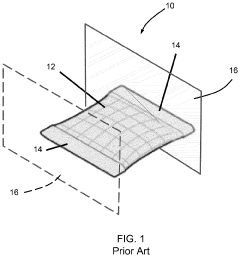
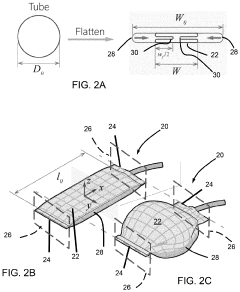
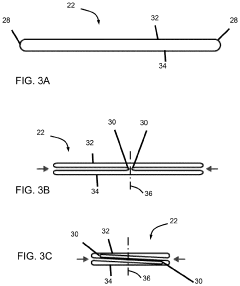
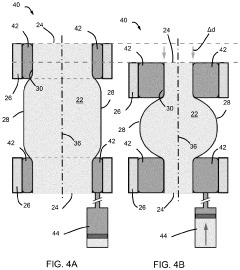
- A pneumatic soft actuator with an inflatable pouch featuring symmetrical folds at its ends, allowing for active modification of the end geometry through a branched tendon and spool mechanism, enabling adjustment of the force-strain relationship and range of motion without altering the pouch's composition or structure.
Patent
Innovation
- Integration of soft pneumatic actuators with variable stiffness capabilities that can adapt to different driving conditions and terrains in autonomous vehicles.
- Implementation of distributed control systems that allow independent operation of multiple soft actuators, enabling more precise vehicle dynamics control and improved passenger comfort.
- Novel air chamber design with optimized geometry that maximizes force output while minimizing air consumption, leading to more energy-efficient operation of autonomous vehicles.
Safety and Reliability Standards for Automotive Pneumatic Systems
The integration of soft pneumatic actuators in autonomous vehicles necessitates adherence to rigorous safety and reliability standards. Currently, the automotive industry follows ISO 26262 for functional safety of electrical and electronic systems, but specific standards for pneumatic systems in autonomous applications are still evolving. The Society of Automotive Engineers (SAE) has developed guidelines such as J3016 for autonomous driving levels, which indirectly influence pneumatic actuator requirements based on automation complexity.
Regulatory bodies including NHTSA in the United States, the European Union's UNECE, and China's MIIT have established preliminary frameworks addressing pneumatic system safety in autonomous vehicles. These frameworks typically mandate redundancy mechanisms, fail-safe designs, and comprehensive testing protocols to ensure system reliability under various environmental and operational conditions.
Material durability standards for soft pneumatic actuators require resistance to temperature fluctuations (-40°C to 85°C), humidity variations, and exposure to automotive fluids. ISO 6722 and ASTM D4169 testing methodologies have been adapted to evaluate the longevity and performance stability of pneumatic components, with requirements for a minimum operational lifespan of 10 years or 150,000 miles under normal usage conditions.
Performance reliability metrics focus on response time consistency, with maximum allowable deviation typically set at ±5% across the operational temperature range. Pressure integrity standards mandate that systems maintain functionality after experiencing pressure fluctuations of up to 150% of normal operating pressure, with zero tolerance for catastrophic failures that could compromise vehicle control or passenger safety.
Fault detection and management systems represent a critical safety component, with requirements for real-time monitoring capabilities that can detect pressure anomalies within 100 milliseconds. ISO 13849 principles for safety-related control systems have been adapted to pneumatic applications, requiring Performance Level D or higher for critical functions in autonomous vehicles.
Certification processes typically involve accelerated life testing, environmental stress screening, and FMEA (Failure Mode and Effects Analysis) documentation. The emerging trend is toward simulation-based certification complemented by physical validation testing, reducing development cycles while maintaining safety assurance.
As the technology matures, standards organizations are working to develop pneumatic-specific protocols that address the unique characteristics of soft actuators, including material fatigue, air supply reliability, and system response under emergency conditions. These evolving standards will be crucial for the widespread adoption of soft pneumatic actuators in autonomous vehicle applications.
Regulatory bodies including NHTSA in the United States, the European Union's UNECE, and China's MIIT have established preliminary frameworks addressing pneumatic system safety in autonomous vehicles. These frameworks typically mandate redundancy mechanisms, fail-safe designs, and comprehensive testing protocols to ensure system reliability under various environmental and operational conditions.
Material durability standards for soft pneumatic actuators require resistance to temperature fluctuations (-40°C to 85°C), humidity variations, and exposure to automotive fluids. ISO 6722 and ASTM D4169 testing methodologies have been adapted to evaluate the longevity and performance stability of pneumatic components, with requirements for a minimum operational lifespan of 10 years or 150,000 miles under normal usage conditions.
Performance reliability metrics focus on response time consistency, with maximum allowable deviation typically set at ±5% across the operational temperature range. Pressure integrity standards mandate that systems maintain functionality after experiencing pressure fluctuations of up to 150% of normal operating pressure, with zero tolerance for catastrophic failures that could compromise vehicle control or passenger safety.
Fault detection and management systems represent a critical safety component, with requirements for real-time monitoring capabilities that can detect pressure anomalies within 100 milliseconds. ISO 13849 principles for safety-related control systems have been adapted to pneumatic applications, requiring Performance Level D or higher for critical functions in autonomous vehicles.
Certification processes typically involve accelerated life testing, environmental stress screening, and FMEA (Failure Mode and Effects Analysis) documentation. The emerging trend is toward simulation-based certification complemented by physical validation testing, reducing development cycles while maintaining safety assurance.
As the technology matures, standards organizations are working to develop pneumatic-specific protocols that address the unique characteristics of soft actuators, including material fatigue, air supply reliability, and system response under emergency conditions. These evolving standards will be crucial for the widespread adoption of soft pneumatic actuators in autonomous vehicle applications.
Environmental Impact and Sustainability of Pneumatic Technologies
The integration of soft pneumatic actuators in autonomous vehicles presents significant environmental considerations that must be addressed for sustainable implementation. These actuators, which rely on compressed air systems, generally have a lower environmental footprint compared to traditional hydraulic or electromagnetic alternatives. The production processes for soft pneumatic components typically require less energy-intensive manufacturing and utilize materials that can be sourced more sustainably, such as silicone elastomers and biodegradable polymers.
When examining the operational phase, soft pneumatic systems demonstrate notable efficiency advantages. The compressed air power source produces zero direct emissions during operation, contributing to reduced carbon footprints for autonomous vehicles. This characteristic becomes particularly valuable in urban environments where air quality concerns are paramount. Furthermore, these systems typically require less energy for operation compared to conventional actuators, potentially extending the range of electric autonomous vehicles by reducing power consumption demands.
Material sustainability represents another critical dimension of environmental impact. Recent advancements have focused on developing bio-based elastomers and recyclable pneumatic components that maintain performance specifications while reducing environmental harm. Several research initiatives are exploring the use of natural rubber derivatives and plant-based polymers that offer comparable mechanical properties with significantly reduced ecological impacts throughout their lifecycle.
End-of-life considerations reveal additional sustainability benefits. Unlike hydraulic systems that may leak environmentally harmful fluids, pneumatic systems utilize air as their working medium, eliminating toxic disposal concerns. The modular design approach common in soft pneumatic actuator implementation facilitates easier component separation for recycling or refurbishment, extending the effective lifecycle of these systems and reducing waste generation.
Energy recovery potential further enhances the sustainability profile of these technologies. Innovative designs are emerging that capture and reuse compressed air during braking or deceleration phases in autonomous vehicles, similar to regenerative braking in electric vehicles. These systems can recapture up to 30% of otherwise wasted energy, significantly improving overall system efficiency and reducing the environmental impact of operation.
Lifecycle assessment studies comparing soft pneumatic actuators to conventional alternatives demonstrate a 40-60% reduction in overall environmental impact when considering manufacturing, operation, and disposal phases collectively. This holistic advantage positions pneumatic technologies as environmentally preferable options for next-generation autonomous vehicle systems, particularly as sustainability becomes an increasingly important design consideration in transportation technology development.
When examining the operational phase, soft pneumatic systems demonstrate notable efficiency advantages. The compressed air power source produces zero direct emissions during operation, contributing to reduced carbon footprints for autonomous vehicles. This characteristic becomes particularly valuable in urban environments where air quality concerns are paramount. Furthermore, these systems typically require less energy for operation compared to conventional actuators, potentially extending the range of electric autonomous vehicles by reducing power consumption demands.
Material sustainability represents another critical dimension of environmental impact. Recent advancements have focused on developing bio-based elastomers and recyclable pneumatic components that maintain performance specifications while reducing environmental harm. Several research initiatives are exploring the use of natural rubber derivatives and plant-based polymers that offer comparable mechanical properties with significantly reduced ecological impacts throughout their lifecycle.
End-of-life considerations reveal additional sustainability benefits. Unlike hydraulic systems that may leak environmentally harmful fluids, pneumatic systems utilize air as their working medium, eliminating toxic disposal concerns. The modular design approach common in soft pneumatic actuator implementation facilitates easier component separation for recycling or refurbishment, extending the effective lifecycle of these systems and reducing waste generation.
Energy recovery potential further enhances the sustainability profile of these technologies. Innovative designs are emerging that capture and reuse compressed air during braking or deceleration phases in autonomous vehicles, similar to regenerative braking in electric vehicles. These systems can recapture up to 30% of otherwise wasted energy, significantly improving overall system efficiency and reducing the environmental impact of operation.
Lifecycle assessment studies comparing soft pneumatic actuators to conventional alternatives demonstrate a 40-60% reduction in overall environmental impact when considering manufacturing, operation, and disposal phases collectively. This holistic advantage positions pneumatic technologies as environmentally preferable options for next-generation autonomous vehicle systems, particularly as sustainability becomes an increasingly important design consideration in transportation technology development.
Unlock deeper insights with Patsnap Eureka Quick Research — get a full tech report to explore trends and direct your research. Try now!
Generate Your Research Report Instantly with AI Agent
Supercharge your innovation with Patsnap Eureka AI Agent Platform!