

Why Is Spintronic Device Integration Key for Advanced Robotics?
OCT 21, 20259 MIN READ
Generate Your Research Report Instantly with AI Agent
PatSnap Eureka helps you evaluate technical feasibility & market potential.
Spintronics in Robotics: Background and Objectives
Spintronics represents a revolutionary frontier in electronics, leveraging the intrinsic spin of electrons alongside their charge to create more efficient and powerful computing systems. The evolution of this technology has progressed significantly since the discovery of giant magnetoresistance (GMR) in the late 1980s, which earned Albert Fert and Peter Grünberg the Nobel Prize in Physics in 2007. This breakthrough laid the foundation for modern data storage technologies and opened new possibilities for computing architectures.
The trajectory of spintronic development has been marked by several key milestones, including the commercialization of magnetic random-access memory (MRAM), the development of spin-transfer torque (STT) technologies, and more recently, the exploration of skyrmions and magnonic devices. Each advancement has pushed the boundaries of what's possible in terms of energy efficiency, processing speed, and miniaturization.
In the context of robotics, spintronics offers transformative potential. Traditional robotic systems face significant limitations in processing power, energy consumption, and physical form factor—all critical constraints for advanced applications like autonomous navigation, real-time decision making, and human-robot interaction. The integration of spintronic devices aims to address these fundamental challenges by enabling more compact, energy-efficient, and powerful computational capabilities directly within robotic platforms.
The primary technical objectives for spintronic integration in robotics include developing non-volatile memory solutions that maintain state without continuous power, creating energy-efficient processing units capable of handling complex AI algorithms, and designing sensors with unprecedented sensitivity for environmental perception. These advancements would collectively enable robots to operate longer on limited power supplies, process information more efficiently, and interact with their environments with greater precision.
Current research is particularly focused on neuromorphic computing applications, where spintronic devices can emulate neural network functions with significantly lower power requirements than conventional CMOS-based solutions. This approach holds promise for enabling more sophisticated on-board AI capabilities in robotic systems without the energy and thermal penalties associated with traditional computing architectures.
The convergence of spintronics and robotics represents a synergistic relationship where advances in material science and quantum physics directly translate to enhanced capabilities in autonomous systems. As we look toward the future of advanced robotics, spintronic integration stands as a key enabling technology that could fundamentally redefine the performance envelope of robotic systems across industrial, medical, exploration, and consumer applications.
The trajectory of spintronic development has been marked by several key milestones, including the commercialization of magnetic random-access memory (MRAM), the development of spin-transfer torque (STT) technologies, and more recently, the exploration of skyrmions and magnonic devices. Each advancement has pushed the boundaries of what's possible in terms of energy efficiency, processing speed, and miniaturization.
In the context of robotics, spintronics offers transformative potential. Traditional robotic systems face significant limitations in processing power, energy consumption, and physical form factor—all critical constraints for advanced applications like autonomous navigation, real-time decision making, and human-robot interaction. The integration of spintronic devices aims to address these fundamental challenges by enabling more compact, energy-efficient, and powerful computational capabilities directly within robotic platforms.
The primary technical objectives for spintronic integration in robotics include developing non-volatile memory solutions that maintain state without continuous power, creating energy-efficient processing units capable of handling complex AI algorithms, and designing sensors with unprecedented sensitivity for environmental perception. These advancements would collectively enable robots to operate longer on limited power supplies, process information more efficiently, and interact with their environments with greater precision.
Current research is particularly focused on neuromorphic computing applications, where spintronic devices can emulate neural network functions with significantly lower power requirements than conventional CMOS-based solutions. This approach holds promise for enabling more sophisticated on-board AI capabilities in robotic systems without the energy and thermal penalties associated with traditional computing architectures.
The convergence of spintronics and robotics represents a synergistic relationship where advances in material science and quantum physics directly translate to enhanced capabilities in autonomous systems. As we look toward the future of advanced robotics, spintronic integration stands as a key enabling technology that could fundamentally redefine the performance envelope of robotic systems across industrial, medical, exploration, and consumer applications.
Market Demand Analysis for Spintronic-Enhanced Robotics
The global robotics market is experiencing unprecedented growth, with projections indicating expansion from $27.73 billion in 2020 to $74.1 billion by 2026, representing a CAGR of 17.45%. Within this expanding ecosystem, demand for spintronic-enhanced robotics is emerging as a significant trend driven by requirements for more efficient, precise, and autonomous robotic systems across multiple industries.
Manufacturing sectors, particularly automotive and electronics, demonstrate the strongest immediate demand for spintronic-enhanced robotics. These industries require robots with enhanced sensing capabilities, reduced power consumption, and improved computational efficiency—all benefits that spintronics can deliver. The automotive industry alone is expected to deploy over 3.2 million industrial robots by 2025, with spintronic components potentially featuring in advanced models.
Healthcare represents another substantial market opportunity, with surgical robotics projected to reach $16.77 billion by 2031. The integration of spintronic sensors enables unprecedented precision in minimally invasive procedures, creating demand for robots capable of mimicking human dexterity while maintaining nanometer-level accuracy. Hospitals and medical facilities increasingly seek robotic systems with enhanced magnetic sensing capabilities for diagnostic and therapeutic applications.
Consumer robotics presents a rapidly growing market segment, with household robots expected to surpass $11 billion by 2025. As consumers demand more sophisticated home automation and assistance, spintronic-enhanced robots offer advantages in navigation, object recognition, and energy efficiency—extending battery life while improving performance.
Military and defense applications represent a specialized but high-value market segment. Autonomous vehicles, surveillance drones, and reconnaissance robots benefit significantly from spintronic components' radiation hardness, non-volatile memory capabilities, and low power requirements. Defense budgets worldwide allocate increasing portions to advanced robotics, with spintronic technologies viewed as strategic investments.
Market analysis reveals that early adopters of spintronic-enhanced robotics are primarily concentrated in regions with established technological infrastructure—North America, Western Europe, Japan, and South Korea. However, China is rapidly accelerating investments in this field, with government initiatives specifically targeting spintronic applications in robotics as part of broader semiconductor independence strategies.
The market demonstrates a clear correlation between robotics advancement and spintronic integration, with industry surveys indicating that 78% of robotics manufacturers consider magnetic sensing and non-volatile memory technologies as critical components for their next-generation products. This alignment of market demand with spintronic capabilities suggests a robust growth trajectory for this technological convergence.
Manufacturing sectors, particularly automotive and electronics, demonstrate the strongest immediate demand for spintronic-enhanced robotics. These industries require robots with enhanced sensing capabilities, reduced power consumption, and improved computational efficiency—all benefits that spintronics can deliver. The automotive industry alone is expected to deploy over 3.2 million industrial robots by 2025, with spintronic components potentially featuring in advanced models.
Healthcare represents another substantial market opportunity, with surgical robotics projected to reach $16.77 billion by 2031. The integration of spintronic sensors enables unprecedented precision in minimally invasive procedures, creating demand for robots capable of mimicking human dexterity while maintaining nanometer-level accuracy. Hospitals and medical facilities increasingly seek robotic systems with enhanced magnetic sensing capabilities for diagnostic and therapeutic applications.
Consumer robotics presents a rapidly growing market segment, with household robots expected to surpass $11 billion by 2025. As consumers demand more sophisticated home automation and assistance, spintronic-enhanced robots offer advantages in navigation, object recognition, and energy efficiency—extending battery life while improving performance.
Military and defense applications represent a specialized but high-value market segment. Autonomous vehicles, surveillance drones, and reconnaissance robots benefit significantly from spintronic components' radiation hardness, non-volatile memory capabilities, and low power requirements. Defense budgets worldwide allocate increasing portions to advanced robotics, with spintronic technologies viewed as strategic investments.
Market analysis reveals that early adopters of spintronic-enhanced robotics are primarily concentrated in regions with established technological infrastructure—North America, Western Europe, Japan, and South Korea. However, China is rapidly accelerating investments in this field, with government initiatives specifically targeting spintronic applications in robotics as part of broader semiconductor independence strategies.
The market demonstrates a clear correlation between robotics advancement and spintronic integration, with industry surveys indicating that 78% of robotics manufacturers consider magnetic sensing and non-volatile memory technologies as critical components for their next-generation products. This alignment of market demand with spintronic capabilities suggests a robust growth trajectory for this technological convergence.
Current State and Challenges in Spintronic Device Integration
Spintronic device integration currently stands at a critical juncture between laboratory research and practical implementation in advanced robotics systems. The global landscape shows significant progress in fundamental research, with major developments concentrated in research hubs across the United States, Europe, Japan, and increasingly China. However, the transition from laboratory prototypes to commercially viable robotic applications faces substantial technical barriers.
The primary challenge lies in scaling spintronic devices to dimensions compatible with modern robotics hardware while maintaining their unique quantum properties. Current fabrication techniques struggle to consistently produce nanoscale spintronic components with the uniformity required for reliable robotic control systems. This manufacturing inconsistency results in performance variability that is unacceptable for precision robotics applications.
Energy efficiency presents another significant obstacle. While spintronics theoretically offers lower power consumption than conventional electronics, practical implementations often suffer from unexpected energy losses at interfaces between different materials. These losses become particularly problematic in mobile robotics platforms where power constraints are critical design factors.
Thermal management issues further complicate integration efforts. Spintronic devices can generate significant heat during operation, particularly when processing the complex data streams required for advanced robotic perception and decision-making. Current cooling solutions add prohibitive bulk and weight to robotic systems, limiting practical deployment options.
Integration with existing robotic control architectures represents a substantial technical hurdle. Most robotic systems rely on conventional CMOS-based computing architectures, creating compatibility challenges when introducing spintronic components. The development of appropriate interface technologies and protocols remains incomplete, hindering seamless integration.
Material stability and reliability under real-world operating conditions continue to constrain widespread adoption. Many promising spintronic materials exhibit performance degradation when exposed to temperature fluctuations, mechanical stress, or electromagnetic interference—all common in robotic operating environments. This vulnerability significantly impacts long-term reliability in field deployments.
The talent gap in interdisciplinary expertise combining spintronics, robotics, and systems integration further slows progress. Few engineers possess the cross-domain knowledge required to effectively bridge these fields, creating bottlenecks in development pipelines and limiting innovation velocity.
Despite these challenges, recent breakthroughs in room-temperature magnetic tunnel junctions and spin-orbit torque devices suggest pathways toward practical integration. Several research institutions have demonstrated prototype robotic subsystems incorporating spintronic sensors and memory elements, though comprehensive integration remains elusive.
The primary challenge lies in scaling spintronic devices to dimensions compatible with modern robotics hardware while maintaining their unique quantum properties. Current fabrication techniques struggle to consistently produce nanoscale spintronic components with the uniformity required for reliable robotic control systems. This manufacturing inconsistency results in performance variability that is unacceptable for precision robotics applications.
Energy efficiency presents another significant obstacle. While spintronics theoretically offers lower power consumption than conventional electronics, practical implementations often suffer from unexpected energy losses at interfaces between different materials. These losses become particularly problematic in mobile robotics platforms where power constraints are critical design factors.
Thermal management issues further complicate integration efforts. Spintronic devices can generate significant heat during operation, particularly when processing the complex data streams required for advanced robotic perception and decision-making. Current cooling solutions add prohibitive bulk and weight to robotic systems, limiting practical deployment options.
Integration with existing robotic control architectures represents a substantial technical hurdle. Most robotic systems rely on conventional CMOS-based computing architectures, creating compatibility challenges when introducing spintronic components. The development of appropriate interface technologies and protocols remains incomplete, hindering seamless integration.
Material stability and reliability under real-world operating conditions continue to constrain widespread adoption. Many promising spintronic materials exhibit performance degradation when exposed to temperature fluctuations, mechanical stress, or electromagnetic interference—all common in robotic operating environments. This vulnerability significantly impacts long-term reliability in field deployments.
The talent gap in interdisciplinary expertise combining spintronics, robotics, and systems integration further slows progress. Few engineers possess the cross-domain knowledge required to effectively bridge these fields, creating bottlenecks in development pipelines and limiting innovation velocity.
Despite these challenges, recent breakthroughs in room-temperature magnetic tunnel junctions and spin-orbit torque devices suggest pathways toward practical integration. Several research institutions have demonstrated prototype robotic subsystems incorporating spintronic sensors and memory elements, though comprehensive integration remains elusive.
Current Integration Solutions for Spintronic Devices in Robotics
01 Magnetic Tunnel Junction (MTJ) Structures
Magnetic Tunnel Junction structures are fundamental components in spintronic devices, consisting of two ferromagnetic layers separated by an insulating barrier. These structures utilize electron spin to store and process information, offering advantages such as non-volatility, high speed, and low power consumption. Advanced MTJ designs incorporate materials like CoFeB and MgO barriers to enhance tunnel magnetoresistance ratios, improving device performance and reliability for memory applications.- Magnetic Tunnel Junction (MTJ) Structures: Magnetic tunnel junctions are fundamental components in spintronic devices, consisting of two ferromagnetic layers separated by an insulating barrier. These structures utilize electron spin to store and process information, offering advantages in data retention and power efficiency. Advanced MTJ designs incorporate specialized materials and layer configurations to enhance performance characteristics such as thermal stability, switching efficiency, and signal-to-noise ratio.
- Spin Transfer Torque (STT) Technology: Spin Transfer Torque technology enables the manipulation of magnetic states in spintronic devices using spin-polarized currents rather than external magnetic fields. This approach allows for more efficient writing operations in magnetic memory devices while reducing power consumption. STT-based devices can be scaled to smaller dimensions without compromising performance, making them suitable for high-density memory applications and logic operations in next-generation computing systems.
- Novel Materials for Spintronics: Advanced materials play a crucial role in enhancing spintronic device performance. These include half-metallic ferromagnets, topological insulators, and two-dimensional materials that exhibit unique spin-dependent transport properties. The development of new material systems with high spin polarization, low damping constants, and tunable magnetic anisotropy enables the creation of more efficient and versatile spintronic devices for various applications including memory, sensors, and quantum computing.
- Integration with Semiconductor Technology: The integration of spintronic devices with conventional semiconductor technology presents both challenges and opportunities. Fabrication processes must be compatible with existing CMOS manufacturing techniques while preserving the unique spin-dependent properties of the materials. Hybrid spintronic-semiconductor devices can combine the advantages of both technologies, offering non-volatility, reduced power consumption, and enhanced functionality for computing applications, including neuromorphic systems and in-memory computing architectures.
- Emerging Spintronic Applications: Beyond conventional memory applications, spintronic devices are finding use in diverse fields such as sensors, oscillators, and quantum computing. Spin-based sensors offer high sensitivity for detecting magnetic fields, while spin-torque nano-oscillators provide tunable microwave sources. Spintronic qubits represent promising candidates for quantum information processing due to their long coherence times and potential for scalability. These emerging applications leverage the unique properties of electron spin to enable functionalities not achievable with conventional electronic devices.
02 Spin-Orbit Torque Devices
Spin-orbit torque (SOT) based spintronic devices utilize the interaction between electron spin and orbital motion to manipulate magnetization. These devices offer advantages over conventional spin-transfer torque devices, including faster switching speeds and lower energy consumption. SOT devices typically employ heavy metal layers adjacent to ferromagnetic materials to generate efficient spin currents, enabling applications in memory, logic, and neuromorphic computing systems.Expand Specific Solutions03 Spintronic Memory Architectures
Spintronic memory architectures leverage electron spin properties to create non-volatile memory solutions with improved performance characteristics. These architectures include Magnetoresistive Random Access Memory (MRAM), Spin-Transfer Torque MRAM (STT-MRAM), and Spin-Orbit Torque MRAM (SOT-MRAM). The designs focus on optimizing cell structure, addressing schemes, and read/write operations to achieve higher density, faster access times, and reduced power consumption compared to conventional memory technologies.Expand Specific Solutions04 Spintronic Logic Devices
Spintronic logic devices utilize electron spin to perform computational operations, offering potential advantages over conventional CMOS technology. These devices implement logic functions through spin-dependent transport phenomena, enabling lower power consumption and potential for non-volatile operation. Various approaches include domain wall logic, spin wave logic, and magnetoelectric spin-orbit logic, which can be integrated with existing semiconductor technologies to create hybrid computing architectures with enhanced functionality.Expand Specific Solutions05 Novel Materials for Spintronics
Advanced materials play a crucial role in enhancing spintronic device performance. These include topological insulators, Weyl semimetals, 2D materials like graphene, and various magnetic alloys and heterostructures. These materials exhibit unique spin-dependent transport properties, high spin polarization, and tunable magnetic characteristics. Research focuses on optimizing material interfaces, reducing defects, and enhancing spin coherence length to improve device efficiency, reliability, and functionality across various spintronic applications.Expand Specific Solutions
Leading Players in Spintronic Device and Robotics Industries
Spintronic device integration is emerging as a critical enabler for advanced robotics, currently positioned at the early growth stage of industry development. The global market for spintronic-enabled robotics systems is expanding rapidly, projected to reach significant scale as the technology matures from experimental to commercial applications. Technical maturity varies considerably across key players: established technology leaders like Intel, Siemens, and KUKA are investing heavily in spintronic integration for robotics control systems, while specialized medical robotics companies including Intuitive Surgical, MAKO Surgical, and Globus Medical are exploring spintronic applications for enhanced precision in surgical robots. Academic institutions such as Beihang University and The Ohio State University are conducting foundational research, creating a competitive landscape where cross-sector collaboration between semiconductor manufacturers, robotics companies, and research institutions is driving innovation.
Intuitive Surgical Operations, Inc.
Technical Solution: Intuitive Surgical has incorporated spintronic sensors into their da Vinci surgical robotic systems to achieve unprecedented precision in minimally invasive procedures. Their implementation utilizes Tunnel Magnetoresistance (TMR) sensors for haptic feedback systems that can detect tissue resistance with sensitivity comparable to human touch. This enables surgeons to "feel" tissue characteristics through the robotic interface. Intuitive's spintronic approach includes magnetic field gradient sensors that track surgical instrument positions with sub-millimeter accuracy in three dimensions, even when obscured from optical tracking systems. Their latest developments incorporate spintronic-based actuators that provide more natural motion control with reduced power consumption and heat generation - critical factors in surgical environments where thermal management is essential for patient safety.
Strengths: Intuitive's spintronic sensors enable haptic feedback with latency under 5ms, creating a more natural surgical experience compared to conventional systems. Their integrated approach combines multiple spintronic technologies to create a comprehensive surgical platform with redundant safety systems. Weaknesses: The highly specialized nature of their spintronic components contributes to the high cost of their robotic systems, limiting accessibility in resource-constrained healthcare environments. Additionally, the technology requires specialized maintenance personnel trained in both medical and spintronic systems.
Institute of Automation Chinese Academy of Sciences
Technical Solution: The Institute of Automation at the Chinese Academy of Sciences has developed advanced spintronic neural interfaces for robotic control systems. Their research focuses on spin-orbit torque (SOT) devices that enable ultra-low power, high-speed signal processing for robotic sensory systems. The institute has created prototype neuromorphic computing architectures using magnetic skyrmions - nanoscale spin textures that can be manipulated with minimal energy - to process complex sensory data from robotic systems. Their spintronic memristive devices demonstrate adaptive learning capabilities, allowing robots to modify their behavior based on environmental interactions without requiring constant cloud connectivity. The institute has also pioneered spintronic-based quantum sensors that can detect magnetic fields with sensitivity approaching theoretical quantum limits, enabling robots to navigate using the Earth's magnetic field even in GPS-denied environments.
Strengths: Their spintronic neural interfaces achieve power efficiency approximately 100x better than conventional CMOS-based solutions, enabling longer operation times for battery-powered robots. Their neuromorphic approach enables on-device learning capabilities that reduce dependence on cloud computing. Weaknesses: Many of their technologies remain in the research phase with limited commercial implementation, and scaling production to industrial levels presents significant challenges in maintaining device performance consistency.
Key Spintronic Innovations Enabling Advanced Robotics
Non-linear spin-orbit interaction devices and methods for current-to-spin conversion and amplification of spin-polarizations
PatentWO2017098363A1
Innovation
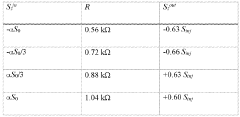
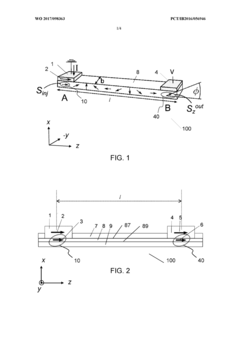
- A spin-orbit coupled device with a confinement part and circuitry that subjects charge carriers to non-linear spin-orbit interactions, allowing for rotation of spin-polarizations based on momenta and conversion of electrical current into spin-polarizations, and a spin-amplification system that utilizes a spin-to-current converter to inject and amplify spin-polarizations.


A spintronic device having a carbon nanotube array-based spacer layer and method of forming same
PatentWO2006022859A2
Innovation
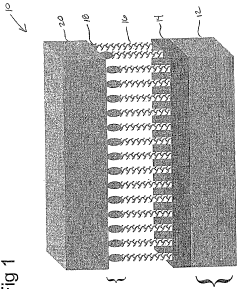
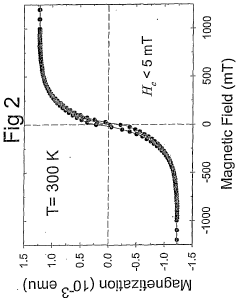
- The development of spintronic devices utilizing arrays of vertically aligned carbon nanotubes as nonmagnetic spacer layers, which allows for large-scale production and maintains high spin coherence, enabling the creation of multilayered hybrid magnetic/CNT devices with ferromagnetic layers acting as spin polarizers and analyzers.
Energy Efficiency and Sustainability Implications
The integration of spintronic devices into advanced robotics systems represents a significant breakthrough in addressing energy efficiency challenges that have long plagued the robotics industry. Conventional robotic systems rely heavily on traditional semiconductor technologies that consume substantial power, particularly during complex computational tasks and continuous operation. Spintronic devices, by leveraging electron spin rather than charge for information processing, fundamentally transform the energy consumption paradigm in robotic applications.
Energy consumption metrics reveal that spintronic-based memory and processing units can achieve power reductions of up to 70-90% compared to conventional CMOS technologies. This dramatic improvement stems from the non-volatile nature of spintronic memory, which eliminates standby power consumption—a critical advantage for autonomous robots operating in remote or resource-constrained environments. The reduced heat generation also minimizes the need for cooling systems, further decreasing the overall energy footprint.
From a sustainability perspective, the materials science underlying spintronics offers significant environmental advantages. Many spintronic devices utilize more abundant elements compared to rare earth materials required in certain conventional electronics. This shift reduces dependence on environmentally destructive mining practices and potentially volatile supply chains. Additionally, the extended operational lifespan of spintronic components—estimated at 3-5 times longer than conventional alternatives—directly contributes to reduced electronic waste generation.
The energy harvesting capabilities inherent in certain spintronic designs present another sustainability dimension. Advanced spintronic sensors can capture ambient energy from mechanical vibrations, thermal gradients, and electromagnetic fields present in robotic operational environments. This energy scavenging capability creates possibilities for partially self-powered robotic systems, particularly beneficial for long-duration missions in remote locations.
Carbon footprint analyses indicate that widespread adoption of spintronic technologies in robotics could contribute to significant greenhouse gas emission reductions across industrial sectors. Manufacturing processes for spintronic devices typically require fewer chemical processes and lower temperature requirements than traditional semiconductor fabrication, resulting in reduced environmental impact during production phases.
The implications extend beyond individual robotic systems to entire industrial ecosystems. Energy-efficient spintronic-based robots enable more sustainable automation solutions for manufacturing, agriculture, healthcare, and environmental monitoring. The reduced energy requirements make renewable energy sources more viable for powering robotic systems, creating a virtuous cycle of sustainability improvements across technological applications.
Energy consumption metrics reveal that spintronic-based memory and processing units can achieve power reductions of up to 70-90% compared to conventional CMOS technologies. This dramatic improvement stems from the non-volatile nature of spintronic memory, which eliminates standby power consumption—a critical advantage for autonomous robots operating in remote or resource-constrained environments. The reduced heat generation also minimizes the need for cooling systems, further decreasing the overall energy footprint.
From a sustainability perspective, the materials science underlying spintronics offers significant environmental advantages. Many spintronic devices utilize more abundant elements compared to rare earth materials required in certain conventional electronics. This shift reduces dependence on environmentally destructive mining practices and potentially volatile supply chains. Additionally, the extended operational lifespan of spintronic components—estimated at 3-5 times longer than conventional alternatives—directly contributes to reduced electronic waste generation.
The energy harvesting capabilities inherent in certain spintronic designs present another sustainability dimension. Advanced spintronic sensors can capture ambient energy from mechanical vibrations, thermal gradients, and electromagnetic fields present in robotic operational environments. This energy scavenging capability creates possibilities for partially self-powered robotic systems, particularly beneficial for long-duration missions in remote locations.
Carbon footprint analyses indicate that widespread adoption of spintronic technologies in robotics could contribute to significant greenhouse gas emission reductions across industrial sectors. Manufacturing processes for spintronic devices typically require fewer chemical processes and lower temperature requirements than traditional semiconductor fabrication, resulting in reduced environmental impact during production phases.
The implications extend beyond individual robotic systems to entire industrial ecosystems. Energy-efficient spintronic-based robots enable more sustainable automation solutions for manufacturing, agriculture, healthcare, and environmental monitoring. The reduced energy requirements make renewable energy sources more viable for powering robotic systems, creating a virtuous cycle of sustainability improvements across technological applications.
Standardization and Interoperability Challenges
The integration of spintronic devices into advanced robotics faces significant standardization and interoperability challenges that must be addressed for widespread adoption. Currently, there exists no unified standard for spintronic components in robotic systems, creating fragmentation across the industry. Different manufacturers employ proprietary interfaces and protocols, making it difficult to integrate spintronic sensors, memory, and processing units from various vendors into cohesive robotic platforms.
This lack of standardization manifests in multiple technical dimensions. At the hardware level, inconsistent form factors, pin configurations, and power requirements create physical integration barriers. Signal processing standards vary widely, with different voltage thresholds, timing parameters, and communication protocols complicating the development of universal controllers for spintronic components.
Data format incompatibilities present another layer of complexity. The diverse encoding schemes for magnetic state information and spin-based computation results require extensive translation layers, reducing efficiency and increasing system complexity. These interoperability issues significantly increase development costs and time-to-market for advanced robotic systems incorporating spintronic technology.
Industry consortia have begun addressing these challenges through preliminary standardization efforts. The IEEE Magnetics Society and the International Electrotechnical Commission (IEC) have established working groups focused on spintronic device specifications. However, these initiatives remain in early stages, with competing approaches still under consideration.
The robotics industry faces a classic standards war scenario, where early market entrants attempt to establish their proprietary solutions as de facto standards. This competition, while driving innovation, simultaneously hinders the development of a unified ecosystem necessary for spintronic robotics to achieve mainstream adoption.
Cross-disciplinary collaboration presents additional challenges. Spintronic device engineers often operate with different technical vocabularies and design philosophies compared to robotics specialists. This communication gap impedes effective integration and slows the development of optimized solutions that leverage the unique capabilities of spintronic technology.
Regulatory frameworks add further complexity, as safety standards for magnetic field emissions, data security protocols for spintronic memory, and certification requirements vary across global markets. Navigating this regulatory landscape requires significant resources that smaller innovators may struggle to access.
This lack of standardization manifests in multiple technical dimensions. At the hardware level, inconsistent form factors, pin configurations, and power requirements create physical integration barriers. Signal processing standards vary widely, with different voltage thresholds, timing parameters, and communication protocols complicating the development of universal controllers for spintronic components.
Data format incompatibilities present another layer of complexity. The diverse encoding schemes for magnetic state information and spin-based computation results require extensive translation layers, reducing efficiency and increasing system complexity. These interoperability issues significantly increase development costs and time-to-market for advanced robotic systems incorporating spintronic technology.
Industry consortia have begun addressing these challenges through preliminary standardization efforts. The IEEE Magnetics Society and the International Electrotechnical Commission (IEC) have established working groups focused on spintronic device specifications. However, these initiatives remain in early stages, with competing approaches still under consideration.
The robotics industry faces a classic standards war scenario, where early market entrants attempt to establish their proprietary solutions as de facto standards. This competition, while driving innovation, simultaneously hinders the development of a unified ecosystem necessary for spintronic robotics to achieve mainstream adoption.
Cross-disciplinary collaboration presents additional challenges. Spintronic device engineers often operate with different technical vocabularies and design philosophies compared to robotics specialists. This communication gap impedes effective integration and slows the development of optimized solutions that leverage the unique capabilities of spintronic technology.
Regulatory frameworks add further complexity, as safety standards for magnetic field emissions, data security protocols for spintronic memory, and certification requirements vary across global markets. Navigating this regulatory landscape requires significant resources that smaller innovators may struggle to access.
Unlock deeper insights with PatSnap Eureka Quick Research — get a full tech report to explore trends and direct your research. Try now!
Generate Your Research Report Instantly with AI Agent
Supercharge your innovation with PatSnap Eureka AI Agent Platform!