A Linear Minimum Mean Square Error Estimation Method Based on Noise Enhancement

A minimum mean square error and mean square error technology, applied in the field of noise enhancement and linear minimum mean square error estimation, can solve the problems of small channel capacity, detection performance and estimation accuracy degradation, etc.

CN107832268BActive Publication Date: 2020-11-03CHONGQING UNIV
3 Cites 0 Cited by

Patent Information

Authority / Receiving Office
CN · China
Patent Type
Patents(China)
Current Assignee / Owner
Publication Date
2020-11-03

Smart Images

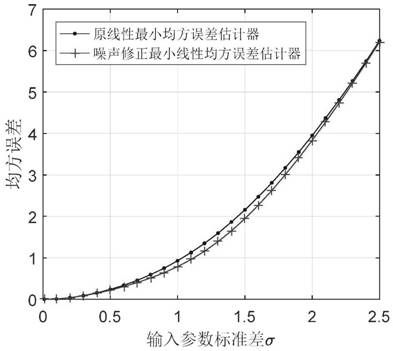
  • Figure 1
    Figure 1
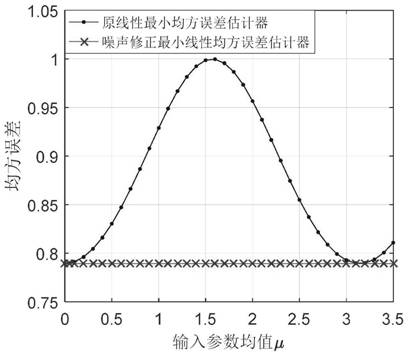
  • Figure 2
    Figure 2
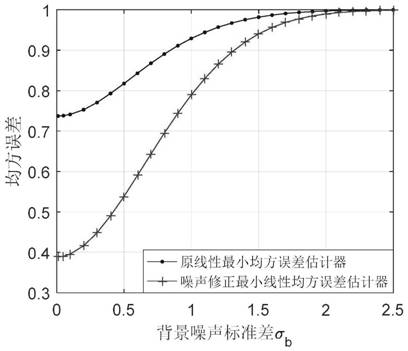
  • Figure 3
    Figure 3
Patent Text Reader

Abstract

The invention discloses a linear minimum mean square error estimation method based on noise enhancement. It belongs to the field of signal processing. It is a linear estimation method that combines noise enhancement and a linear minimum mean square error estimation method. First add additive noise independent of the nonlinear system input signal, and obtain the nonlinear system output signal after the noise is added after the nonlinear system, and then use the nonlinear system output signal to perform linear minimum mean square error estimation on the input parameters , establish a noise-enhanced parameter estimation model, and finally solve the optimal additive noise under the model, and obtain the parameter estimation under the optimal additive noise. The invention combines the noise enhancement with the linear minimum mean square error estimation method, and achieves the purpose of further reducing the minimum mean square error generated when the system output signal linearly estimates the input parameters by adding noise to the nonlinear system input.
Need to check novelty before this filing date? Find Prior Art

Description

technical field

[0001] The invention belongs to the field of signal processing, in particular to noise enhancement and linear minimum mean square error estimation. Background technique

[0002] Noise is everywhere, and understanding and mastering the distribution and performance of noise is a very important issue. In classical signal processing, noise is viewed as an unwanted signal or disturbance to a system. More noise in the system will lead to smaller channel capacity, thus degrading the detection performance and estimation accuracy. However, the impact of noise on the system is not all negative. Under certain conditions, noise can positively enhance the signal and system through the nonlinear system, which is called noise enhancement phenomenon. With the in-depth exploration and application research on noise enhancement in recent years, the important role played by noise enhancement in signal detection and estimation has gained more and more attention and affirmation....

Examples

Embodiment Construction

[0031] The present invention will be further described below in conjunction with the examples, but it should not be understood that the scope of the subject of the present invention is limited to the following examples. Without departing from the above-mentioned technical ideas of the present invention, various replacements and changes made according to common technical knowledge and conventional means in this field shall be included in the protection scope of the present invention.

[0032] This embodiment discloses a noise-enhanced linear minimum mean square error estimation method, including the following steps:

[0033] (1) Establish a noise enhancement parameter estimation model:

[0034] Nonlinear system input signal x=θ+v, where θ is a useful input parameter to be estimated, and the value of θ is determined by its probability density function p θ (θ) determined, v represents the background noise, and its probability density function is p v (v).

[0035] First, add ...