
Breeding method of donkeys in northern farming-grazing miscellaneous zone
A technology of farming and animal husbandry staggered belt and house feeding, which is applied in animal husbandry, animal feed, animal feed and other directions, can solve the problems affecting the development of the donkey industry, the survival rate of the donkey foal is not high, and the infertility of repeated mating can improve the immunity of the body. strength and lactation, improve reproductive survival rate, and ensure the effect of growth and development
Patent Information
- Authority / Receiving Office
- CN · China
- Patent Type
- Applications(China)
- Current Assignee / Owner
- Publication Date
- 2020-11-10
Smart Images

Figure 1 
Figure 2 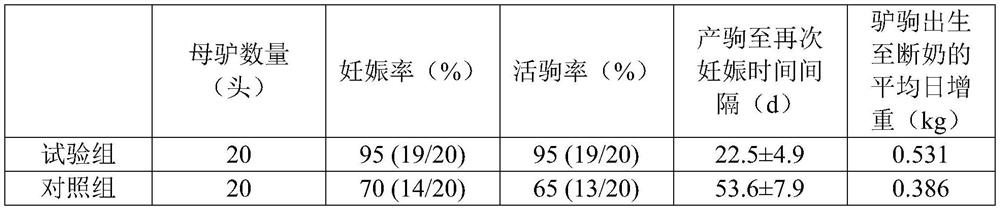
Figure 3
Abstract
Description
technical field
[0001] The invention belongs to the technical field of livestock breeding, and in particular relates to a method for raising donkeys with interlaced farming and animal husbandry in northern China. Background technique
[0002] Donkeys are monogastric herbivorous domestic animals with a gentle temperament, easy to be tamed, strong endurance, small strides, fast movement, excellent pulling power, long continuous working life, and excellent service performance. Donkey meat is delicious, tender and juicy, and has therapeutic and health effects. Donkey skin is the only legal raw material for making donkey-hide gelatin, a traditional Chinese medicine, and has important medicinal value. The composition and protein types of donkey milk are close to those of human milk, and it has the characteristics of low fat, high milk protein, and high lactose. Dwarf donkeys and miniature donkeys can be used as companion donkeys because of their small and docile bodies. Donkeys...
Examples
Embodiment 1
[0035] A method for raising donkeys with interlaced farming and animal husbandry in northern China, comprising:
[0036]The stages of feeding in stages are divided into four stages: 1-3 months of pregnancy, 4-9 months of pregnancy, 10 months of pregnancy to the 15th day before the expected date of delivery, and four stages from the 15th day before the expected date of delivery to the day of foaling. Among them, the concentrate feed for 1-3 months of pregnancy accounts for 18% of the total weight of the diet, and the protein content of the whole diet is 11.1%; the concentrate feed for 4-9 months of pregnancy accounts for 24% of the total weight of the diet, and the protein content of the whole diet 11.4%; from the 10th month of pregnancy to the 15th day before the expected date of delivery, the concentrate feed accounted for 29% of the total weight of the diet, and the protein content of the whole diet was 11.7%; 30% reduction on the basis of the previous stage.
[0037] The f...
Embodiment 2
[0067] A method for raising donkeys with interlaced farming and animal husbandry in northern China, comprising:
[0068] The stages of feeding in stages are divided into four stages: 1-3 months of pregnancy, 4-9 months of pregnancy, 10 months of pregnancy to the 15th day before the expected date of delivery, and four stages from the 15th day before the expected date of delivery to the day of foaling. Among them, the concentrate feed for 1-3 months of pregnancy accounts for 19% of the total weight of the diet, and the protein content of the whole diet is 11.2%; the concentrate feed for 4-9 months of pregnancy accounts for 25% of the total weight of the diet, and the protein content of the whole diet 11.5%; from the 10th month of pregnancy to the 15th day before the expected date of delivery, the concentrate feed accounted for 30% of the total weight of the diet, and the protein content of the whole diet was 11.8%; It is reduced by 32% on the basis of the previous stage.
[006...
Embodiment 3
[0099] A method for raising donkeys with interlaced farming and animal husbandry in northern China, comprising:
[0100] The stages of feeding in stages are divided into four stages: 1-3 months of pregnancy, 4-9 months of pregnancy, 10 months of pregnancy to the 15th day before the expected date of delivery, and four stages from the 15th day before the expected date of delivery to the day of foaling. Among them, the concentrate feed for 1-3 months of pregnancy accounts for 20% of the total weight of the diet, and the protein content of the whole diet is 11.3%; the concentrate feed for 4-9 months of pregnancy accounts for 26% of the total weight of the diet, and the protein content of the whole diet 11.6%; from the 10th month of pregnancy to the 15th day before the expected date of delivery, the concentrate feed accounted for 31% of the total weight of the diet, and the protein content of the whole diet was 11.9%; 35% reduction on the basis of the previous stage.
[0101] The ...