
Nano-focusing X ray lens combination
A combined lens and nano-focusing technology, which is applied in the field of X-ray microstructured optical devices, can solve the problems of unsatisfactory lens focusing performance, poor light-gathering ability of the combined lens, and low X-ray radiation transmittance, and achieve an increase in light-gathering aperture , small material restrictions, good focus spot quality
Patent Information
- Authority / Receiving Office
- CN · China
- Patent Type
- Applications(China)
- Current Assignee / Owner
- Publication Date
- 2008-07-16
- Estimated Expiration
- Not applicable · inactive patent
Smart Images
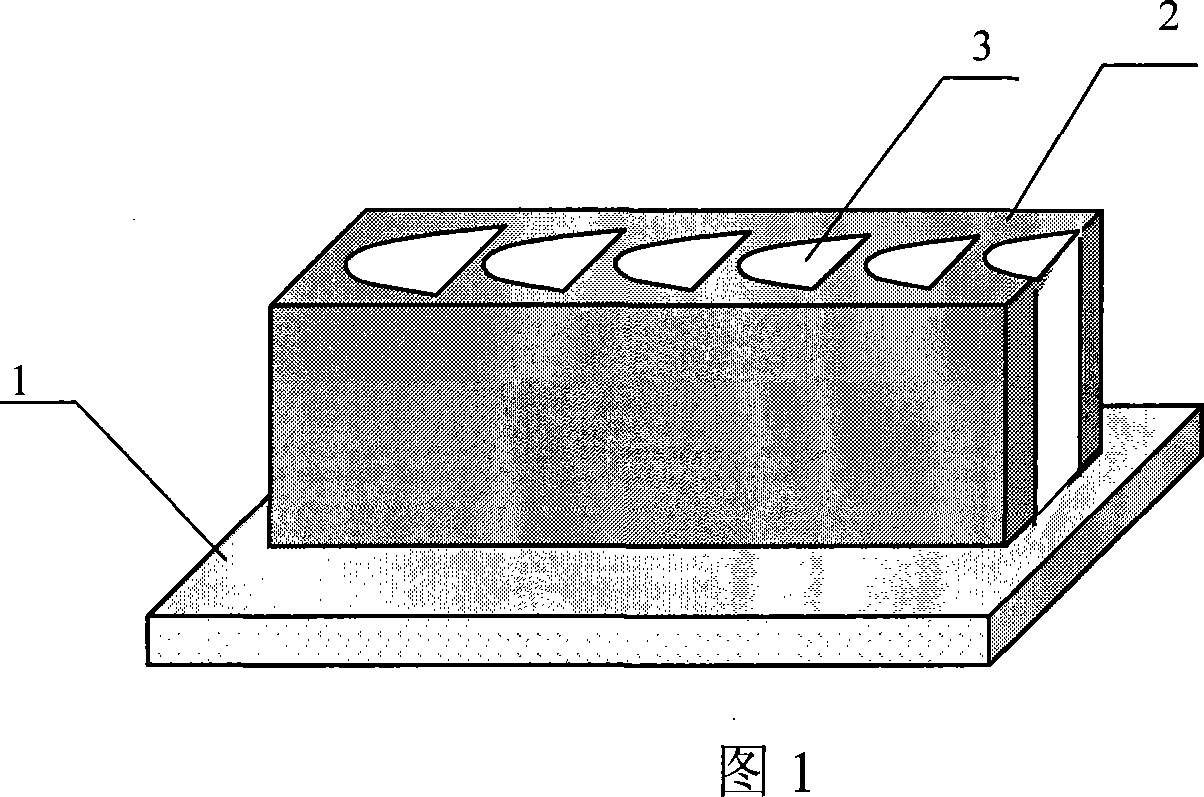
Figure 1
Abstract
Description
(1) Technical field
[0001] The invention belongs to an X-ray microstructure optical device, in particular to a microstructure X-ray optical device capable of focusing X-rays at a nanometer scale, and is suitable for one-dimensional focusing and imaging of high-energy X-ray band (>5keV) radiation. (2) Background technology
[0002] X-ray composite lens is an X-ray microstructure optical device based on refraction effect proposed by A. Snigirev in 1996, which is suitable for high-energy X-ray band (that is, X-ray radiation energy exceeds 5keV). It has the advantages of no need to bend the optical path, good high temperature stability and easy cooling, simple and compact structure, and low requirements on the surface roughness of the lens. It has broad application prospects in the field of ultra-high resolution X-ray diagnostic science and technology. In recent years, research on various X-ray diagnostic techniques based on X-ray combined lenses is very active. For example...
Examples
Embodiment 1
[0018] As shown in Figure 1, a nano-focusing X-ray composite lens includes a lens body 2, a substrate 1 located below the lens body, and a plurality of through-hole air gaps 3 arranged in a straight line sequence are opened on the lens body , each through-hole-shaped air gap forms a refractive unit of a combined lens together with the lens main body material, the cross-sectional shape of the air gap is elliptical, and the maximum diameter of the air gap corresponding to the short axis of the ellipse is smaller than the short axis of the ellipse , the long axis of the ellipse corresponding to the air gap is on the same straight line, the size of the ellipse corresponding to the air gap decreases gradually, and they are arranged in order from large to small, and the incident X-ray beam first enters and passes through the elliptical air gap with the largest size refraction unit. The geometric aperture of the refraction unit is determined by the elliptical geometric size of its ai...
Embodiment 2
[0022] As shown in Figure 1, a nano-focusing X-ray composite lens includes a lens body 2, a substrate 1 located below the lens body, and a plurality of through-hole air gaps 3 arranged in a straight line sequence are opened on the lens body , each through-hole-shaped air gap forms a refractive unit of a combined lens together with the lens main body material, the cross-sectional shape of the air gap is elliptical, and the maximum diameter of the air gap corresponding to the short axis of the ellipse is smaller than the short axis of the ellipse , the long axis of the ellipse corresponding to the air gap is on the same straight line, the size of the ellipse corresponding to the air gap decreases gradually, and they are arranged in order from large to small, and the incident X-ray beam first enters and passes through the elliptical air gap with the largest size refraction unit. The geometric aperture of the refraction unit is determined by the elliptical geometric size of its ai...
Embodiment 3
[0026] As shown in Figure 1, a nano-focusing X-ray composite lens includes a lens body 2, a substrate 1 located below the lens body, and a plurality of through-hole air gaps 3 arranged in a straight line sequence are opened on the lens body , each through-hole-shaped air gap forms a refractive unit of a combined lens together with the lens main body material, the cross-sectional shape of the air gap is elliptical, and the maximum diameter of the air gap corresponding to the short axis of the ellipse is smaller than the short axis of the ellipse , the long axis of the ellipse corresponding to the air gap is on the same straight line, the size of the ellipse corresponding to the air gap decreases gradually, and they are arranged in order from large to small, and the incident X-ray beam first enters and passes through the elliptical air gap with the largest size refraction unit. The geometric aperture of the refraction unit is determined by the elliptical geometric size of its ai...