
Hot rolled ferrite/martensite double phase steel and production method thereof
A hot-rolled dual-phase steel and production method technology, applied in the field of steel rolling, can solve the problems of high production cost and complicated process of hot-rolled ferrite/martensitic dual-phase steel, reduce the difficulty of surface quality control, and solve the problem of production The effect of high cost and excellent comprehensive mechanical properties
Patent Information
- Authority / Receiving Office
- CN · China
- Patent Type
- Applications(China)
- Current Assignee / Owner
- Publication Date
- 2012-06-27
- Estimated Expiration
- Not applicable · inactive patent
Smart Images
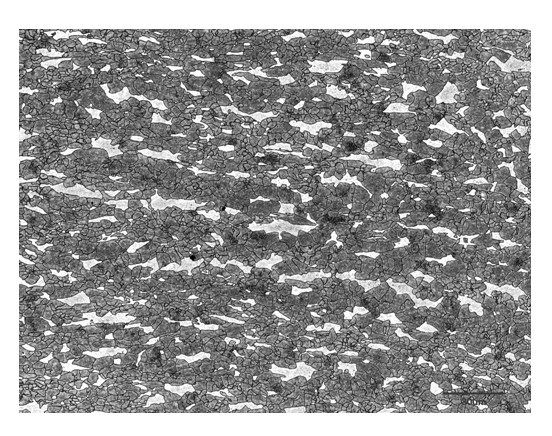
Figure 1
Abstract
Description
technical field
[0001] The invention relates to the field of steel rolling, in particular to a hot-rolled dual-phase steel with a tensile strength of 780 MPa and a production method thereof. Background technique
[0002] In recent years, with the development of automobiles in the direction of energy saving, weight reduction and safety, hot-rolled dual-phase steel has been widely used in the manufacture of automobile reinforcement plates due to its high strength, fatigue resistance, high hole expansion performance and high formability , wheels, chassis, bumpers, various frames of the car body and other components. Under the ULSAB program, most high-strength automotive panels are made of duplex steel.
[0003] At present, the composition of ferritic-martensitic dual-phase steel disclosed in published patent documents and other documents has the following characteristics: (1) adding more Si elements and Al elements, the functions include expanding the ferrite transformation zo...
Examples
Embodiment 1
[0024] The smelted molten steel conforming to the composition scheme described in Component 1 in Table 1 was cast into billets, and then the billets were heated up to 1200°C with the furnace and kept for 0.5h before rolling. Among them, the starting rolling temperature of the austenite recrystallization zone is 1180°C, and the deformation amount is 65%; the starting rolling temperature of the austenite non-recrystallization zone is 930°C, the billet deformation amount is 35%, and the final rolling temperature is 800°C. After the steel plate is rolled, it is warmed in the air. After the temperature reaches 600°C, water cooling is started. The cooling rate of water cooling is 45°C / s, and it is cooled to 300°C, reaching the coiling temperature, and then coiled.
Embodiment 2
[0026] The smelted molten steel conforming to the composition scheme described in component 2 in Table 1 was cast into billets, and then the billets were heated up to 1200°C with the furnace and kept for 0.5h before rolling. Among them, the starting rolling temperature of the austenite recrystallization zone is 1150°C, and the deformation is 60%; the starting rolling temperature of the austenite non-recrystallization zone is 910°C, the billet deformation is 40%, and the final rolling temperature is 780°C. After the steel plate is rolled, it is warmed in the air. After the temperature reaches 580°C, water cooling is started. The cooling rate of water cooling is 50°C / s, and it is cooled to 250°C, reaching the coiling temperature, and then coiled.
Embodiment 3
[0028] The smelted molten steel conforming to the composition scheme described in Component 3 in Table 1 was cast into billets, and then the billets were heated up to 1200°C with the furnace and kept for 0.5h for rolling. Among them, the starting rolling temperature of the austenite recrystallization zone is 1100°C, the deformation amount is 50%; the starting rolling temperature of the austenite non-recrystallization zone is 910°C, the billet deformation amount is 50%, and the final rolling temperature is 750°C. After the steel plate is rolled, it is warmed in the air. After the temperature reaches 550°C, water cooling is started. The cooling rate of water cooling is 60°C / s, and it is cooled to 210°C, reaching the coiling temperature, and then coiled.