
New process of amino G acid ammonification production
A new process, amino technology, applied in the new process field of amino G acid ammoniation production, can solve the problems of low solubility of liquid ammonia, hydrolysis side reactions, low conversion rate, etc., and achieve the effect of high safety factor
Patent Information
- Authority / Receiving Office
- CN · China
- Current Assignee / Owner
- Publication Date
- 2014-09-10
- Estimated Expiration
- Not applicable · inactive patent
Smart Images
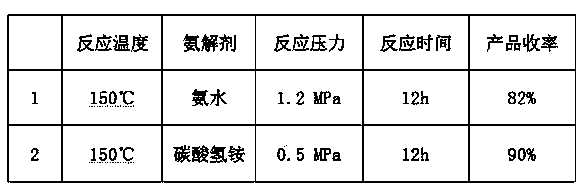
Figure 1
Abstract
Description
technical field
[0001] The invention relates to a new ammonification production process of amino G acid, which belongs to the field of organic chemistry. Background technique
[0002] Amino G acid (2-naphthylamine-6,8-disulfonic acid) is an important dye intermediate, industrially using amino G acid can synthesize a variety of dyes, such as CI direct orange 74, CI media yellow 80, CI acid red 47 etc. It can also be used as raw material to synthesize R acid through alkali fusion reaction, or synthesize 2-naphthylamine-3,6,8-trisulfonic acid (K acid) through sulfonation reaction, and further synthesize 2R acid through alkali fusion reaction. At present, the ammoniation of amino G acid is usually synthesized by the pressurized ammoniation reaction of G salt. The ammonia solution agent uses ammonia water, and ammonium bisulfite is used as a catalyst. The pressure of the ammoniation reaction is as high as 1.2MPa, which requires high requirements on the reactor and safety factor....
Examples
Embodiment 1
[0021] In a 5000L stainless steel ammoniation reaction kettle, add 1000L of water, 350 kg of ammonium bicarbonate, and 1600 kg of ammonium 6,8-naphthalene disulfonate (G salt), start stirring and open the jacket to freeze the water in the pot The internal temperature was lowered to 25° C., and the stirring was maintained for 15 minutes, and the stirring speed was controlled at 50 rpm. Open the jacket steam valve, slowly heat up to 60°C, at this time, the pressure in the reactor is 0.3Mpa, maintain the temperature and pressure for 2 hours, and control the stirring speed at 30 rpm. Within 60 minutes, continue to open the jacket steam valve to raise the temperature to 150° C., the pressure in the kettle is 0.5 Mpa, and maintain the temperature and pressure to react for 10 hours. After reacting for 10 hours, take a sample to analyze the ammonia content. If the content is more than 90%, it is qualified; if the ammonia content is less than 90%, it is unqualified. Continue to react u...
Embodiment 2
[0023] In a 5000L stainless steel ammoniation reaction kettle, add 1500L of water, 500 kg of ammonium bicarbonate, and 2000 kg of ammonium 6,8-naphthalene disulfonate (G salt), start stirring and open the jacket to freeze the water in the pot The internal temperature was lowered to below 25° C., and the stirring was maintained for 15 minutes, and the stirring speed was controlled at 60 rpm. Open the jacket steam valve, slowly heat up to 60°C, at this time, the pressure in the reactor is 0.3Mpa, maintain the temperature and pressure for 2 hours, and control the stirring speed at 30 rpm. Within 60 minutes, continue to open the jacket steam valve to raise the temperature to 150° C., the pressure in the kettle is 0.5 Mpa, and maintain the temperature and pressure to react for 10 hours. After reacting for 10 hours, take a sample to analyze the ammonia content. If the content is more than 90%, it is qualified; if the ammonia content is less than 90%, it is unqualified. Continue to r...
Embodiment 3
[0025] In the 5000L stainless steel ammoniation reaction kettle, add 800L of water, add 320 kg of ammonium bicarbonate, add 1300 kg of ammonium 6,8-naphthalene disulfonate (G salt), start stirring and open the jacket to freeze the water to cover the pot The internal temperature was lowered to below 25° C., and the stirring was maintained for 15 minutes, and the stirring speed was controlled at 60 rpm. Open the steam valve of the jacket, slowly heat up to 60°C, at this time, the pressure in the reactor is 0.3Mpa, maintain the temperature and pressure for 2 hours, and control the stirring speed at 30 rpm. Within 60 minutes, continue to open the jacket steam valve to raise the temperature to 150° C., the pressure in the kettle is 0.5 Mpa, and maintain the temperature and pressure to react for 10 hours. After reacting for 10 hours, take a sample to analyze the ammonia content. If the content is more than 90%, it is qualified; if the ammonia content is less than 90%, it is unqualif...