
Heat treatment carburizing process of carburizing steel
A carburizing steel and carburizing technology, which is applied in the field of heat treatment of metal materials, can solve problems such as the inability to meet the service performance requirements, and achieve the effects of avoiding carbide coarsening, increasing carbide size, and improving wear resistance.
Patent Information
- Authority / Receiving Office
- CN · China
- Patent Type
- Patents(China)
- Current Assignee / Owner
- Publication Date
- 2017-09-19
Smart Images
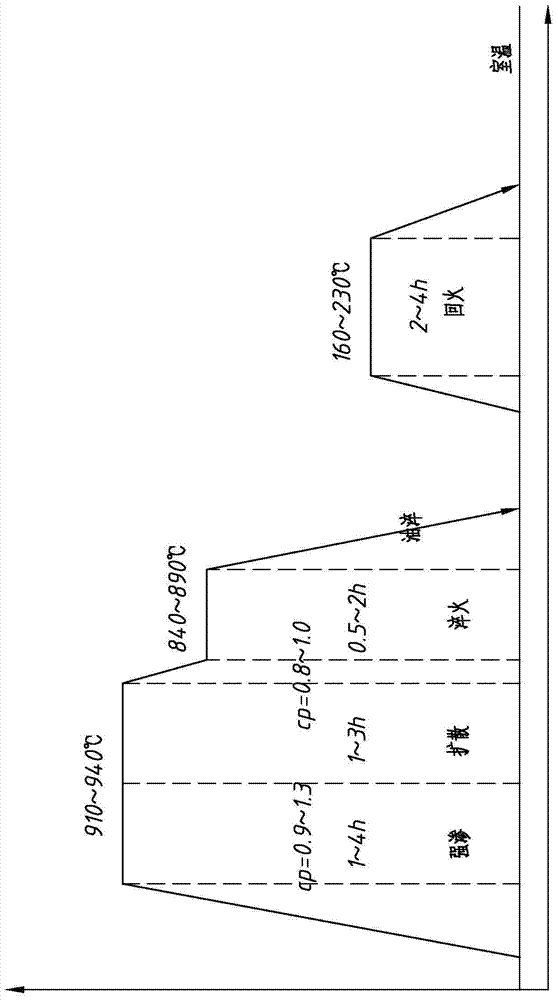
Figure 1 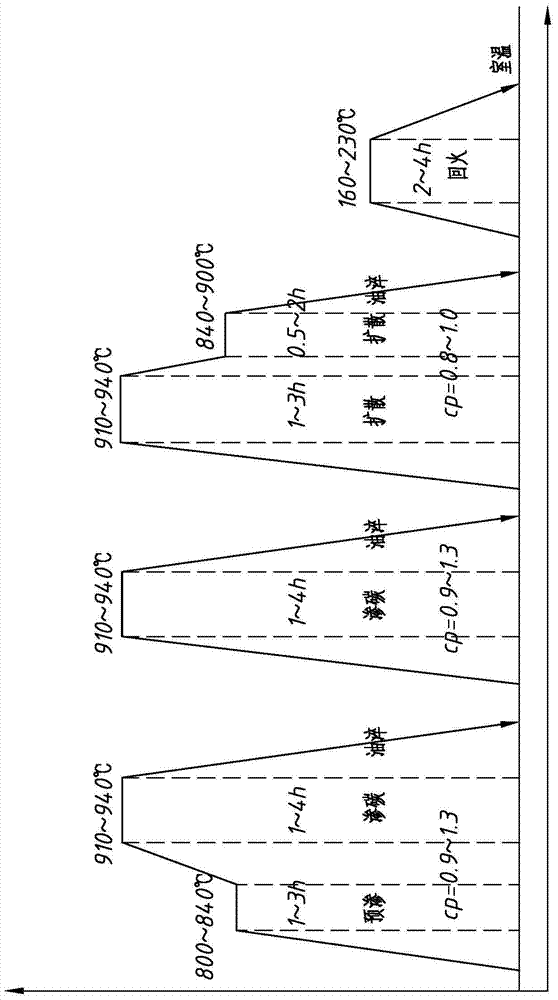
Figure 2 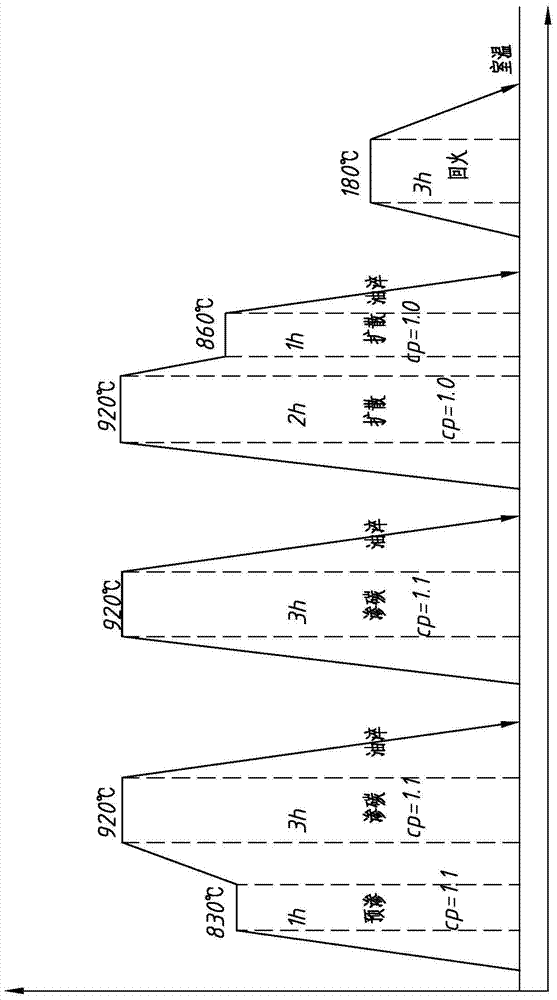
Figure 3
Abstract
Description
technical field
[0001] The invention relates to a heat treatment process for metal materials, specifically a heat treatment and carburization process for carburized steel. Background technique
[0002] Due to the particularity of the working environment of bearing parts, many bearings have requirements for wear resistance while being able to withstand impact loads.
[0003] In order to meet the requirements of the above working conditions, the bearing needs the material (carbon steel) to be carburized and heat treated; carburizing: it is a kind of metal surface treatment, so that the activated carbon atoms decomposed in the carburizing medium penetrate into the surface of the steel part, In order to obtain high carbon on the surface, the heart still maintains the original composition. This is a common heat treatment process for metal materials, which can make the surface of the carburized workpiece obtain high hardness and improve its wear resistance.
[0004] In conventio...
Examples
Embodiment 1
[0025] according to image 3 The process curve diagram proceeds:
[0026] (1) Pre-carburization: 1h pre-carburization at 830°C and carbon potential 1.1;
[0027] (2) Cyclic carburizing: use 920°C, carbon potential 1.1, carry out carburizing for 3 hours, and then cool in oil at 100°C; after that, use 920°C, carbon potential 1.1, carry out carburizing for 3 hours, and then in 100°C The process step of cooling in oil is cycled once to complete the cyclic carburizing with 2 cycles;
[0028] (3) Diffusion and quenching: Use 920°C, carbon potential 1.0, and carry out carburizing diffusion for 2 hours to obtain a gentle carbon concentration distribution and reduce the stress caused by carburizing heat treatment; after diffusion, cool the temperature to 860°C, carbon potential 1.0, after holding for 1 hour, quench and cool in oil at 100°C;
[0029] (4) Tempering: Tempering at 180°C for 3 hours.
[0030] After completion, use the peeling method to detect the carbide content on the ...
Embodiment 2
[0032] according to Figure 4 The process curve diagram proceeds:
[0033] (1) Pre-carburization: 800°C, carbon potential 0.9, 2h pre-carburization;
[0034] (2) Cyclic carburizing: use 910°C, carbon potential 0.9, carry out carburizing for 1h, and then cool in oil at 50°C; after that, use 910°C, carbon potential 0.9, carry out carburizing for 1h, and then in 50°C The process step of cooling in oil is cycled once to complete the cyclic carburizing with 2 cycles;
[0035] (3) Diffusion and quenching: use 910°C, carbon potential 1.0, and carry out carburizing diffusion for 2 hours to obtain a gentle carbon concentration distribution and reduce stress caused by carburizing heat treatment; after diffusion, cool the temperature to 860°C, carbon potential 1.0, after holding for 1 hour, quench and cool in oil at 100°C;
[0036] (4) Tempering: Tempering at 180°C for 3 hours.
[0037] After completion, use the peeling method to detect the carbide content on the surface: the carbide...
Embodiment 3
[0039] according to Figure 5 The process curve diagram proceeds:
[0040] (1) Pre-carburization: 840°C, carbon potential 1.3, 3h pre-carburization;
[0041] (2) Cyclic carburizing: use 940°C, carbon potential 1.3, carry out carburizing for 4 hours, and then cool in oil at 130°C; after that, use 940°C, carbon potential 1.3, carry out carburizing for 4 hours, and then in 130°C The process step of cooling in oil is cycled once to complete the cyclic carburizing with 2 cycles;
[0042] (3) Diffusion and quenching: use 940°C, carbon potential 1.0, and carry out carburizing diffusion for 2 hours to obtain a gentle carbon concentration distribution and reduce stress caused by carburizing heat treatment; after diffusion, cool the temperature to 900°C, carbon potential 0.8, after holding for 1 hour, quench and cool in oil at 100°C;
[0043] (4) Tempering: Tempering at 180°C for 3 hours.
[0044] After completion, use the peeling method to detect the carbide content on the surface:...