
A kind of method by directly synthesizing cyclohexanol by aniline hydrogenation
A technology of cyclohexanol and aniline, which is applied in the field of chemical technology, can solve the problems of complex process route, high production cost, and low efficiency of cyclohexene, and achieve the effect of simple synthesis process, cheap and easy to obtain aniline, and simple and clean reaction conditions
Patent Information
- Authority / Receiving Office
- CN · China
- Patent Type
- Patents(China)
- Current Assignee / Owner
- Publication Date
- 2017-03-01
Smart Images
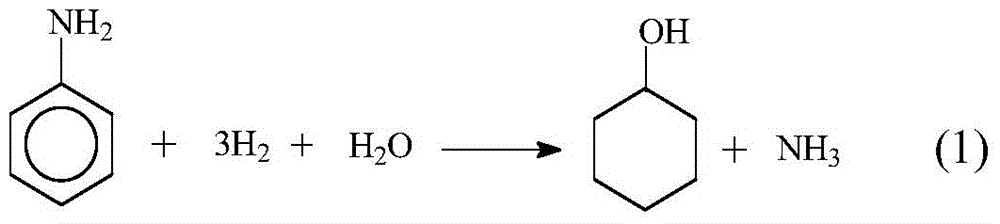
Figure 1
Abstract
Description
technical field
[0001] The invention relates to a new method for directly synthesizing cyclohexanol by hydrogenation of aniline, specifically a process for directly synthesizing cyclohexanol by using aniline as a raw material and catalyzing the hydrogenation of aniline with a supported metal catalyst, belonging to the technical field of chemical technology. Background technique
[0002] Cyclohexanol is an important organic chemical raw material and an important intermediate for the synthesis of caprolactam, adipic acid, and fine chemicals such as medicine, paint, and dye.
[0003] At present, there are generally three methods for the synthesis of cyclohexanol. (1) Using phenol as a raw material, one-step catalytic hydrogenation to prepare cyclohexanol is relatively simple, but it is limited due to the high price of phenol. (2) Using benzene as a raw material, complete hydrogenation to obtain cyclohexane, and further oxidation to obtain cyclohexanol or cyclohexanone. This i...
Examples
Embodiment 1
[0024] Add aniline 1.5g, 2% (wt) Ru / MCM-41 (molecular sieve) catalyst 0.41g, water 170ml and tert-butanol 10ml (the molar ratio is 1:0.005:583:6.5) in the autoclave successively. Pass N 2 Make a replacement. Then the temperature was raised to 180° C., and then hydrogen gas was introduced until the reaction pressure was 4.4 MPa. After 8 hours of reaction, the hydrogen gas flow was stopped and the temperature was lowered. The catalyst and the reaction solution were separated by filtration under reduced pressure, and the reaction solution was extracted and separated by toluene to obtain an organic phase, which was analyzed by gas chromatography. The yield of product cyclohexanol was 99.6% according to quantitative calculation.
Embodiment 2
[0026] Add 1.5g of aniline, 0.41g of 2% Ru / AC catalyst, 170ml of water and 10ml of tert-butanol (the molar ratio is 1:0.005:583:6.5) in the autoclave. Pass N 2 Make a replacement. Then the temperature was raised to 180° C., and then hydrogen gas was introduced until the reaction pressure was 4.4 MPa. After 8 hours of reaction, the hydrogen gas flow was stopped and the temperature was lowered. The catalyst and the reaction solution were separated by filtration under reduced pressure, and the reaction solution was extracted and separated by toluene to obtain an organic phase, which was analyzed by gas chromatography. The yield of the product cyclohexanol by quantitative calculation is 99.9%.
Embodiment 3
[0028] In the autoclave, add aniline 1.5g, 2%Ru / SiO 2 Catalyst 0.41g, water 170ml and tert-butanol 10ml (the molar ratio is 1:0.005:583:6.5). Pass N 2 Make a replacement. Then the temperature was raised to 180° C., and then hydrogen gas was introduced until the reaction pressure was 4.4 MPa. After 8 hours of reaction, the hydrogen gas flow was stopped and the temperature was lowered. The catalyst and the reaction solution were separated by filtration under reduced pressure, and the reaction solution was extracted and separated by toluene to obtain an organic phase, which was analyzed by gas chromatography. The yield of product cyclohexanol was 99.6% according to quantitative calculation.