
Method for directly synthesizing cyclohexanone by hydrogenation of aniline
A technology of cyclohexanone and aniline, applied in the field of chemical technology, can solve the problems of high production cost, low efficiency of cyclohexene, complicated process route, etc., and achieves the effects of cheap and easy-to-obtain aniline, mild reaction conditions and simple synthesis process.
Patent Information
- Authority / Receiving Office
- CN · China
- Patent Type
- Patents(China)
- Current Assignee / Owner
- Publication Date
- 2015-10-28
Smart Images
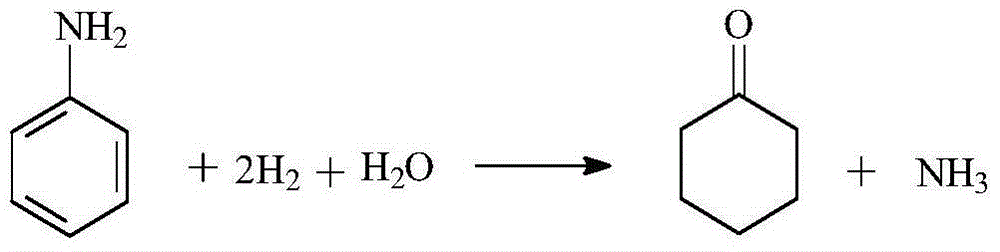
Figure 1
Abstract
Description
technical field
[0001] The invention relates to a method for directly synthesizing cyclohexanone by aniline hydrogenation, belonging to the technical field of chemical technology. Background technique
[0002] Cyclohexanone is the main intermediate for the preparation of caprolactam and adipic acid. It is also an important organic chemical raw material and industrial solvent. It is used in industries such as medicine, paint, coating, rubber and pesticides. In addition, it also has a great role in the recycling of printing and plastics. Dosage.
[0003] At present, there are three main industrial production process routes of cyclohexanone in the world according to raw materials: cyclohexane liquid phase oxidation (U.Schuchardt, D. Cardoso, R. Sercheli, et al. "Cyclohexane oxidation continues to be a challenge", Applied Catalysis A: General, 2001, 211 (1): 1-17), phenol hydrogenation method (L.M.Sikhwivhilu, N.J.Coville, D.Naresh, et al. "Nanotubular titanate supported pallad...
Examples
Embodiment 1
[0033] In the autoclave, add aniline 0.37g successively, the Pd / MCM-41 (molecular sieve) catalyst 0.78g that loading capacity is mass percent 2%, AlCl 3 N 2 Make a replacement. Then raise the temperature to 80°C, and then feed hydrogen to the reaction pressure of 1.3MPa and keep it. After 1 hour of reaction, stop the hydrogen flow, cool down to room temperature, and filter and separate the catalyst and the reaction solution under reduced pressure. The reaction solution is extracted and separated by toluene to obtain an organic phase. , and the organic phase was analyzed by gas chromatography. The yield of the product cyclohexanone was quantitatively calculated to be 56.4%.
Embodiment 2~5
[0035] The same operation steps and reaction conditions as in the process of synthesizing cyclohexanone in Example 1, the active metals of the catalyst were changed to Ru, Rh, Pt, Au respectively. The organic phase was analyzed by gas chromatography, and the yield of the product cyclohexanone was quantitatively calculated. The experimental results are shown in Table 1.
[0036] The impact of table 1 catalyst active metal on the synthetic cyclohexanone reaction
[0037] Example
Embodiment 6~10
[0039] The operating steps and reaction conditions of the synthetic cyclohexanone process in Example 1 are the same, and the carrier of the catalyst is changed to AC, γ-Al 2 o 3 , TS-1, HZSM-5, SBA-15, etc. The organic phase was analyzed by gas chromatography, and the yield of the product cyclohexanone was quantitatively calculated. The experimental results are shown in Table 2.
[0040] The impact of table 2 catalyst carrier on the synthetic cyclohexanone reaction
[0041] Example