
Actuator based on stimulating tympanic membrane and its hearing aid
A hearing aid device and actuator technology, applied in the field of hearing aid devices and actuators for the treatment of hearing loss, can solve problems such as difficulty in fitting, inability to ensure the fit of the ear canal, and easy blocking of the ear.
Patent Information
- Authority / Receiving Office
- CN · China
- Patent Type
- Patents(China)
- Current Assignee / Owner
- Publication Date
- 2017-11-17
Smart Images
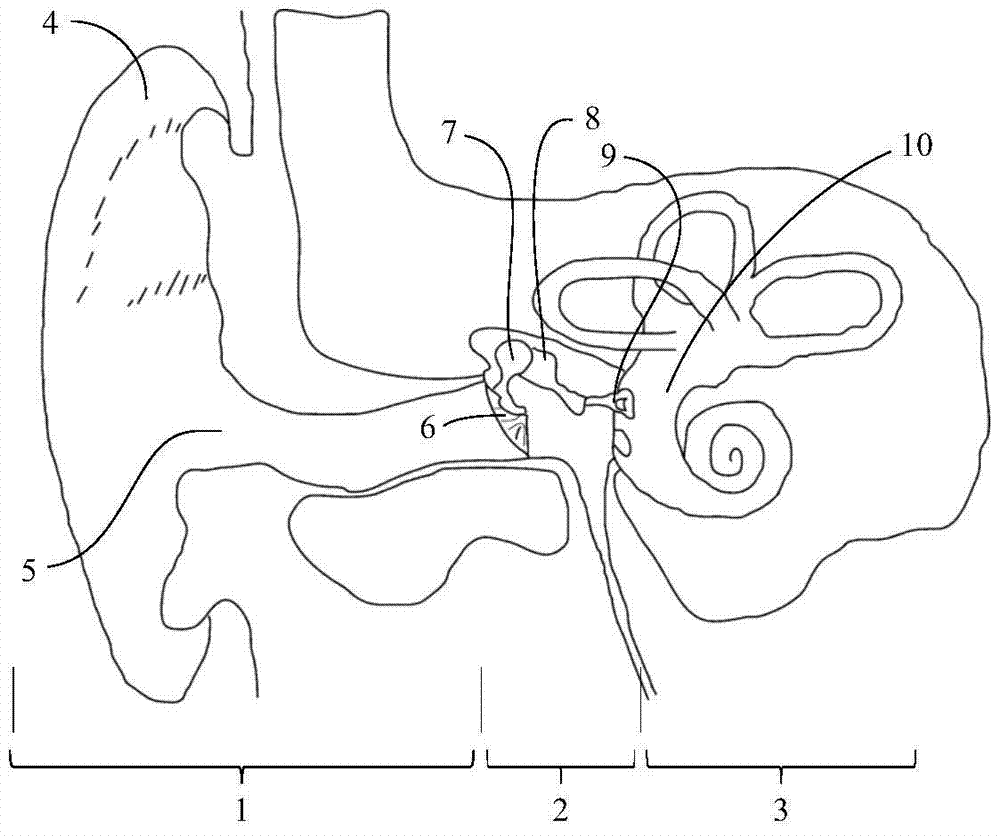
Figure 1 
Figure 2 
Figure 3
Abstract
Description
technical field
[0001] The invention relates to an actuator for treating hearing loss and a hearing aid device using the actuator, which is used for directly exciting the tympanic membrane to compensate for hearing loss. Background technique
[0002] Sensorineural deafness is the most common type of hearing loss, and it is one of the most common diseases in my country. There are many reasons, such as congenital, high-intensity noise, etc. For some hearing-impaired patients, hearing aids can be used to improve or restore hearing, but traditional hearing aids have many problems: poor sound quality; only mild to moderate sensorineural hearing loss; output sound signals and ear canal feedback The sound signal of the patient is prone to aliasing, which reduces the clarity of the sound signal that the patient finally feels.
[0003] In response to the above problems, domestic and foreign research institutions and researchers have begun to study mechanically stimulated implantabl...
Examples
Embodiment Construction
[0051] The present invention will be further described below in conjunction with the accompanying drawings.
[0052] Such as figure 1 It is a schematic diagram of the human ear structure, showing the cross sections of the outer ear 1 , the middle ear 2 and the inner ear 3 . Among them, the outer ear 1 mainly includes the auricle 4 and the ear canal 5; the middle ear 2 includes the tympanic membrane (eardrum) 6 and the ossicular chain. The ossicular chain consists of three tiny interconnected bones (ossicles), the malleus7, the incus8 and the stapes9. The malleus 7 is attached to the eardrum 6, while the stapes 9, the last bone in the ossicular chain, is coupled to the cochlea 10 of the inner ear. In the normal auditory system, the pinna 4 of the outer ear 1 collects pressure fluctuations in the external air, and transmits them to the tympanic membrane 6 through the ear canal 5, causing the vibration of the tympanic membrane 6 and the ossicular chain in the middle ear 2 syste...