
Application of ammonia gas in sofc battery and its application device
A technology of ammonia gas and batteries, which is applied in the application of ammonia gas in SOFC batteries and its application devices, can solve the problems of catalyst poisoning, fuel cell performance degradation, emissions, etc., and achieve the effect of saving energy and reducing demand
Patent Information
- Authority / Receiving Office
- CN · China
- Patent Type
- Patents(China)
- Current Assignee / Owner
- Publication Date
- 2017-09-22
- Estimated Expiration
- Not applicable · inactive patent
Smart Images
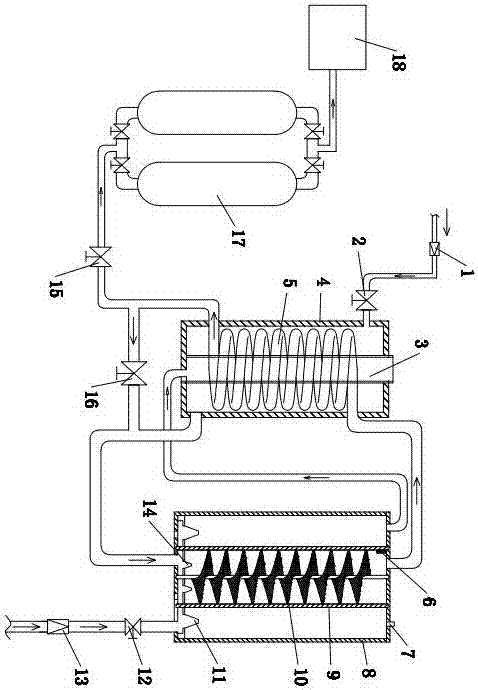
Figure 1
Abstract
Description
technical field
[0001] The invention relates to the application of ammonia gas in SOFC battery and its application device. Background technique
[0002] Now that fossil fuels are becoming increasingly depleted, people are striving to develop new energy sources. Fuel cells can use energy more efficiently without polluting the environment. Fuel cells are a new ideal power generation technology.
[0003] A fuel cell is an electrochemical reaction mainly through oxygen or other oxidants and fuel. A fuel cell is a battery that converts the chemical energy in the fuel into electrical energy. In the fuel cell, the fuel and air are respectively sent to the anode and cathode of the fuel cell. Electricity will be produced. At present, there are many different technical solutions for fuel cell power generation, such as alkaline fuel cell (AFC), proton exchange membrane fuel cell (PEMFC), phosphoric acid fuel cell (PAFC), molten carbonate fuel cell (MCFC) and solid oxide fuel cells (S...
Examples
Embodiment Construction
[0034] The specific embodiments of the present invention will be further described below in conjunction with the accompanying drawings. It should be noted here that the descriptions of these embodiments are used to help understand the present invention, but are not intended to limit the present invention. In addition, the technical features involved in the various embodiments of the present invention described below may be combined with each other as long as they do not constitute a conflict with each other.
[0035] In the description of the present invention, the terms "first", "second" and "third" are used for descriptive purposes only, and should not be understood as indicating or implying relative importance.
[0036] In the description of the present invention, the orientations or positional relationships shown by the terms "upper" and "lower" are based on the orientations or positional relationships shown in the drawings, which are only for the convenience of describing...