
A quantum dot-based biomolecule concentration detection method
A technology for biomolecules and concentration detection, applied in the direction of measuring devices, analytical materials, material excitation analysis, etc., can solve the problems that the instrument has not been marketed, it is difficult to find quantum dots, quantum dot fluorescence intensity and wavelength inhomogeneity
Patent Information
- Authority / Receiving Office
- CN · China
- Patent Type
- Patents(China)
- Current Assignee / Owner
- Publication Date
- 2020-10-27
Smart Images
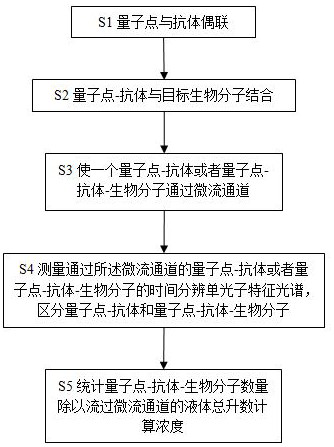
Figure 1 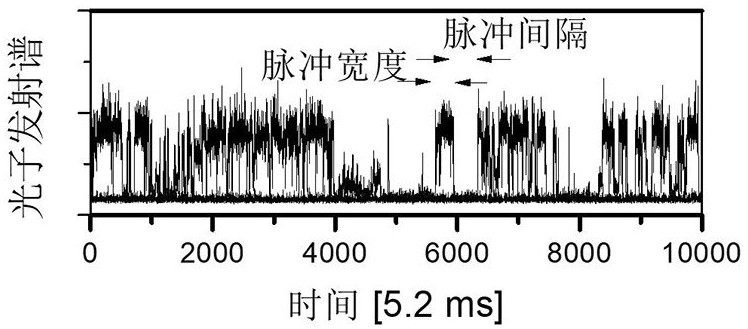
Figure 2 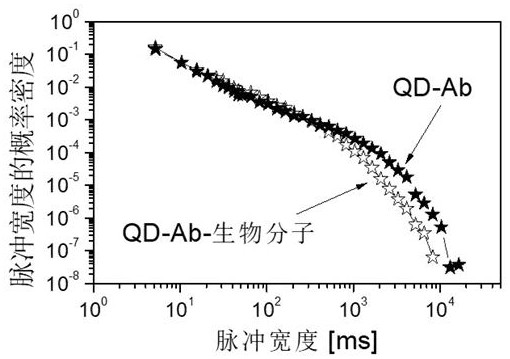
Figure 3
Abstract
Description
technical field
[0001] The invention relates to a method for detecting the concentration of biomolecules, in particular to a method for detecting the concentration of biomolecules based on quantum dots. Background technique
[0002] The rapid development of society has greatly improved people's living standards, and put forward new requirements for living hygiene and disease prediction. However, it is difficult for existing biomolecular detection methods to achieve rapid identification and measurement. Therefore, in the monitoring of bacteria such as drinking water, It is difficult to make breakthroughs in practical applications in the screening of bacterial drug resistance and the identification and quantification of cancer biomarkers. State-of-the-art methods for identifying and quantifying biomolecules at low concentrations include:
[0003] Liquid chromatography and mass spectrometry (LC-MS): LC physically separates components in a liquid solution; MS provides structura...
Examples
Embodiment 2
[0049] The method for detecting the concentration of biomolecules based on quantum dots involved in this embodiment includes the following steps:
[0050] S1. According to the water-soluble quantum dot QD surface modification (carboxyl, sulfhydryl), through different cross-linking agents and the antibody coupling of the target biomolecule to be detected:
[0051] Using the SMCC (succinimidyl 4-[N-maleimidomethyl]cycloethane-1-carboxylate Eurolink reaction to couple sulfhydryl-activated quantum dots to amino-activated antibodies for amino and sulfhydryl The covalent reaction couples the antibody and the quantum dots to form a quantum dot-antibody stock solution.
[0052] S2. Stir the quantum dot-antibody stock solution with the solution to be tested containing the target biomolecule for 20 minutes, mix and culture to combine the quantum dot-antibody with the target biomolecule, and obtain a mixture containing quantum dot-antibody and quantum dot-antibody-biomolecule solution; ...
Embodiment 3
[0059] The method for detecting the concentration of biomolecules based on quantum dots involved in this embodiment includes the following steps:
[0060] S1. According to the water-soluble quantum dot QD surface modification (carboxyl, sulfhydryl), through different cross-linking agents and the antibody coupling of the target biomolecule to be detected:
[0061] Using the SMCC (succinimidyl 4-[N-maleimidomethyl]cycloethane-1-carboxylate Eurolink reaction to couple sulfhydryl-activated quantum dots to amino-activated antibodies for amino and sulfhydryl The covalent reaction couples the antibody and the quantum dots to form a quantum dot-antibody stock solution.
[0062] S2. Stir the quantum dot-antibody stock solution with the solution to be tested containing the target biomolecule for 20 minutes, mix and culture to combine the quantum dot-antibody with the target biomolecule, and obtain a mixture containing quantum dot-antibody and quantum dot-antibody-biomolecule solution; ...