
Saliency-based rate allocation method for ctu layer in hevc full i-frame coding
A technology of bit rate allocation and frame coding, applied in the field of video coding, can solve problems such as differences in the subjective sensitivity of human eyes, and achieve the effect of reasonable target bit allocation at the frame layer, reasonable target bit allocation, and improved subjective quality.
Patent Information
- Authority / Receiving Office
- CN · China
- Patent Type
- Patents(China)
- Current Assignee / Owner
- Publication Date
- 2022-07-26
Smart Images
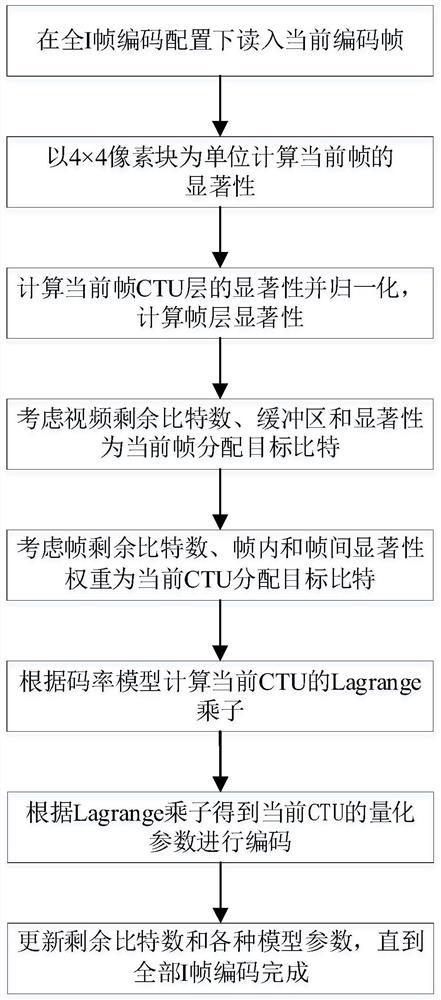
Figure 1 
Figure 2 
Figure 3
Abstract
Description
technical field
[0001] The invention relates to the technical field of video coding, in particular to the technical field of video subjective quality optimization, and in particular to a significant-based CTU layer bit rate allocation method for HEVC full I-frame coding. Background technique:
[0002] The goal of video coding is to obtain the optimal subjective video quality under the limitation of bit rate. High-performance video coding (HEVC) or H.265 is the latest video coding standard in the world. Compared with the previous generation video coding standard H.264, its coding efficiency has doubled, and it supports full I-frame coding and low latency (LD). Various configurations with Random Access (RA). Among them, full I-frame coding only uses intra-frame pixels for spatial prediction instead of inter-frame pixels for temporal prediction. It has the characteristics of fast coding speed and convenient inter-frame parallel coding. It is suitable for high coding speed and ...
Examples
Embodiment Construction
[0056] In order to make the technical means, creative features, achievement goals and effects realized by the present invention easy to understand, the present invention will be further described below with reference to the specific embodiments.
[0057] like figure 1 As shown, a significant-based CTU layer code rate allocation method for HEVC full I frame encoding includes the following steps:
[0058] S1: Read in the current coded frame under the full I-frame coding configuration, and calculate the saliency of different regions of the current frame in units of 4×4 pixel blocks. Step S1 includes the following steps:
[0059] S11: Read in the YUV pixel value of the current coded frame, divide the luminance channel (Y) according to the size of the 4×4 pixel block, and combine the 4×4 pixel block of the Y channel and the pixel value of the corresponding UV channel to form 4×4 feature vector of the block layer
[0060] S12: Utilize feature vectors of 4×4 block layers The sa...