
A kind of rice double haploid breeding method based on haploid induction line
A haploid induction line and rice technology, applied in the agricultural field, can solve the problems of large differences between genotypes, low induction rate, and small number of seeds obtained, and achieve shortened breeding time, strong technical versatility, and batch production Effect
Patent Information
- Authority / Receiving Office
- CN · China
- Patent Type
- Patents(China)
- Current Assignee / Owner
- Publication Date
- 2021-01-01
Smart Images
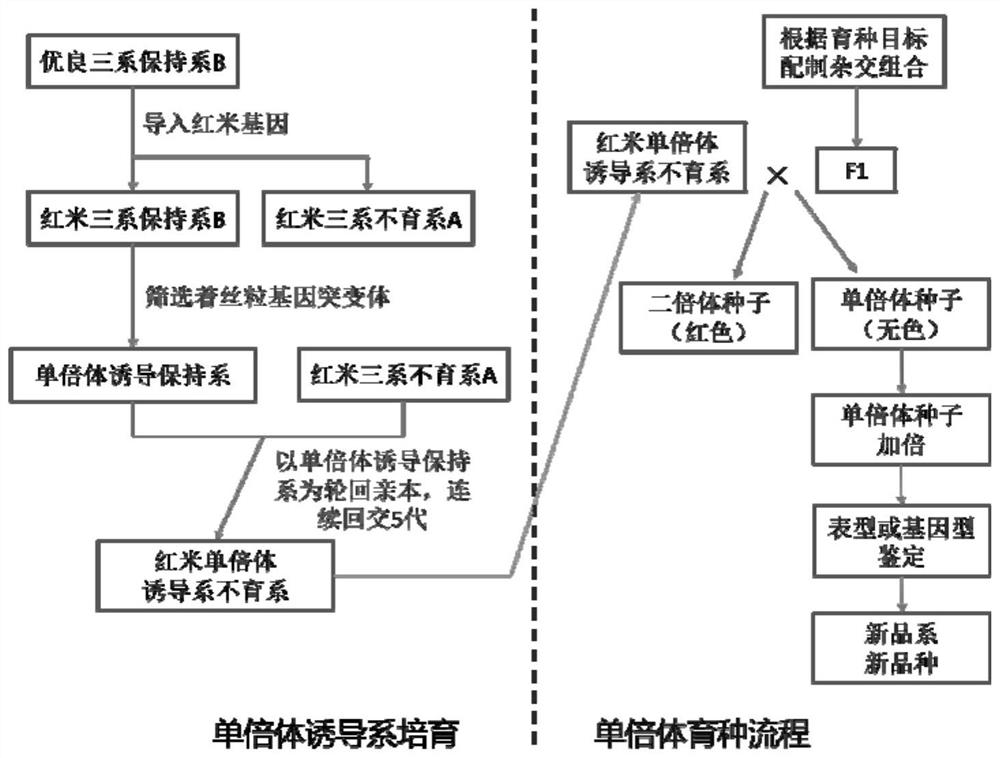
Figure 1
Abstract
Description
technical field
[0001] The invention relates to a rice double haploid breeding method based on a haploid induction system, which belongs to the field of agricultural technology. Background technique
[0002] Haploid breeding technology is to obtain purified double haploid (DH plants) by doubling the chromosome group of natural or artificially cultivated haploid plants. It is more and more popular among breeders for its fast, accurate and efficient characteristics At present, more than 250 crop species in the world have applied double haploid breeding, and more than 300 double haploid pure lines from cultivated species have been bred in 12 species. The core of traditional breeding technology is to fix favorable genes and make them homozygous through continuous selection. This process usually requires multiple generations of self-crossing or backcrossing. Lines need more than 6 generations, and the use of double haploid breeding method generally only needs 2 generations, whic...
Examples
Embodiment Construction
[0028] The present invention will be further described below in combination with specific embodiments and accompanying drawings.
[0029] A kind of rice double haploid breeding method based on haploid induction line, such as figure 1 shown, including the following steps:
[0030] 1. The maintainer line H353-B carrying multiple favorable genes was transformed into a red rice maintainer line.
[0031] In the early stage, our research group bred a three-line maintainer line H353-B carrying 3 excellent genes (amylose content gene Wx, aroma gene fgr, and rice blast resistance gene Pita), and bred its homokaryotic heterogeneous The sterile line H353-A was crossed to obtain highly sterile F1. Using a material H22 (male parent) carrying a dominant red seed coat gene RR to cross with H353-B (female parent), the seed coat of the F1 generation is red, and H353-B is used as the recurrent parent, and each backcross generation is selected The red seed coat individual was backcrossed with...