
Wiping cloth for tin plate surface black ash and manufacturing process thereof
A manufacturing process and technology of tin plate, which is applied in the field of fiber-cotton blended cloth, can solve the problems of low tin hardness and scratches on the tin layer, and achieve good dust wiping effect
Patent Information
- Authority / Receiving Office
- CN · China
- Patent Type
- Applications(China)
- Current Assignee / Owner
- Publication Date
- 2020-04-14
Smart Images
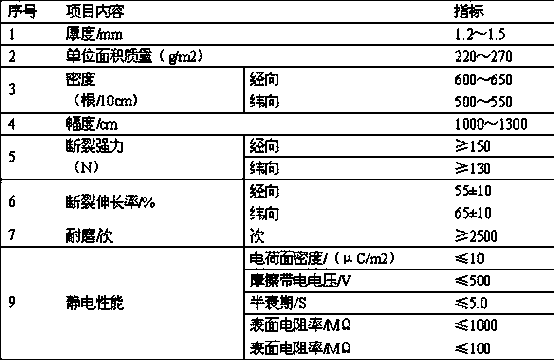
Figure 1 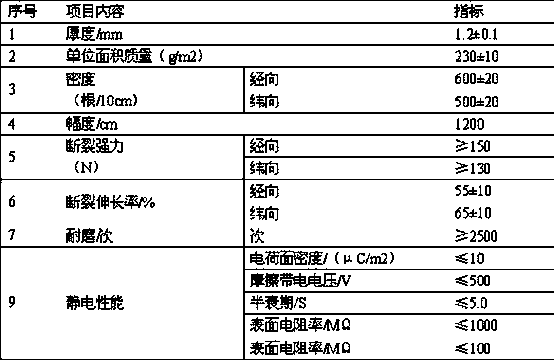
Figure 2
Abstract
Description
technical field
[0001] The invention relates to the field of fiber-cotton blended cloth, in particular to an erasing cloth for black ash on the surface of a tinplate and a manufacturing process thereof. Background technique
[0002] Tinplate is an important food packaging material. People's living standards are improving day by day, and the application range and consumption of tinplate are increasing day by day. At the same time, people have higher and higher requirements on the quality of tinplate, especially the surface quality of tinplate.
[0003] Black ash on the surface of tinplate is a major surface defect of tinplate. The formation of this kind of black ash is related to the characteristics of the production process of tinplate. At present, it is impossible to prevent the formation of black ash by changing the production process conditions. Therefore, only physical methods can be used to erase this layer of black ash on the surface of the tinplate. The structure ...
Examples
Embodiment 1
[0024] The erasing cloth in this embodiment is used for wiping the black ash on the surface of the tinplate with a coating thickness of 1.1-2.8 thickness. For this tinplate, the coating is not easy to be scratched due to the thin coating thickness. The main consideration is to wipe the dust effect, its formula and production process are:
[0025] The content of cotton in the wiping cloth is 75%, wool fiber contains 5%, chemical fiber contains 20%, and chemical fiber adopts polyester fiber;
[0026] The fiber blending containing the above-mentioned components is spun out of a spindle, and a gray cloth is woven into a gray cloth by a circular weft machine. The thickness of the gray cloth is controlled at 1.2 mm, and the gray cloth is singed;
[0027] The woven gray fabric is softened by an overflow machine. The softener used for softening contains 5% emulsion type high-temperature softener, 2% inorganic antistatic agent, 1% penetrating agent, 1.5% fluorosilane coupling agent, an...
Embodiment 2
[0033] The erasing cloth in the present embodiment is used for coating thickness to be greater than the black ash of 2.8 thickness tinplate surfaces to wipe, for this tinplate, because the thickness of tinplate is big, coating is easy to produce scratch, so mainly will consider wiping In addition to the softness of the cloth, its formula and production process are:
[0034] The content of cotton in the wiping cloth is 90%, wool fiber contains 0%, chemical fiber contains 10%, and chemical fiber adopts polyester fiber;
[0035] The fiber blending containing the above-mentioned components is spun out of a spindle, and a gray cloth is woven into a gray cloth by a circular weft machine. The thickness of the gray cloth is controlled at 1.5 mm, and the gray cloth is singed;
[0036] The woven gray fabric is softened by an overflow machine. The softener used for softening contains 10% emulsion type high-temperature softener, 2% inorganic antistatic agent, 1% penetrating agent, 2.0% fl...
Embodiment 3
[0040] The erasing cloth in this embodiment is used for erasing the black ash on the surface of the secondary cold-rolled tinplate, usually the black ash on the surface of the secondary cold-rolled tinplate is more serious than the black ash on the surface of other types of substrates, so The factor to be considered is the dust absorption ability of the erasing cloth, and its formula and production process are:
[0041] The content of cotton in the wiping cloth is 85%, wool fiber contains 10%, chemical fiber contains 5%, and chemical fiber adopts polyester fiber;
[0042] The fiber blending containing the above-mentioned components is spun out of a spindle, and a gray cloth is woven into a gray cloth by a circular weft machine. The thickness of the gray cloth is controlled at 1.5 mm, and the gray cloth is singed;
[0043] The woven gray fabric is softened by an overflow machine. The softener used for softening contains 5% emulsion type high-temperature softener, 5% inorganic a...