
Preparation method of salazosulfapyridine
A technology of sulfasalazine and nitroso sulfapyridine is applied in the field of sulfasalazine and can solve the problems of low yield of sulfasalazine, easy hydrolysis of diazonium salt, influence of reaction yield and the like
Patent Information
- Authority / Receiving Office
- CN · China
- Current Assignee / Owner
- Publication Date
- 2020-06-19
- Estimated Expiration
- Not applicable · inactive patent
Smart Images

Figure 1 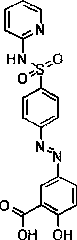
Figure 2
Abstract
Description
technical field
[0001] The invention relates to the technical field of sulfasalazine, in particular to a synthesis method of sulfasalazine. Background technique
[0002] Sulfasalazine (SASP), also known as 5-[p-(2-pyridinesulfamoyl)benzene]azosalicylic acid. Molecular formula is C18H14N4O5S, molecular weight: 398.39. Its molecular structure is as follows:
[0003]
[0004] SASP is mainly used for the treatment of non-specific ulcerative colitis. This product has a special affinity for connective tissue and plays a therapeutic role by releasing sulfapyridine and 5-aminosalicylic acid in the intestinal wall. It is also used clinically for the treatment of rheumatic joints inflammation. Although this product is an old product, the market demand is still very large, especially its quality requirements are getting higher and higher.
[0005] In the prior art, there are few disclosures on its preparation method. British Patent GB 11296655 discloses a synthetic method of su...
Examples
Embodiment 1
[0020] Add 2.9g of the formula 5-aminosalicylic acid into 50ml of water at 20-25°C and stir, add hydrochloric acid and stir to dissolve, heat up to 30-35°C and keep warm. Then add dropwise a solution of 5 g of 4-nitrososulfopyridine in 10 ml of methanol at 30 to 35° C. After dropping, raise the temperature to 50° C. and keep it warm until the reaction is complete. After the heat preservation is completed, cool to 0°C, filter with suction, and dry the material to obtain 7 g of sulfasalazine, with a yield of 92.5%.
Embodiment 2
[0022] Add 1.45g of the formula 5-aminosalicylic acid into 50ml of water at 20-25°C and stir, then add hydrochloric acid and stir to dissolve, heat up to 30-35°C and keep warm. Then add dropwise a solution of 5 g of 4-nitrososulfopyridine in 10 ml of methanol at 30 to 35° C. After dropping, raise the temperature to 50° C. and keep it warm until the reaction is complete. After heat preservation, cool to 0°C, filter with suction, and dry the material to obtain 3.5 g of sulfasalazine with a yield of 46.3%.
Embodiment 3
[0024] Add 4.35g of the formula 5-aminosalicylic acid into 50ml of water at 20-25°C and stir, add hydrochloric acid and stir to dissolve, heat up to 30-35°C and keep warm. Then add dropwise a solution of 5 g of 4-nitrososulfopyridine in 10 ml of methanol at 30 to 35° C. After dropping, raise the temperature to 50° C. and keep it warm until the reaction is complete. After the heat preservation is completed, cool to 0°C, filter with suction, and dry the material to obtain 6.9 g of sulfasalazine, with a yield of 91.2%.