
Multi-scale analysis and ensemble learning gas sensor fault mode identification method
A gas sensor and multi-scale analysis technology, applied in character and pattern recognition, instruments, computer components, etc., can solve the problems of poor discrimination and poor classification accuracy of classifiers, and achieve good classification accuracy and superior general The effect of chemical performance
Patent Information
- Authority / Receiving Office
- CN · China
- Current Assignee / Owner
- Publication Date
- 2020-10-02
Smart Images
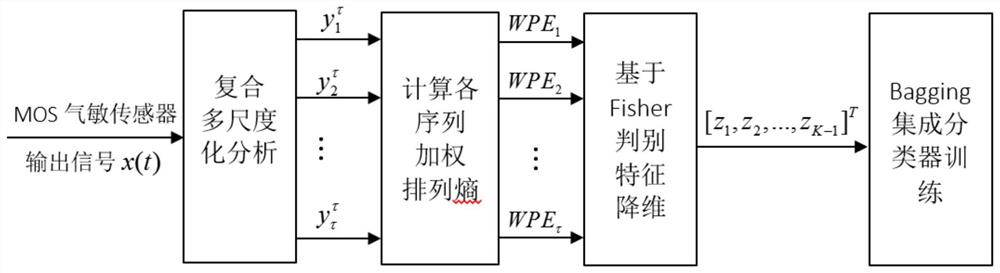
Figure 1 
Figure 2 
Figure 3
Abstract
Description
technical field
[0001] The invention belongs to the technical field of machine olfaction, and relates to a gas sensor fault pattern recognition method based on multi-scale analysis and integrated learning. Background technique
[0002] Pattern recognition is the main method to realize sensor fault recognition at present. The main process is as follows: First, collect the sensor signals under normal conditions and various fault conditions to form a training sample set for various states of the sensor; then select an appropriate fault signal feature extraction method to extract The fault feature information constitutes the fault feature training sample set; next, the fault feature training sample set is used to train the classifier based on the pattern recognition method; finally, the trained classifier is used to perform pattern recognition on the sensor test samples, and the classifier Output the type of fault identified. From the above process description, we can see that...
Examples
Embodiment Construction
[0035] The following will clearly and completely describe the technical solutions in the embodiments of the present invention with reference to the accompanying drawings in the embodiments of the present invention. Obviously, the described embodiments are only some, not all, embodiments of the present invention. Based on the embodiments of the present invention, all other embodiments obtained by persons of ordinary skill in the art without making creative efforts belong to the protection scope of the present invention.
[0036] See attached figure 1 , which is a flowchart of a gas sensor fault pattern recognition method based on multi-scale analysis and integrated learning provided in this embodiment, the specific execution process of this embodiment is as follows:
[0037] S1. Perform multi-scale analysis of weighted permutation entropy on the fault signal time series output by the gas sensor, and obtain the composite multi-scale weighted permutation entropy of fault signals ...