
Air flight target classification and identification method based on radar track data
A flying target, classification and recognition technology, applied in neural learning methods, character and pattern recognition, instruments, etc., can solve the problems of poor generality and low recognition rate of radar data, and achieve low cost, good classification accuracy, and good popularization and application. Foreground effect
Patent Information
- Authority / Receiving Office
- CN · China
- Current Assignee / Owner
- Publication Date
- 2022-01-18
Smart Images
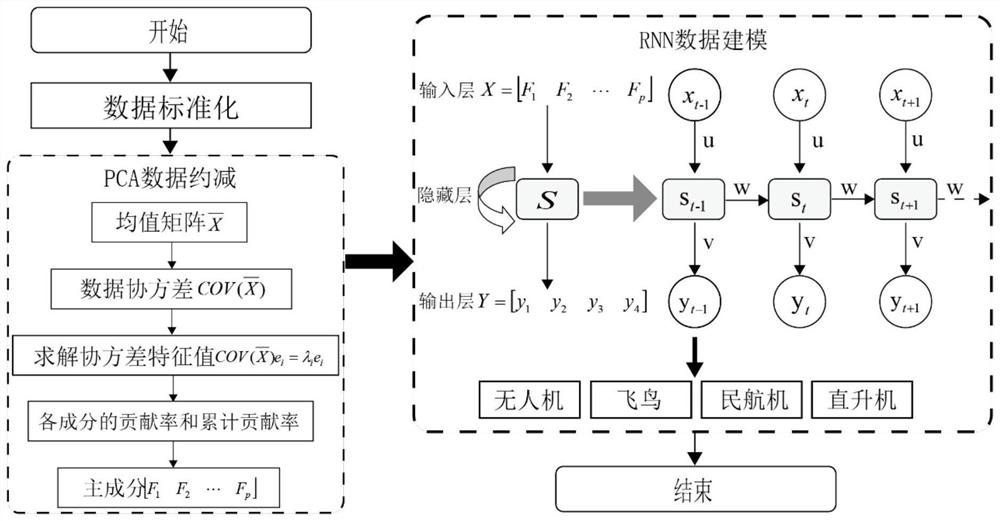
Figure 1 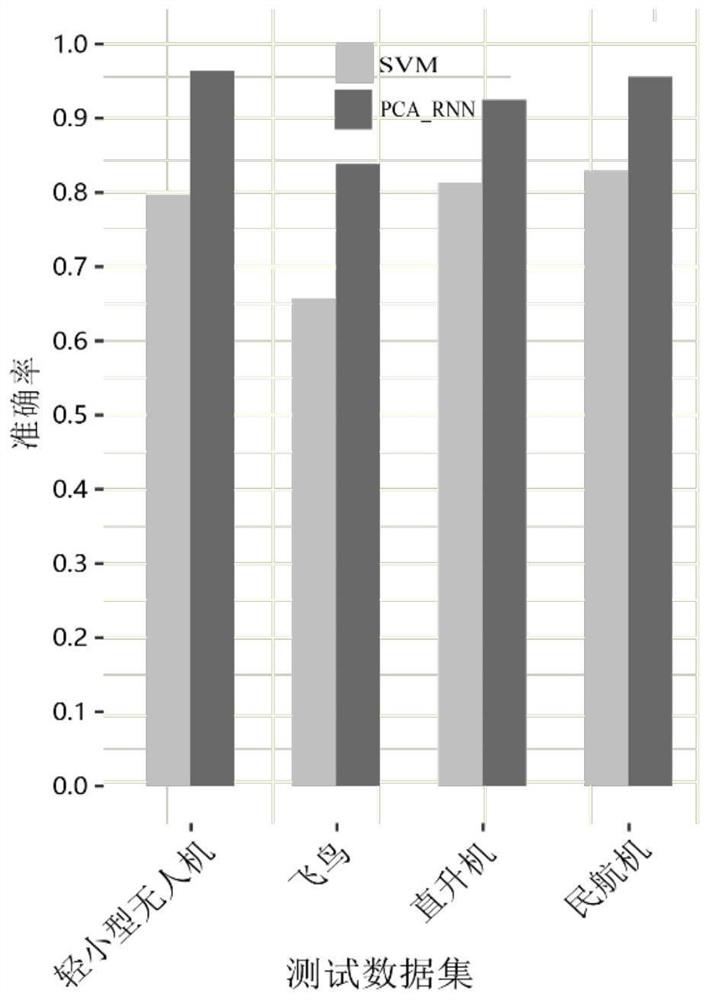
Figure 2 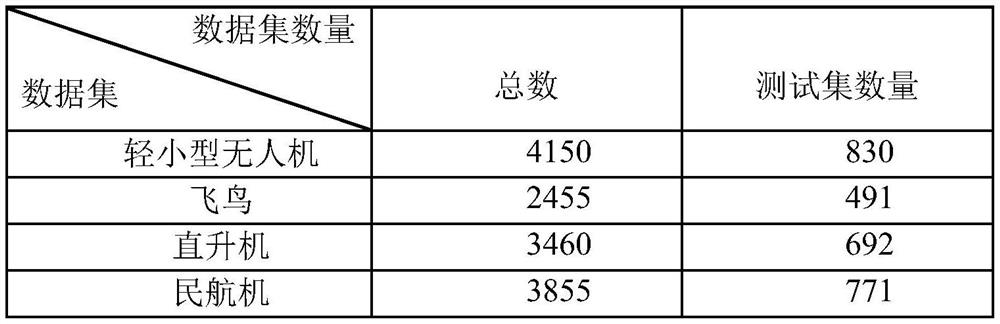
Figure 3
Abstract
Description
technical field
[0001] The invention belongs to the technical field of radar data processing. Background technique
[0002] The study of air flight target recognition has important guiding significance in long-range early warning operations and tactical defense. In modern information warfare, the accurate identification of the enemy's incoming target is conducive to our accurate threat estimation and reasonable firepower allocation in battlefield decision-making, and plays an important role in improving the combat effectiveness of weapon systems.
[0003] Among them, light and small UAVs are similar in size to flying birds. They are typical slow and small targets with a small scattering area. The flight speed, echo amplitude, scattering cross-sectional area, flight height and trajectory characteristics of the passing target cannot be clearly distinguished. For high-resolution radar, it is more difficult to classify and identify light and small UAVs and flying birds, which p...
Examples
Embodiment Construction
[0023] figure 1 For the realization process of the present invention, the present invention is illustrated below in conjunction with examples.
[0024] 1. In order to verify the effectiveness of the present invention, the air target data used in the experiment comes from the real data collected by a certain type of radar. The track data of four airborne targets including light and small unmanned aerial vehicles (DJI Phantom 4Pro), birds, helicopters, and civil aircraft were collected through radar as training samples, and the true class labels of each target were confirmed through optoelectronic equipment. The characteristics of target track data mainly include: batch number, period, azimuth, distance, elevation angle, time, course, speed, track azimuth, track distance, track elevation angle, predicted azimuth, predicted distance, predicted elevation angle, track quality, track Eighteen feature dimensions, such as trace state, point trace amplitude, and elevation angle qualit...