
Compound taking diphenyl acridine as core, and application of compound in organic electroluminescent device
A diphenylacridine and compound technology, applied in the application field of organic electroluminescent devices, can solve different problems, and achieve the effects of not being easy to gather, blocking energy loss, and improving external quantum efficiency
Patent Information
- Authority / Receiving Office
- CN · China
- Patent Type
- Applications(China)
- Current Assignee / Owner
- Publication Date
- 2021-03-12
Smart Images
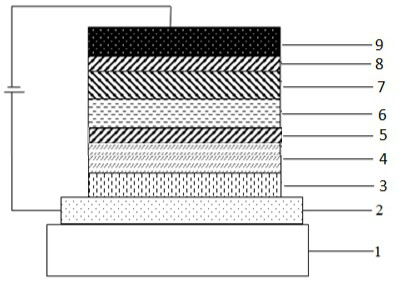
Figure 1 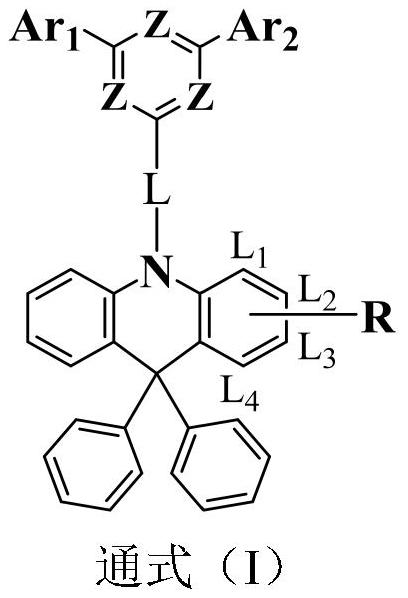
Figure 2 
Figure 3
Abstract
Description
technical field
[0001] The invention relates to the technical field of semiconductors, in particular to a compound with diphenylacridine as the core and its application in organic electroluminescent devices. Background technique
[0002] Organic electroluminescent (OLED: Organic Light Emission Diodes) device technology can be used to manufacture new display products and also can be used to make new lighting products, which is expected to replace the existing liquid crystal display and fluorescent lighting, and has a wide application prospect. The OLED light-emitting device is like a sandwich structure, including electrode material film layers, and organic functional materials sandwiched between different electrode film layers. Various functional materials are superimposed on each other according to the application to form an OLED light-emitting device. As a current device, when a voltage is applied to the electrodes at both ends of the OLED light-emitting device, and the pos...
Examples
Embodiment 1
[0073] Embodiment 1: the synthesis of compound 2:
[0074]
[0075] In a 250ml three-neck flask, under the protection of nitrogen, add 0.01mol raw material A1, 0.012mol intermediate D1, 150ml toluene and stir to mix, then add 0.03mol sodium tert-butoxide, 1×10 -4 molPd 2 (dba) 3 , 1×10 -4mol of tri-tert-butylphosphine, heated to 110°C, refluxed for 24 hours, sampled and spotted on the plate, showed that no raw material A1 remained, and the reaction was complete; naturally cooled to room temperature, filtered, and the filtrate was subjected to vacuum rotary evaporation (-0.09MPa, 85°C ), purified through a neutral silica gel column to obtain the target product, with a HPLC purity of 99.3% and a yield of 71.8%;
[0076] Elemental analysis structure (molecular formula C 53 h 35 NO): Theoretical C, 90.70; H, 5.03; N, 2.00; O, 2.28; Tested: C, 90.65; H, 5.04; N, 2.02. ESI-MS(m / z)(M + ): The theoretical value is 701.27, and the measured value is 701.45.
[0077] 1 H NMR ...
Embodiment 2
[0078] Embodiment 2: the synthesis of compound 12:
[0079]
[0080] The synthesis steps of compound 12 are similar to those of compound 2, except that intermediate D1 is replaced by intermediate D2;
[0081] Elemental analysis structure (molecular formula C 55 h 35 NO 2 ): theoretical value C, 89.04; H, 4.76; N, 1.89; O, 4.31; test value: C, 89.00; H, 4.77; N, 1.91. ESI-MS(m / z)(M + ): The theoretical value is 741.27, and the measured value is 741.12.
[0082] 1 H NMR (500MHz, Chloroform-d) δ8.02 (ddd, J = 10.3, 7.4, 1.4Hz, 3H), 7.84 (dd, J = 7.5, 1.4Hz, 1H), 7.68 (t, J = 1.5Hz, 1H),7.61–7.52(m,4H),7.51–7.34(m,8H),7.32(s,1H),7.31–7.15(m,13H),7.15–7.07(m,2H),7.02(ddd, J=8.8,7.3,1.6Hz,2H).
Embodiment 3
[0083] Embodiment 3: the synthesis of compound 19:
[0084]
[0085] The synthesis steps of compound 19 are similar to those of compound 2, except that raw material A1 is replaced by raw material A2, and intermediate D1 is replaced by intermediate D3;
[0086] Elemental analysis structure (molecular formula C 55 h 36 N 2 O): Theoretical value C, 89.16; H, 4.90; N, 3.78; O, 2.16; Test value: C, 89.10; H, 4.91; N, 3.80. ESI-MS(m / z)(M + ): The theoretical value is 740.28, and the measured value is 740.33.
[0087] 1 HNMR(500MHz, Chloroform-d)δ8.14–8.08(m,2H),8.01(dd,J=7.5,1.5Hz,1H),7.79(s,1H),7.64–7.56(m,5H),7.54 (dd, J=7.5,1.5Hz,1H),7.47(td,J=7.4,1.6Hz,1H),7.44–7.33(m,4H),7.33–6.99(m,21H).