
A low-dropout linear regulator ldo power-up circuit
A low-dropout linear and voltage stabilizer technology, applied in the direction of instruments, adjusting electrical variables, control/regulation systems, etc., to achieve high pressure bearing capacity, prevent overshoot voltage from destroying circuits, and delay power-on time
Patent Information
- Authority / Receiving Office
- CN · China
- Patent Type
- Patents(China)
- Current Assignee / Owner
- Publication Date
- 2021-12-10
Smart Images
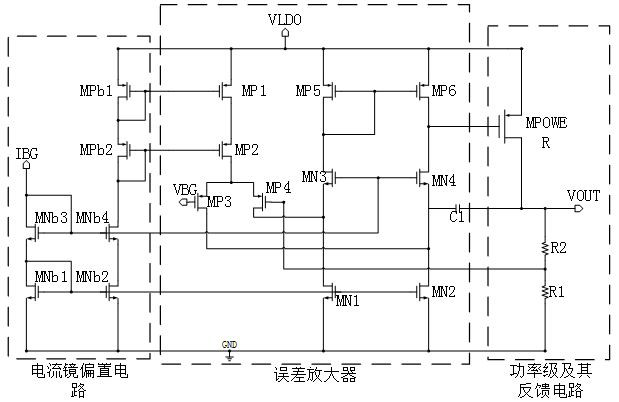
Figure 1 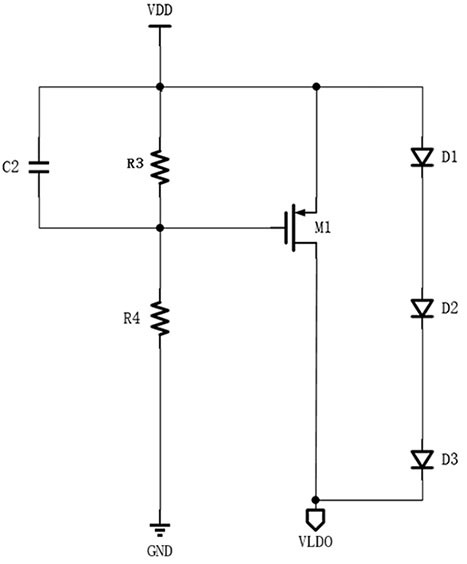
Figure 2
Abstract
Description
technical field
[0001] The invention belongs to the technical field of amplifier circuits, in particular to an LDO power-on circuit for a low-dropout linear regulator. Background technique
[0002] With the advancement of process nodes, the withstand voltage value of circuit devices generally decreases. In order to save costs, SoCs are usually designed using the same process, so it is even more necessary to convert high input voltages into low voltages to supply power to subsequent circuit modules.
[0003] Low dropout linear regulator (LDO) has the advantages of low output noise, simple circuit structure and small area. In particular, the LDO with no external capacitor structure has fewer peripheral components, so it is widely used in SoCs. However, when the LDO designed with the same low-voltage process as the system-on-chip works at high voltage, it also has the risk of breakdown, and its reliability is low.
[0004] In order to overcome the above problems, it is usual...
Examples
Embodiment Construction
[0028]It should be noted that, in the case of no conflict, the embodiments of the present invention and the features in the embodiments can be combined with each other.
[0029] In describing the present invention, it should be understood that the terms "center", "longitudinal", "transverse", "upper", "lower", "front", "rear", "left", "right", " The orientations or positional relationships indicated by "vertical", "horizontal", "top", "bottom", "inner" and "outer" are based on the orientations or positional relationships shown in the drawings, and are only for the convenience of describing the present invention and Simplified descriptions, rather than indicating or implying that the device or element referred to must have a particular orientation, be constructed and operate in a particular orientation, and thus should not be construed as limiting the invention. In addition, the terms "first", "second", etc. are used for descriptive purposes only, and should not be understood a...