
FY-3D passive microwave data under-cloud surface temperature inversion and verification method
A passive microwave data, FY-3D technology, applied in the field of quantitative remote sensing, can solve the problems of difficult verification and low precision, and achieve the effect of ensuring spatial representativeness
Patent Information
- Authority / Receiving Office
- CN · China
- Patent Type
- Applications(China)
- Current Assignee / Owner
- Publication Date
- 2022-07-08
Smart Images
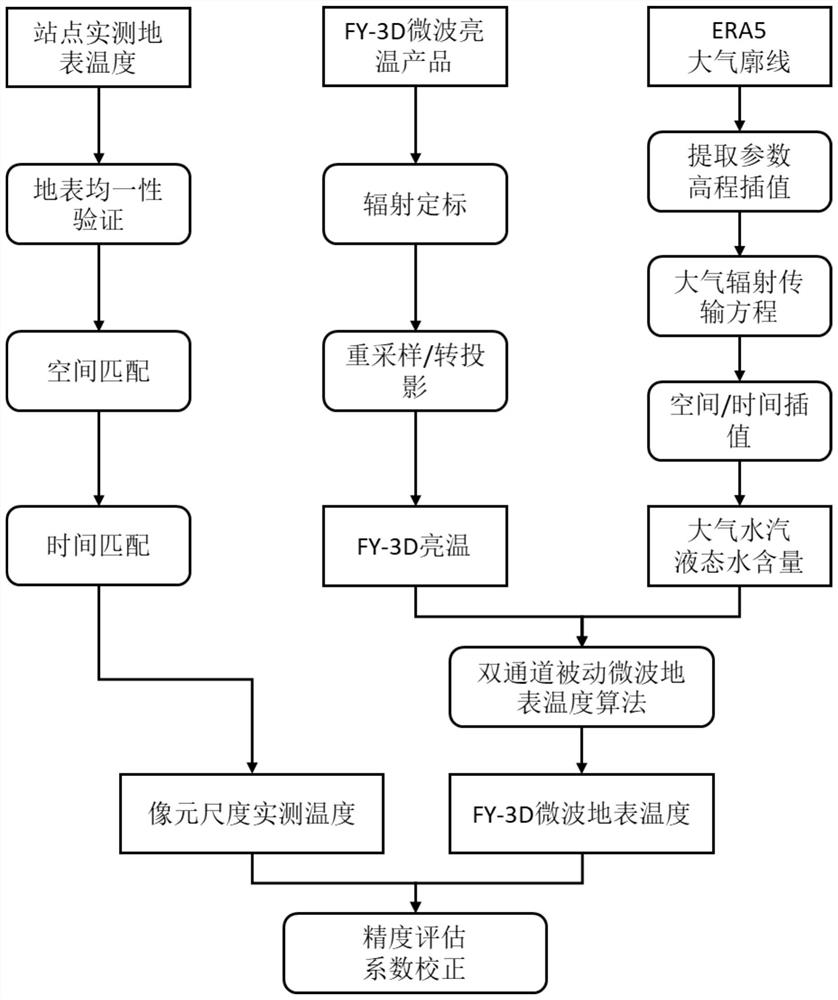
Figure 1 
Figure 2 
Figure 3
Abstract
Description
technical field
[0001] The invention relates to the technical field of quantitative remote sensing, in particular to a method for inversion and verification of surface temperature under a cloud of FY-3D passive microwave data. Background technique
[0002] Surface temperature is a very important characteristic physical quantity that characterizes the changes of surface processes. It is an indispensable and important parameter for the study of material and energy exchange between the surface and the atmosphere, climate change, etc. It involves many basic disciplines and major application fields. How to quantitatively invert the surface temperature from the radiation information obtained from remote sensing data is a difficult problem in the field of quantitative remote sensing. At present, the use of satellite remote sensing data for surface temperature inversion mainly uses thermal infrared remote sensing data for inversion. The spatial resolution of thermal infrared remote...
Examples
Embodiment Construction
[0044] The technical solutions in the embodiments of the present invention will be clearly and completely described below with reference to the accompanying drawings in the embodiments of the present invention. Obviously, the described embodiments are only a part of the embodiments of the present invention, but not all of the embodiments. Based on the embodiments of the present invention, all other embodiments obtained by those of ordinary skill in the art without creative efforts shall fall within the protection scope of the present invention.
[0045] The purpose of the present invention is to provide a method for inversion and verification of the surface temperature under the cloud of FY-3D passive microwave data, which can improve the estimation and verification accuracy of the surface temperature under the cloud.
[0046] In order to make the above objects, features and advantages of the present invention more clearly understood, the present invention will be described in ...