
High-gloss high-glass-fiber-content nylon 66 composite material and preparation method thereof
By introducing self-developed high-gloss compatibilizer into the nylon 66 composite material, the problem of gloss reduction after the addition of glass fiber is solved, and composite materials with high gloss and high mechanical properties are achieved, which are suitable for a variety of application scenarios.
Patent Information
- Application Number
- CN202411900214.4
- Authority / Receiving Office
- CN · China
- Patent Type
- Applications(China)
- Current Assignee / Owner
- Filing Date
- 2024-12-23
- Publication Date
- 2025-04-08
- Estimated Expiration
- 2044-12-23
AI Technical Summary
After adding glass fiber, the gloss of nylon 66 composite material has a severe decrease, limiting its application in appearance parts.
Intermediate 2 was prepared by using an independently developed high-gloss compatibilizer to prepare intermediate 1 by substitution of n-alkyl alcohol and vinyl trichlorosilane. Intermediate 2 was prepared by initiating addition between unsaturated double bonds between methyl thioglycolate and intermediate 1. Finally, the high-gloss compatibilizer was prepared by amine ester transesterification of γ-aminopropyltriethoxysilane and terminal methyl ester of intermediate 2. During the heating and kneading process of this high-light compatibilizer, the ethoxysilane structure is hydrolyzed and coupled, and multiple alkyl chains are introduced to reduce the winding of nylon macromolecular chains, promote the nucleation and crystallization of nylon molecules on the surface of glass fibers, reduce the interface between high-crystal zones and low-crystal zones, and improve gloss.
A nylon 66 composite material with high gloss and high fiber content has been achieved, maintaining high mechanical strength and impact toughness, suitable for loaded products, and exhibits excellent gloss characteristics in appearance applications.
Smart Images
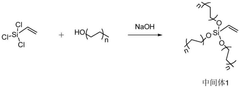
Figure BDA0005202951190000021 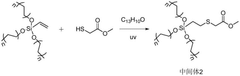
Figure BDA0005202951190000031 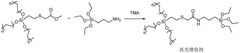
Figure BDA0005202951190000032
Abstract
Description
Technical Field
[0001] The present invention belongs to the technical field of composite fabrics, and in particular, relates to a high-gloss and high-glass-fiber-content nylon 66 composite material and a preparation method thereof. Background Art
[0002] As an engineering plastic with excellent comprehensive properties, nylon 66 is widely used in aerospace, automotive, electronics and other industries. However, its strength and modulus are relatively low, which limits its further development in high-demand application fields. In order to overcome this limitation, people are committed to developing new composite materials that improve the performance of nylon 66; glass fiber (hereinafter referred to as glass fiber) is a reinforced fiber material with the characteristics of high strength, high modulus and low weight. The combination of glass fiber and nylon 66 can effectively improve its mechanical properties and is cost-effective, making it an ideal choice for structural materials.
[0003] Due to the addition of glass fiber, the physical and mechanical properties of nylon 66 have been effectively improved, and the mechanical strength, wear resistance and dimensional stability have been greatly improved. However, the glossiness of the composite material has been seriously reduced, which has greatly limited its application in appearance parts. In long-term research, it was found that the reasons for this defect include: the addition of glass fiber forms a large number of nylon-glass fiber interfaces in the composite system, and the light is scattered on the inhomogeneous interface to reduce the glossiness. This defect cannot be fundamentally eliminated, and the glossiness decreases more seriously with the increase of glass fiber content. More importantly, the introduction of glass fiber hinders the movement and arrangement of nylon molecules on its surface, inhibits the crystallization of nylon during the molding process, and forms a large number of uneven low-crystalline areas on the glass fiber surface. From the perspective of the entire composite system, a wide high-crystalline area-low-crystalline area inhomogeneous interface is formed from the nylon matrix to the glass fiber surface, and serious light scattering is formed in this area, resulting in a sharp deterioration in glossiness. Summary of the invention
[0004] In order to solve the technical problems mentioned in the background technology, the object of the present invention is to provide a high-gloss and high-glass fiber content nylon 66 composite material and a preparation method thereof.
[0005] The purpose of the present invention can be achieved by the following technical solutions:
[0006] A high-gloss, high-glass-fiber-content nylon 66 composite material, comprising:
[0007] The invention comprises 50-60wt% of alkali-free glass fiber, 2.2-3.5wt% of high gloss compatibilizer, 3.5-5wt% of toughening agent, 0.15-0.2wt% of antioxidant and 0.6-0.9wt% of processing aid, and the balance is nylon 66 resin.
[0008] The high-gloss compatibilizer is prepared by the following method:
[0009] Step A1: premix n-alkyl alcohol, sodium hydroxide and anhydrous tetrahydrofuran, introduce dry gas protection, control the temperature of the water bath to 0-10°C, apply stirring at 120-150rpm, slowly add vinyltrichlorosilane to react for 2-3h, then raise the temperature to 60-70°C and reflux for 1-1.5h. After the reaction is completed, filter and dry by rotary evaporation to obtain intermediate 1.
[0010] Furthermore, the feed ratio of vinyltrichlorosilane, n-alkyl alcohol, sodium hydroxide and anhydrous tetrahydrofuran is 10mmol:30mmol:0.2-0.4g:55-90mL, n-alkyl alcohol is substituted with vinyltrichlorosilane, and alkyl side chains are introduced. The specific reaction route is as follows:
[0011]
[0012] Preferably, the n-alkyl alcohol is one of n-butanol, n-octanol and n-decanol.
[0013] Step A2: Mix the intermediate 1, methyl thioglycolate, benzophenone and ethanol, raise the temperature to 45-60°C, apply stirring at 60-90 rpm and 150-200 W / m 2 The reaction was carried out under ultraviolet irradiation for 3.5-5 h. After the reaction was completed, ethanol was removed to obtain intermediate 2.
[0014] Furthermore, the feed ratio of intermediate 1, methyl thioglycolate, benzophenone and ethanol is 10mmol:10mmol:10-20mg:50-80mL, and methyl thioglycolate initiates addition with the unsaturated double bond of intermediate 1 to introduce a terminal methyl ester structure. The specific reaction route is as follows:
[0015]
[0016] Step A3: Mix the intermediate 2, γ-aminopropyltriethoxysilane and dimethyl sulfoxide, introduce dry gas protection, heat to 80-100°C, stir at 60-120 rpm, add trimethylaluminum intermittently and react for 4-5 hours. After the reaction is completed, remove dimethyl sulfoxide under reduced pressure to obtain a high-gloss compatibilizer.
[0017] Furthermore, the feed ratio of intermediate 2, γ-aminopropyltriethoxysilane, trimethylaluminum and dimethyl sulfoxide is 10mmol:10mmol:25-50mg:60-80mL, γ-aminopropyltriethoxysilane and the terminal methyl ester of intermediate 2 are subjected to amine ester exchange, and ethoxysilane is introduced for modification. The specific reaction route is as follows:
[0018]
[0019] Preferably, the length of the alkali-free glass fiber is 1.5-4.5 mm and the diameter is 9-14 um.
[0020] Preferably, the toughening agent is compounded from POE-g-MAH (maleic anhydride grafted POE) and E-GMA (ethylene-glycidyl methacrylate copolymer).
[0021] A method for preparing a high-gloss and high-glass-fiber-content nylon 66 composite material comprises the following steps:
[0022] Step S1: impregnating the alkali-free glass fiber with an ethanol aqueous solution to control the liquid content to 4.5-6wt%, then mixing with the remaining raw materials, heating to 220±10°C and mixing for 25-30min, and drying the material until the moisture content is not higher than 0.1wt% to obtain a batch;
[0023] Step S2: melt-extrude the compound material through a twin-screw extruder, and the extrusion temperature zones are set as follows: the temperature of the first zone is 200±10°C, the temperature of the second zone is 260±10°C, the temperature of the third zone is 270±10°C, the temperature of the fourth zone is 280±10°C, the temperature of the fifth zone is 270±10°C, the temperature of the sixth zone is 270±10°C, the temperature of the seventh zone is 270±10°C, the temperature of the eighth zone is 270±10°C, the temperature of the ninth zone is 270±10°C, and the temperature of the die is 265±10°C; then, the compound material is stretched, cooled and shaped, and pelletized to obtain a composite material.
[0024] Beneficial effects of the present invention:
[0025] The alkali-free glass fiber content in the nylon 66 composite material disclosed by the present invention reaches more than 50wt%, has high mechanical strength, and can be applied to some load-bearing products;
[0026] The composite system of the present invention introduces a self-developed high-gloss compatibilizer to effectively improve the gloss of the composite material. The high-gloss compatibilizer is prepared by substitution of n-alkyl alcohol and vinyl trichlorosilane to prepare intermediate 1, and then methyl thioglycolate and the unsaturated double bond of intermediate 1 are induced to form intermediate 2. Finally, γ-aminopropyl triethoxysilane and the terminal methyl ester of intermediate 2 are subjected to amine ester exchange to prepare the high-gloss compatibilizer. During the temperature-raising mixing process, the ethoxysilane structure of the high-gloss compatibilizer is fully hydrolyzed and coupled on the surface of the alkali-free glass fiber after impregnation, and a silicon-containing multi-branched alkyl chain is introduced into the surface of the alkali-free glass fiber. On the one hand, the alkyl The introduction of the chain reduces the entanglement between the nylon macromolecular chains on the surface of the alkali-free glass fiber, making the nylon macromolecules easier to orient and crystallize. On the other hand, the silicon-containing alkyl chain, as a heterogeneous component, provides nucleation sites to promote the nucleation and crystallization of nylon molecular chains on the surface of the alkali-free glass fiber, thereby greatly reducing the high-crystalline region-low-crystalline region interface content in the composite system, effectively reducing the scattering of light, and thus allowing the composite material to maintain a high gloss; in addition, the alkyl chain on the surface of the alkali-free glass fiber plays an in-situ toughening role, compensating for the increased brittleness caused by the increase in crystallinity, so that the composite material maintains a high impact toughness. DETAILED DESCRIPTION
[0027] The following will be combined with the embodiments of the present invention to clearly and completely describe the technical solutions in the embodiments of the present invention. Obviously, the described embodiments are only part of the embodiments of the present invention, not all of the embodiments. Based on the embodiments of the present invention, all other embodiments obtained by ordinary technicians in this field without creative work are within the scope of protection of the present invention.
[0028] Example 1: Preparation of a high gloss and high glass fiber content nylon 66 composite material, as follows:
[0029] (1) Preparation of high-gloss compatibilizer
[0030] Step A1: premix n-alkyl alcohol, sodium hydroxide and anhydrous tetrahydrofuran, introduce dry nitrogen protection, control the temperature of the water bath to 0°C, apply stirring at 120rpm, slowly add vinyltrichlorosilane to react for 2h, then raise the temperature to 60°C and reflux for 1h, wherein the n-alkyl alcohol is n-butanol, and the feed ratio of vinyltrichlorosilane, n-butanol, sodium hydroxide and anhydrous tetrahydrofuran is 10mmol:30mmol:0.2g:55mL. After the reaction is completed, filter and dry by rotary evaporation to obtain intermediate 1.
[0031] Step A2: Mix the intermediate 1, methyl thioglycolate, benzophenone and ethanol, raise the temperature to 45°C, apply 60 rpm stirring and 150 W / m 2 The reaction was carried out under ultraviolet irradiation for 3.5 hours, wherein the feed ratio of intermediate 1, methyl thioglycolate, benzophenone and ethanol was 10 mmol: 10 mmol: 10 mg: 50 mL. After the reaction was completed, ethanol was removed to obtain intermediate 2.
[0032] Step A3: Mix the intermediate 2, γ-aminopropyltriethoxysilane and dimethyl sulfoxide, pass dry gas protection, heat to 80°C, apply stirring at 60rpm, take equal amounts of trimethylaluminum and divide them into three portions, add them intermittently for 30 minutes, and control the total reaction time to be 4 hours, wherein the feed ratio of intermediate 2, γ-aminopropyltriethoxysilane, trimethylaluminum and dimethyl sulfoxide is 10mmol:10mmol:25mg:60mL. After the reaction, remove dimethyl sulfoxide under reduced pressure to obtain a high-gloss compatibilizer.
[0033] (2) Preparation of composite materials
[0034] Ingredients: calculated by weight percentage, 50wt% of alkali-free glass fiber, specifications: straight 9um, length 1.5mm; 2.2wt% of high-gloss compatibilizer, homemade in this embodiment; 5wt% of toughening agent, N413 type POE-g-MAH and BF-7M type E-GMA are compounded in an equal weight ratio; 0.2wt% of antioxidant, antioxidant 1010 and antioxidant 168 are compounded in an equal weight ratio; 0.6wt% of processing aid, Hyper C181 lubricating agent is selected; the balance EPR27 type nylon 66 resin is supplemented to 100wt%.
[0035] Step S1: prepare an ethanol aqueous solution with a volume fraction of 20%, immerse the alkali-free glass fiber in the ethanol aqueous solution, drain and control the liquid content to 4.5wt%, then mix with the remaining raw materials, mix at 220±10℃ for 25min, dry the material until the moisture content is not higher than 0.1wt%, and obtain a batch material.
[0036] Step S2: melt-extrude the compound material through a twin-screw extruder, and the extrusion temperature zones are set as follows: the temperature of the first zone is 200±10°C, the temperature of the second zone is 260±10°C, the temperature of the third zone is 270±10°C, the temperature of the fourth zone is 280±10°C, the temperature of the fifth zone is 270±10°C, the temperature of the sixth zone is 270±10°C, the temperature of the seventh zone is 270±10°C, the temperature of the eighth zone is 270±10°C, the temperature of the ninth zone is 270±10°C, and the temperature of the die is 265±10°C; then, the compound material is stretched, cooled and shaped, and pelletized to obtain a composite material.
[0037] Example 2, preparation of high gloss and high glass fiber content nylon 66 composite material, specifically as follows:
[0038] (1) Preparation of high-gloss compatibilizer
[0039] Step A1: premix n-alkyl alcohol, sodium hydroxide and anhydrous tetrahydrofuran, introduce dry nitrogen protection, control the temperature of the water bath to 10°C, apply stirring at 150rpm, slowly add vinyltrichlorosilane to react for 3h, then raise the temperature to 70°C and reflux for 1.5h, wherein the n-alkyl alcohol is n-decanol, and the feed ratio of vinyltrichlorosilane, n-decanol, sodium hydroxide and anhydrous tetrahydrofuran is 10mmol:30mmol:0.4g:90mL. After the reaction is completed, filter and dry by rotary evaporation to obtain intermediate 1.
[0040] Step A2: Mix the intermediate 1, methyl thioglycolate, benzophenone and ethanol, raise the temperature to 60°C, apply stirring at 90 rpm and 200 W / m 2 The reaction was carried out under ultraviolet irradiation for 5 hours, wherein the feed ratio of intermediate 1, methyl thioglycolate, benzophenone and ethanol was 10 mmol: 10 mmol: 20 mg: 80 mL. After the reaction was completed, ethanol was removed to obtain intermediate 2.
[0041] Step A3: Mix the intermediate 2, γ-aminopropyltriethoxysilane and dimethyl sulfoxide, introduce dry gas protection, heat to 100°C, apply stirring at 120rpm, take equal amounts of trimethylaluminum and divide them into three portions, add them intermittently for 30 minutes, and control the total reaction time to be 5 hours, wherein the feed ratio of intermediate 2, γ-aminopropyltriethoxysilane, trimethylaluminum and dimethyl sulfoxide is 10mmol:10mmol:50mg:80mL. After the reaction, remove dimethyl sulfoxide under reduced pressure to obtain a high-gloss compatibilizer.
[0042] (2) Preparation of composite materials
[0043] Ingredients: calculated by weight percentage, 60wt% of alkali-free glass fiber, specifications: straight 14um, length 4.5mm; 3.5wt% of high-gloss compatibilizer, homemade in this embodiment; 4wt% of toughening agent, N413 type POE-g-MAH and BF-7M type E-GMA are compounded in an equal weight ratio; 0.15wt% of antioxidant, antioxidant 1010 and antioxidant 168 are compounded in an equal weight ratio; 0.9wt% of processing aid, Hyper C181 lubricating agent is selected; the balance EPR27 type nylon 66 resin is supplemented to 100wt%.
[0044] Step S1: prepare an ethanol aqueous solution with a volume fraction of 20%, immerse the alkali-free glass fiber in the ethanol aqueous solution, drain and control the liquid content to 6wt%, then mix with the remaining raw materials, mix at 220±10℃ for 30min, dry the material until the moisture content is not higher than 0.1wt%, and obtain a batch material.
[0045] Step S2: melt-extrude the compound material through a twin-screw extruder, and the extrusion temperature zones are set as follows: the temperature of the first zone is 200±10°C, the temperature of the second zone is 260±10°C, the temperature of the third zone is 270±10°C, the temperature of the fourth zone is 280±10°C, the temperature of the fifth zone is 270±10°C, the temperature of the sixth zone is 270±10°C, the temperature of the seventh zone is 270±10°C, the temperature of the eighth zone is 270±10°C, the temperature of the ninth zone is 270±10°C, and the temperature of the die is 265±10°C; then, the compound material is stretched, cooled and shaped, and pelletized to obtain a composite material.
[0046] Example 3, preparation of high gloss and high glass fiber content nylon 66 composite material, specifically as follows:
[0047] (1) Preparation of high-gloss compatibilizer
[0048] Step A1: premix n-alkyl alcohol, sodium hydroxide and anhydrous tetrahydrofuran, introduce dry nitrogen protection, control the temperature of the water bath to 5°C, apply stirring at 150rpm, slowly add vinyltrichlorosilane to react for 2.2h, then raise the temperature to 65°C and reflux for 1.5h, wherein the n-alkyl alcohol is n-octanol, and the feed ratio of vinyltrichlorosilane, n-octanol, sodium hydroxide and anhydrous tetrahydrofuran is 10mmol:30mmol:0.3g:80mL. After the reaction is completed, filter and dry by rotary evaporation to obtain intermediate 1.
[0049] Step A2: Mix the intermediate 1, methyl thioglycolate, benzophenone and ethanol, raise the temperature to 50°C, apply 60 rpm stirring and 180 W / m 2 The reaction was carried out under ultraviolet irradiation for 4 hours, wherein the feed ratio of intermediate 1, methyl thioglycolate, benzophenone and ethanol was 10 mmol: 10 mmol: 20 mg: 70 mL. After the reaction was completed, ethanol was removed to obtain intermediate 2.
[0050] Step A3: Mix the intermediate 2, γ-aminopropyltriethoxysilane and dimethyl sulfoxide, pass dry gas protection, heat to 90°C, apply stirring at 90rpm, take equal amounts of trimethylaluminum and divide them into three portions, add them intermittently for 30 minutes, and control the total reaction time to be 4.5 hours, wherein the feed ratio of intermediate 2, γ-aminopropyltriethoxysilane, trimethylaluminum and dimethyl sulfoxide is 10mmol:10mmol:30mg:70mL. After the reaction, remove dimethyl sulfoxide under reduced pressure to obtain a high-gloss compatibilizer.
[0051] (2) Preparation of composite materials
[0052] Ingredients: calculated by weight percentage, 55wt% alkali-free glass fiber, specifications: straight 10um, length 3.5mm; 3wt% high gloss compatibilizer, homemade in this embodiment; 3.5wt% toughening agent, N413 type POE-g-MAH and BF-7M type E-GMA are compounded in an equal weight ratio; 0.18wt% antioxidant, antioxidant 1010 and antioxidant 168 are compounded in an equal weight ratio; 0.8wt% processing aid, Hyper C181 lubricating agent is selected; the balance EPR27 type nylon 66 resin is supplemented to 100wt%.
[0053] Step S1: prepare an ethanol aqueous solution with a volume fraction of 20%, immerse the alkali-free glass fiber in the ethanol aqueous solution, drain and control the liquid content to 5wt%, then mix with the remaining raw materials, mix at 220±10℃ for 30min, dry the material until the moisture content is not higher than 0.1wt%, and obtain a batch material.
[0054] Step S2: melt-extrude the compound material through a twin-screw extruder, and the extrusion temperature zones are set as follows: the temperature of the first zone is 200±10°C, the temperature of the second zone is 260±10°C, the temperature of the third zone is 270±10°C, the temperature of the fourth zone is 280±10°C, the temperature of the fifth zone is 270±10°C, the temperature of the sixth zone is 270±10°C, the temperature of the seventh zone is 270±10°C, the temperature of the eighth zone is 270±10°C, the temperature of the ninth zone is 270±10°C, and the temperature of the die is 265±10°C; then, the compound material is stretched, cooled and shaped, and pelletized to obtain a composite material.
[0055] Example 4, preparation of high gloss and high glass fiber content nylon 66 composite material, specifically as follows:
[0056] (1) Preparation of high-gloss compatibilizer
[0057] Step A1: premix n-alkyl alcohol, sodium hydroxide and anhydrous tetrahydrofuran, introduce dry nitrogen protection, control the temperature of the water bath to 10°C, apply stirring at 150rpm, slowly add vinyltrichlorosilane to react for 2.5h, then raise the temperature to 60°C and reflux for 1.5h, wherein the n-alkyl alcohol is n-octanol, and the feed ratio of vinyltrichlorosilane, n-octanol, sodium hydroxide and anhydrous tetrahydrofuran is 10mmol:30mmol:0.3g:80mL. After the reaction is completed, filter and dry by rotary evaporation to obtain intermediate 1.
[0058] Step A2: Mix the intermediate 1, methyl thioglycolate, benzophenone and ethanol, raise the temperature to 55°C, apply 90 rpm stirring and 200 W / m 2 The reaction was carried out under ultraviolet irradiation for 4.5 h, wherein the feed ratio of intermediate 1, methyl thioglycolate, benzophenone and ethanol was 10 mmol: 10 mmol: 15 mg: 70 mL. After the reaction was completed, ethanol was removed to obtain intermediate 2.
[0059] Step A3: Mix the intermediate 2, γ-aminopropyltriethoxysilane and dimethyl sulfoxide, pass dry gas protection, heat to 80°C, apply 90rpm stirring, take equal amounts of trimethylaluminum and divide them into three parts, add them intermittently for 30 minutes, and control the total reaction time to be 5 hours, wherein the feed ratio of intermediate 2, γ-aminopropyltriethoxysilane, trimethylaluminum and dimethyl sulfoxide is 10mmol:10mmol:35mg:70mL. After the reaction, remove dimethyl sulfoxide under reduced pressure to obtain a high-gloss compatibilizer.
[0060] (2) Preparation of composite materials
[0061] Ingredients: calculated by weight percentage, 53wt% alkali-free glass fiber, specifications: straight 10um, length 3.5mm; 3.2wt% high-gloss compatibilizer, homemade in this embodiment; 4wt% toughener, N413 type POE-g-MAH and BF-7M type E-GMA are selected and compounded in an equal weight ratio; 0.15wt% antioxidant, antioxidant 1010 and antioxidant 168 are selected and compounded in an equal weight ratio; 0.7wt% processing aid, Hyper C181 lubricating agent is selected; the balance EPR27 type nylon 66 resin is supplemented to 100wt%.
[0062] Step S1: prepare an ethanol aqueous solution with a volume fraction of 20%, immerse the alkali-free glass fiber in the ethanol aqueous solution, drain and control the liquid content to 5.5wt%, then mix with the remaining raw materials, mix at 220±10℃ for 30min, dry the material until the moisture content is not higher than 0.1wt%, and obtain a batch material.
[0063] Step S2: melt-extrude the compound material through a twin-screw extruder, and the extrusion temperature zones are set as follows: the temperature of the first zone is 200±10°C, the temperature of the second zone is 260±10°C, the temperature of the third zone is 270±10°C, the temperature of the fourth zone is 280±10°C, the temperature of the fifth zone is 270±10°C, the temperature of the sixth zone is 270±10°C, the temperature of the seventh zone is 270±10°C, the temperature of the eighth zone is 270±10°C, the temperature of the ninth zone is 270±10°C, and the temperature of the die is 265±10°C; then, the compound material is stretched, cooled and shaped, and pelletized to obtain a composite material.
[0064] In contrast, referring to Example 4, no high gloss compatibilizer was added to the composite system, and 1.5 wt% of lubricant TAF, 1.1 wt% of silane coupling agent KH-550 and 0.6 wt% of anti-glass fiber exposure agent PFE-A were added; the specific composite process was adjusted as follows: mixing, kneading, extruding, drawing, cooling and pelletizing the raw materials, and the process parameters were set the same as in Example 4.
[0065] The composite material prepared as above was hot-pressed at a molding temperature of 280°C and a molding pressure of 12 MPa. After molding, samples were taken and subjected to tensile tests according to GB / T 1040.1-2018; bending tests according to GB / T 9341-2008; impact tests according to GB / T 1843-2008; and 60° angle gloss tests according to GB / T 8807-1988. The specific test results are shown in Table 1:
[0066] Table 1
[0067]
[0068] It can be seen from the test results in Table 1 that the composite material prepared in the embodiment has a similar mechanical strength to that of the comparative example; the impact strength of the embodiment is slightly higher than that of the comparative example. After analysis, it may be related to the toughening effect of the high-gloss compatibilizer between the glass fiber and the nylon resin, thereby improving the bonding toughness between the two; the glossiness of the embodiment is significantly higher than that of the comparative example, showing excellent high-gloss characteristics, and has broad application prospects as an appearance product.
[0069] Samples were taken from the composite material prepared as above, and melt mass flow rate test was carried out according to ISO 1133-1-2011 standard, the temperature was 280°C, and the load was 5kg; samples were taken from the composite material prepared as above for crystallinity test, and DSC analysis was performed, specifically: in nitrogen atmosphere, the sample was heated to 270°C at 10°C / min and kept warm for 5min to eliminate thermal history, then cooled to 220°C at 40°C / min for isothermal crystallization, then heated to 270°C at 10°C / min and kept warm for 3min, then cooled to room temperature at 20°C / min, and finally heated to 270°C at 10°C / min, and the crystallinity of the sample was measured; the specific test results are shown in Table 2:
[0070] Table 2
[0071]
[0072] It can be seen from the test results in Table 2 that the melt mass flow rate of the composite material prepared in the example is significantly higher than that of the comparative example, and the crystallinity is slightly higher than that of the comparative example.
[0073] In the description of the specification, the description with reference to the terms "one embodiment", "example", "specific example", etc. means that the specific features, structures, materials or characteristics described in conjunction with the embodiment or example are included in at least one embodiment or example of the present invention. In this specification, the schematic representation of the above terms does not necessarily refer to the same embodiment or example. Moreover, the specific features, structures, materials or characteristics described can be combined in any one or more embodiments or examples in a suitable manner.
[0074] The above contents are merely examples and explanations of the present invention. Those skilled in the art may make various modifications or additions to the specific embodiments described or replace them in a similar manner. As long as they do not deviate from the invention or exceed the scope defined by the claims, they shall all fall within the protection scope of the present invention.
Claims
1. A high gloss and high glass fiber content nylon 66 composite material, characterized in that: The components are: 50-60wt% of alkali-free glass fiber, 2.2-3.5wt% of high-gloss compatibilizer, 3.5-5wt% of toughening agent, 0.15-0.2wt% of antioxidant and 0.6-0.9wt% of processing aid, and the balance is nylon 66 resin; The high-gloss compatibilizer is prepared by the following method: Step A1: premix n-alkyl alcohol, sodium hydroxide and anhydrous tetrahydrofuran, introduce dry gas protection, control the water bath temperature at 0-10°C, stir and slowly add vinyltrichlorosilane to react for 2-3h, then heat to 60-70°C and reflux for 1-1.5h to obtain intermediate 1; Step A2: Mix the intermediate 1, methyl thioglycolate, benzophenone and ethanol, raise the temperature to 45-60°C, stir and heat at 150-200W / m 2 UV irradiation reaction for 3.5-5h to obtain intermediate 2; Step A3: Intermediate 2, γ-aminopropyltriethoxysilane and dimethyl sulfoxide are mixed, dry gas is introduced for protection, the temperature is raised to 80-100° C., and trimethylaluminum is added intermittently with stirring for 4-5 hours to obtain a high-gloss compatibilizer.
2. The high gloss and high glass fiber content nylon 66 composite material according to claim 1, characterized in that: The feed ratio of vinyltrichlorosilane, n-alkyl alcohol, sodium hydroxide and anhydrous tetrahydrofuran is 10mmol:30mmol:0.2-0.4g:55-90mL.
3. The high gloss and high glass fiber content nylon 66 composite material according to claim 2, characterized in that: The n-alkyl alcohol is one of n-butanol, n-octanol and n-decanol.
4. The high gloss and high glass fiber content nylon 66 composite material according to claim 2, characterized in that: The feed ratio of intermediate 1, methyl thioglycolate, benzophenone and ethanol is 10 mmol: 10 mmol: 10-20 mg: 50-80 mL.
5. The high gloss and high glass fiber content nylon 66 composite material according to claim 4, characterized in that: The feed ratio of intermediate 2, γ-aminopropyltriethoxysilane, trimethylaluminum and dimethyl sulfoxide is 10 mmol: 10 mmol: 25-50 mg: 60-80 mL.
6. A method for preparing a high-gloss, high-glass-fiber-content nylon 66 composite material according to any one of claims 1 to 5, characterized in that: The steps include: Step S1: impregnating the alkali-free glass fiber with an ethanol aqueous solution to control the liquid content to 4.5-6wt%, then mixing with the remaining raw materials, heating to 220±10°C and mixing for 25-30min, and drying the material until the moisture content is not higher than 0.1wt% to obtain a batch; Step S2: melt-extrude the compound material through a twin-screw extruder, and the extrusion temperature zones are set as follows: the temperature of the first zone is 200±10°C, the temperature of the second zone is 260±10°C, the temperature of the third zone is 270±10°C, the temperature of the fourth zone is 280±10°C, the temperature of the fifth zone is 270±10°C, the temperature of the sixth zone is 270±10°C, the temperature of the seventh zone is 270±10°C, the temperature of the eighth zone is 270±10°C, the temperature of the ninth zone is 270±10°C, and the temperature of the die is 265±10°C; then, the compound material is stretched, cooled and shaped, and pelletized to obtain a composite material.
7. The method for preparing a high-gloss and high-glass-fiber-content nylon 66 composite material according to claim 6, characterized in that: The length of alkali-free glass fiber is 1.5-4.5mm and the diameter is 9-14um.
8. The method for preparing a high-gloss and high-glass-fiber-content nylon 66 composite material according to claim 6, characterized in that: The toughening agent is compounded by POE-g-MAH and E-GMA.
Citation Information
Patent Citations
Electroluminescent device with high efficiency luminescence
CN102569667A
Multi-shell-structure quantum dot composite particle, and high-fluorescent-brightness quantum dot probe and preparation method thereof
CN102925158A
Temperature and weather resistant paint containing diatomite for copper sculptures
CN103709890A
Coated substrates and methods
US5919552A
Cited By
Glass fiber reinforced PET composite material and preparation method thereof
CN119875330A
A glass fiber reinforced PET composite material and its preparation method
CN119875330B