
Insulating pattern and method of forming the same
An insulating pattern and pattern technology, which is applied in the direction of pattern and lithography, electrical components, printed circuit manufacturing, etc., can solve the problems that pattern printing cannot correspond to high-precision patterns, reduce operability, and increase material costs.
Patent Information
- Authority / Receiving Office
- CN · China
- Patent Type
- Applications(China)
- Current Assignee / Owner
- Publication Date
- 2006-10-18
- Estimated Expiration
- Not applicable · inactive patent
Smart Images
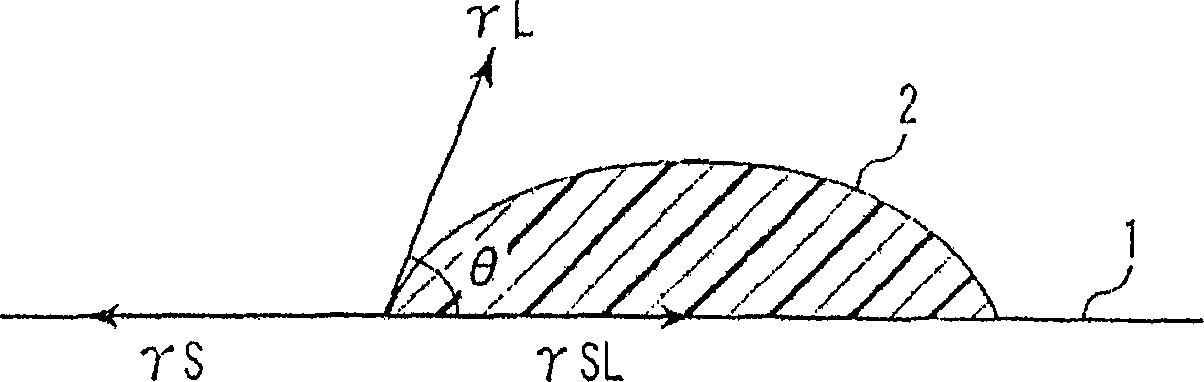
Figure 1 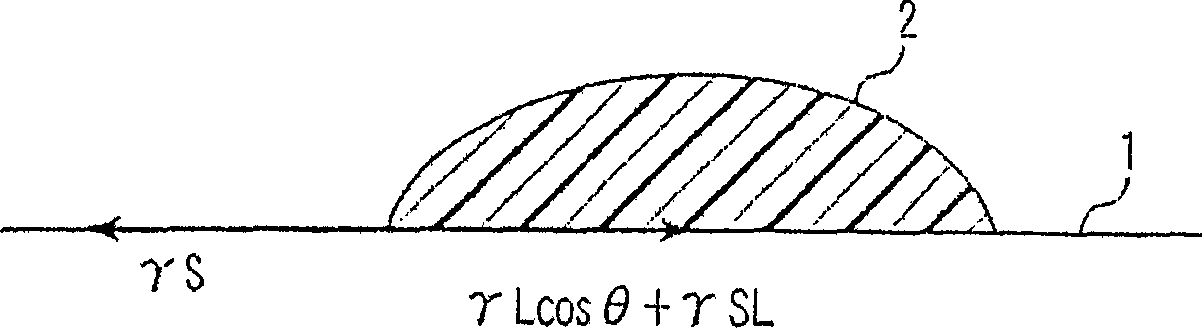
Figure 2 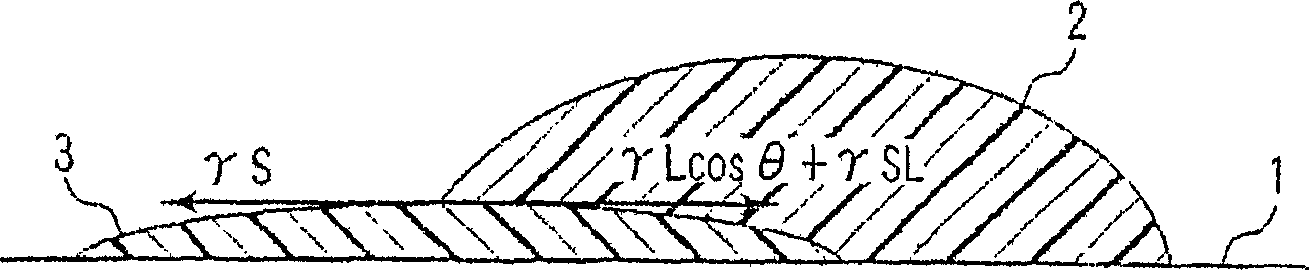
Figure 3
Abstract
Description
technical field
[0001] The present invention relates to an insulating pattern and a method for forming the same, in particular to a technique for forming an insulating pattern such as a solder resist using a repellent. Background technique
[0002] Solder resist ink (solder resist ink) is a product aimed at preventing solder bridges and protecting circuits when soldering components on printed wiring boards. Selective circuits that must be protected are selected by screen printing, etc. It can be covered by light curing, heat curing, etc. to make it have protective properties. On the other hand, mounting components are soldered to uncovered but selectively exposed portions. In addition, although the leads of the mounted components are mounted on the printed wiring board with solder, the area of the portion selectively exposed without being covered with the solder resist is generally smaller than the area covered with the solder resist.
[0003] Usually, a liquid compositi...
Examples
Embodiment 1
[0071] 100 parts by mass of carboxyl-containing copolymer resin (trade name: Cycroma-P250) produced by Diacel Chemical Industry Co., Ltd., 75 parts by mass of propylene glycol monomethyl ether, and silicone compound (trade name: KS-66) produced by Shin-Etsu Chemical Co., Ltd. 2 The parts by mass were fully mixed to obtain an alkali-soluble repellent (A-1).
[0072] The obtained repellent (A-1) was applied on the circuit-formed FR-4 substrate in a pattern reciprocal to the solder resist pattern using an inkjet printer, and dried and cured at 80° C. for 10 minutes.
Embodiment 2
[0074] 100 parts by mass of carboxyl-containing copolymer resin (trade name: Cycroma-P250) produced by Diacel Chemical Industry Co., 75 parts by mass of propylene glycol monomethyl ether, silicone compound (trade name: FS-1265-1000) produced by Toray DowCorning Silicone Co. ) and 2 parts by mass were fully mixed to obtain an alkali-soluble repellent (A-2).
[0075] The obtained repellent (A-2) was applied on the circuit-formed FR-4 substrate in a pattern reciprocal to the solder resist pattern using an inkjet printer, and dried and cured at 80° C. for 10 minutes.
Embodiment 3
[0077] 100 parts by mass of carboxyl-containing copolymer resin (trade name: Cycroma-P250) produced by Diacel Chemical Industry Co., 75 parts by mass of propylene glycol monomethyl ether, silicone grafted acrylic resin (trade name: X- 22-8195) 100 parts by mass were fully mixed to obtain an alkali-soluble repellent (A-3).
[0078] The obtained repellent (A-3) was applied on the circuit-formed FR-4 substrate in a pattern reciprocal to the solder resist pattern using an inkjet printer, and dried and cured at 80° C. for 10 minutes.