
Superconductive current lead welding method
A technology of wire welding and superconducting current, applied in welding equipment, metal processing equipment, manufacturing tools, etc., can solve problems such as loosening and brazing melting, and achieve the effects of reducing the chance of heating, easy operation, and low temperature
Patent Information
- Authority / Receiving Office
- CN · China
- Current Assignee / Owner
- Publication Date
- 2007-06-20
- Estimated Expiration
- Not applicable · inactive patent
Smart Images
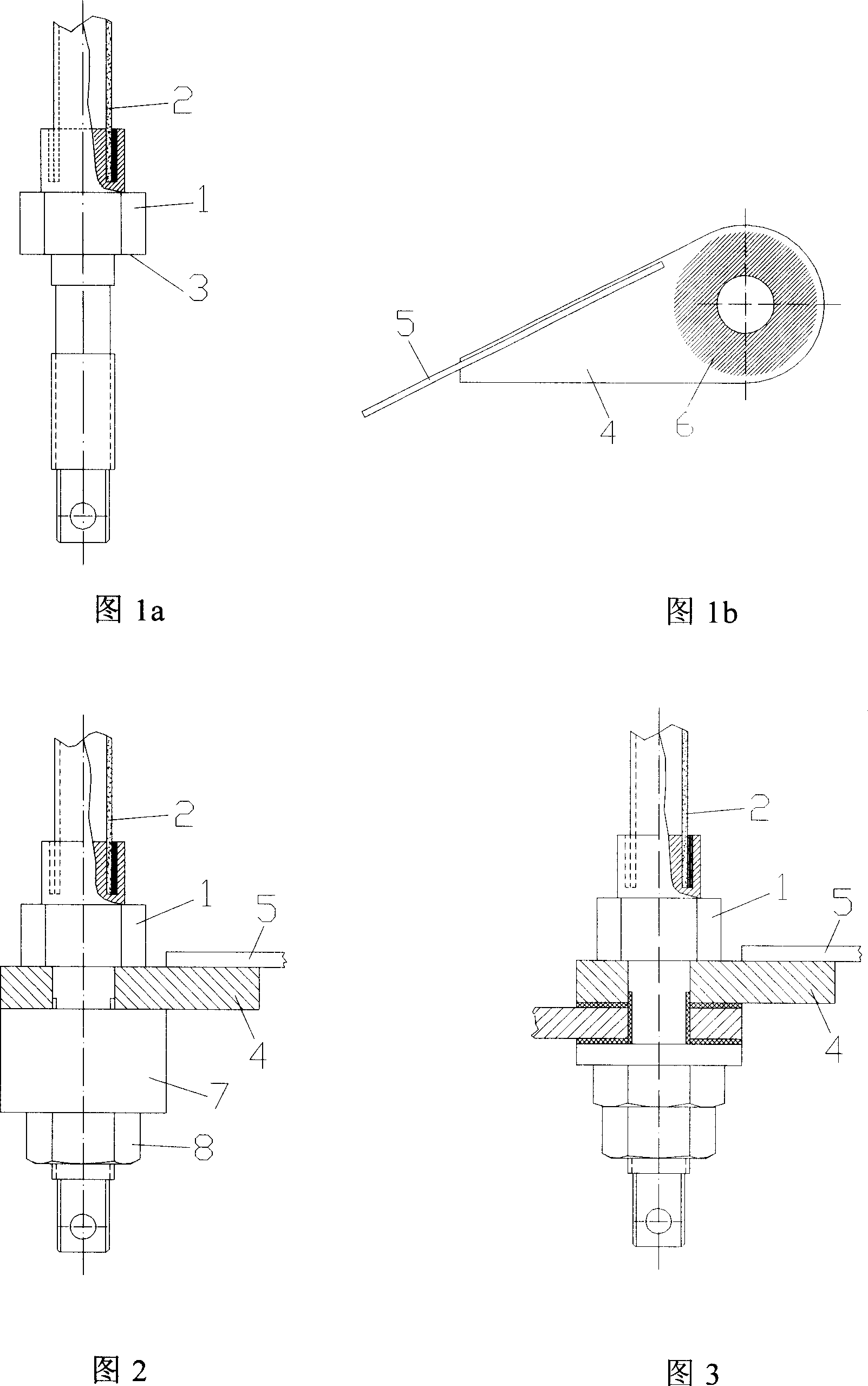
Figure 1
Abstract
Description
technical field
[0001] The invention relates to a welding method between superconducting wires in current leads of cryogenic devices. Background technique
[0002] The most primitive current lead in cryogenic devices is a piece of structure, made of copper or alloy materials. After the emergence of high-temperature superconductors, in order to reduce the heat leakage of the current leads, the current leads are changed to a two-stage structure, especially for the case of supplying power to superconducting magnets (or samples) in the extremely low temperature region. In the two-stage structure, the section above the liquid nitrogen temperature zone is still made of copper or alloy materials, and the section below the liquid nitrogen temperature zone is a tubular, rod-shaped or strip-shaped high-temperature superconductor.
[0003] Since the current carried by the superconducting current lead is generally relatively large, in order to reduce the joint resistance or consider th...
Examples
Embodiment Construction
[0013] The present invention will be further described below in conjunction with the accompanying drawings and specific embodiments.
[0014] As shown in FIG. 1 a , the copper pillar 1 is first soldered to the tubular high-temperature superconductor 2 by tin brazing, and at the same time solder is hung on the plane 3 of the copper pillar 1 . As shown in Figure 1b, the copper block 4 is first soldered to the lead-out wire 5 of the superconducting magnet with tin brazing. , which is the shaded area shown in Figure 1b, quickly wipe over to remove excess solder on this area.
[0015] In Fig. 2, the copper pillar 1 and the high-temperature superconductor 2 that have been welded together are put on a lathe to turn the solder layer on the plane 3 until only a thin layer of solder is left on the plane 3, and the thickness of the solder layer is equal to that on the plane 3. The color of copper is not exposed. After using a file to scrape off the excess solder on the edge of the roun...