
Non-regular electrical stimulation patterns for treating neurological disorders
a non-regular electrical stimulation and neurological disorder technology, applied in the field of systems and methods for stimulating nerves in animals, can solve the problems of increasing frequency, reducing the therapeutic window, and generating stronger side effects, and reducing the average stimulation frequency
Patent Information
- Authority / Receiving Office
- US · United States
- Patent Type
- Patents(United States)
- Current Assignee / Owner
- Publication Date
- 2021-05-25
Smart Images
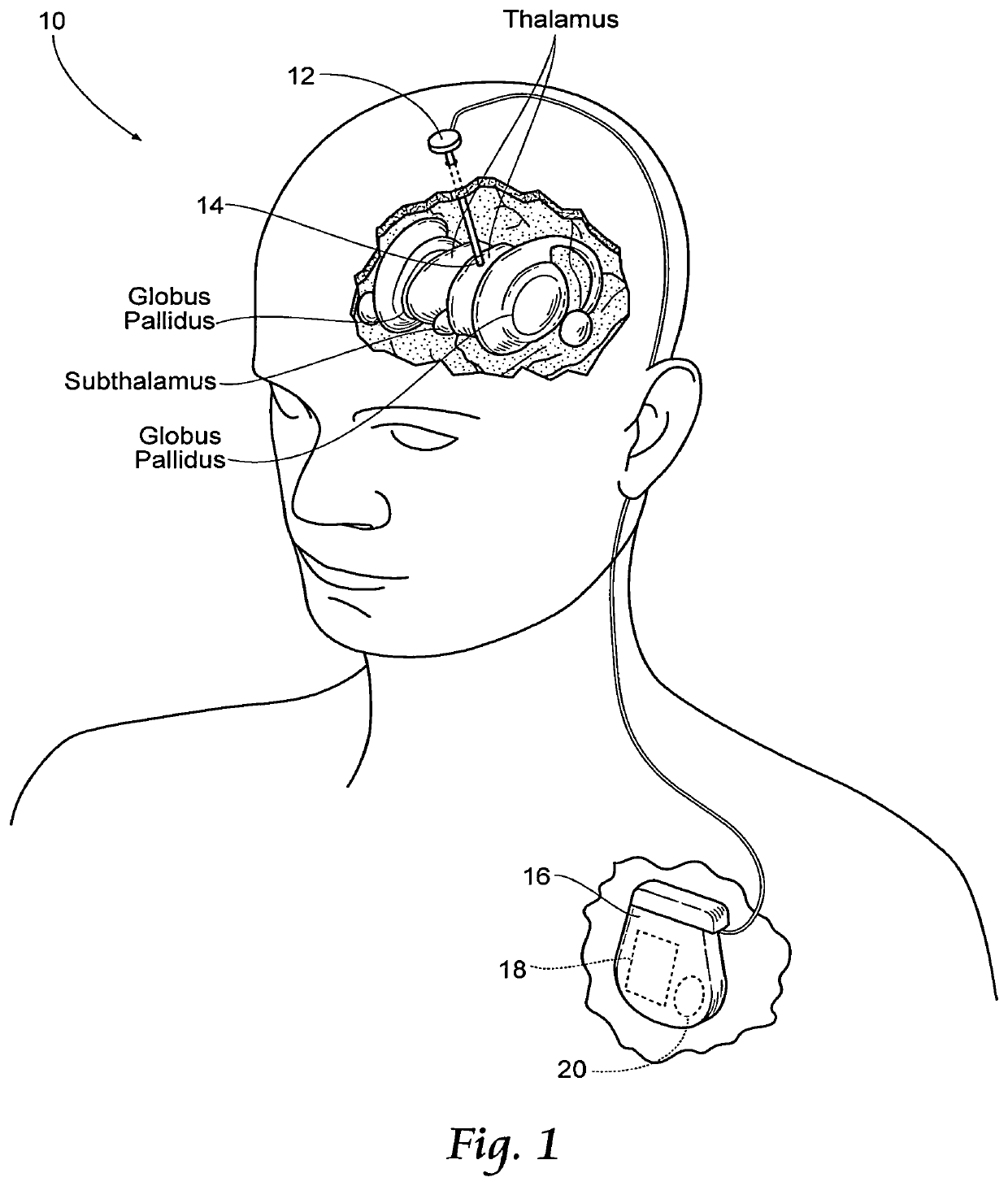
Figure 1 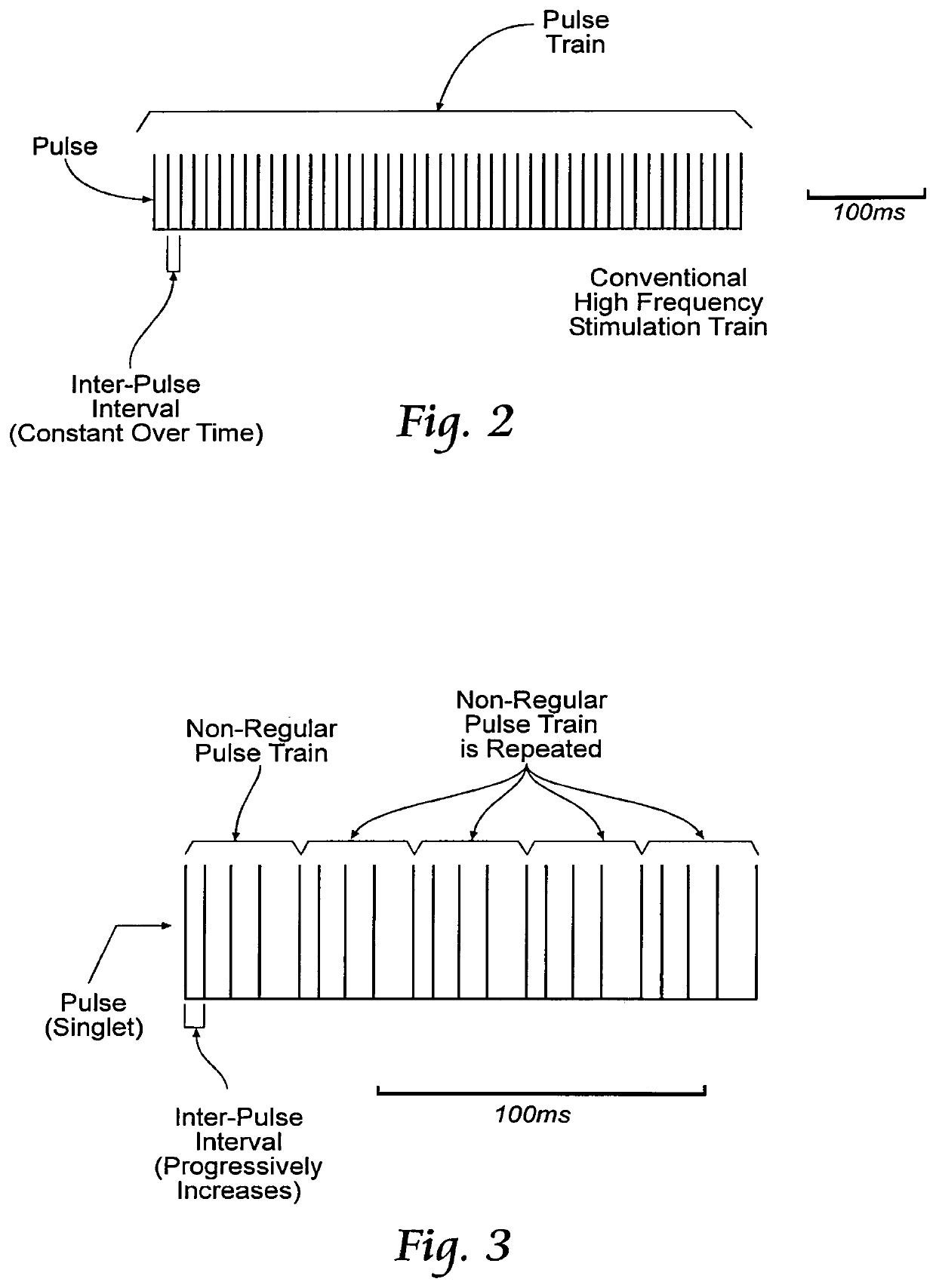
Figure 2 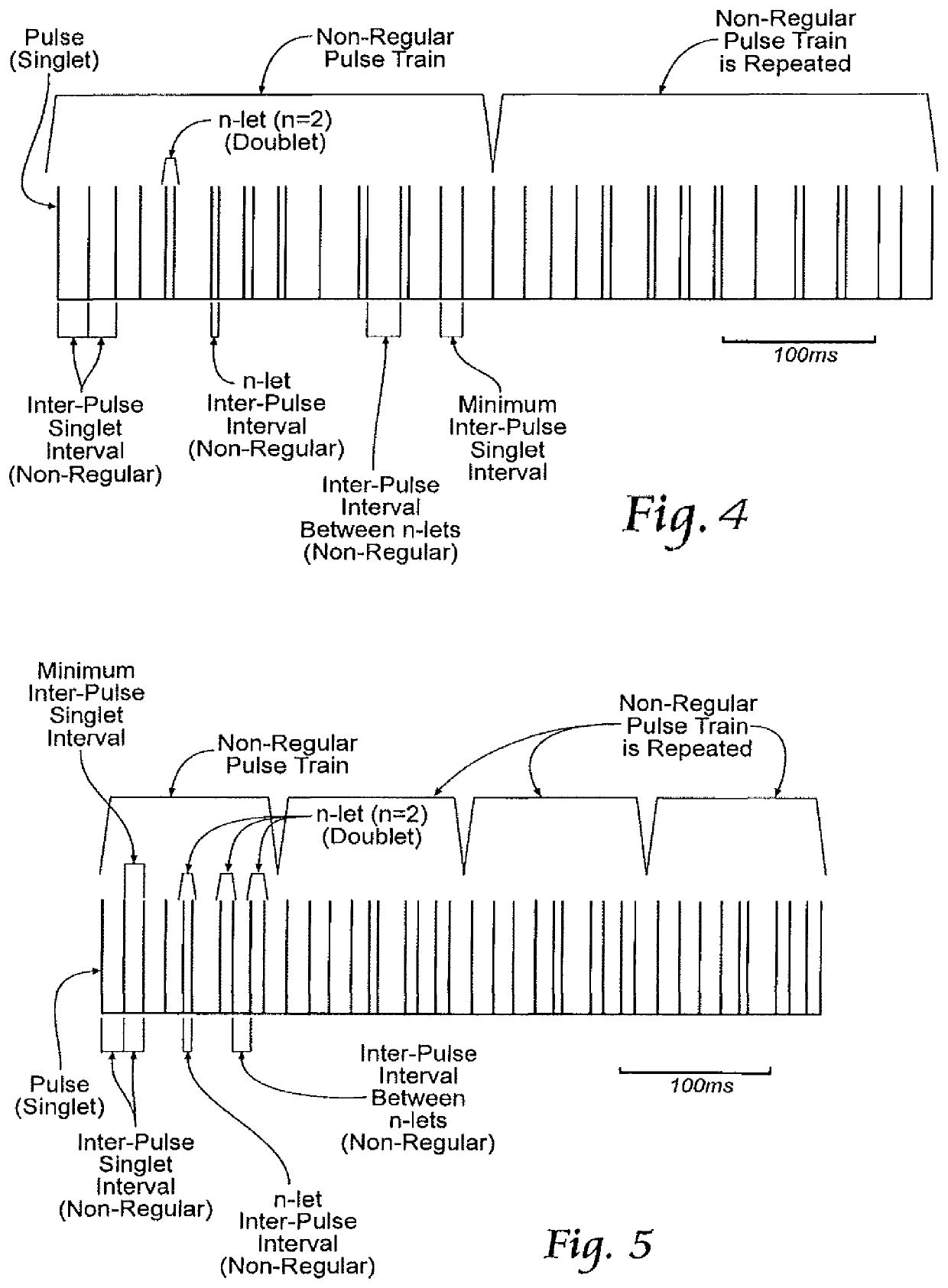
Figure 3
Abstract
Description
CROSS-REFERENCE TO RELATED APPLICATION
[0001] This application is a continuation-in-part of U.S. patent application Ser. No. 13 / 897,504, now U.S. Pat. No. 9,259,579, entitled “Non-Regular Electrical Stimulation Patterns for Treating Neurological Disorders,” filed May 20, 2013, which is a continuation of U.S. patent application Ser. No. 12 / 587,295, now U.S. Pat. No. 8,447,405, filed Oct. 5, 2009, and entitled “Non-Regular Electrical Stimulation Patterns for Treating Neurological Disorders,” which claimed the benefit of U.S. Provisional Patent Application Ser. No. 61 / 102,575, filed Oct. 3, 2008, and entitled “Stimulation Patterns For Treating Neurological Disorders Via Deep Brain Stimulation,” which are both incorporated herein by reference.FIELD OF THE INVENTION
[0002] This invention relates to systems and methods for stimulating nerves in animals, including humans.BACKGROUND OF THE INVENTION
[0003] Deep Brain Stimulation (DBS) has been found to be successful in treating a variety of brain...
Examples
example
[0048]Computational models of thalamic DBS (McIntyre et al. 2004, Birdno, 2009) and subthalamic DBS (Rubin and Terman, 2004) can be used with genetic-algorithm-based optimization (Davis, 1991) (GA) to design non-regular stimulation patterns or trains that produce desired relief of symptoms with a lower average stimulation frequency than regular, high-rate stimulation. McIntyre et al. 2004, Birdno, 2009; Rubin and Terman, 2004; and Davis, 1991 are incorporated herein by reference.
[0049]In the GA implementation, the stimulus train (pattern) is the chromosome of the organism, and each gene in the chromosome is the IPI between two successive pulses in the train. The implementation can start, e.g., with trains of 21 pulses (20 genes) yielding a train length of ˜400 ms (at average frequency of 50 Hz), and the 6 s trains required for stimulation are built by serial concatenation of 15 identical pulse trains. The process can start with an initial population of, e.g., 50 organisms, constitut...