
Integrated active flux microfluidic devices and methods
a microfluidic device and active flux technology, applied in the direction of fluid speed measurement, positive displacement liquid engine, flow mixer, etc., can solve the problems of large sample volume, high cost, time-consuming and labor-intensive, and conventional techniques are expensive and labor-intensive, so as to achieve rapid and complete sample exposure, quick and accurate analysis, and low cost
Patent Information
- Authority / Receiving Office
- US · United States
- Patent Type
- Applications(United States)
- Current Assignee / Owner
- Publication Date
- 2004-12-09
- Estimated Expiration
- Not applicable · inactive patent
Smart Images
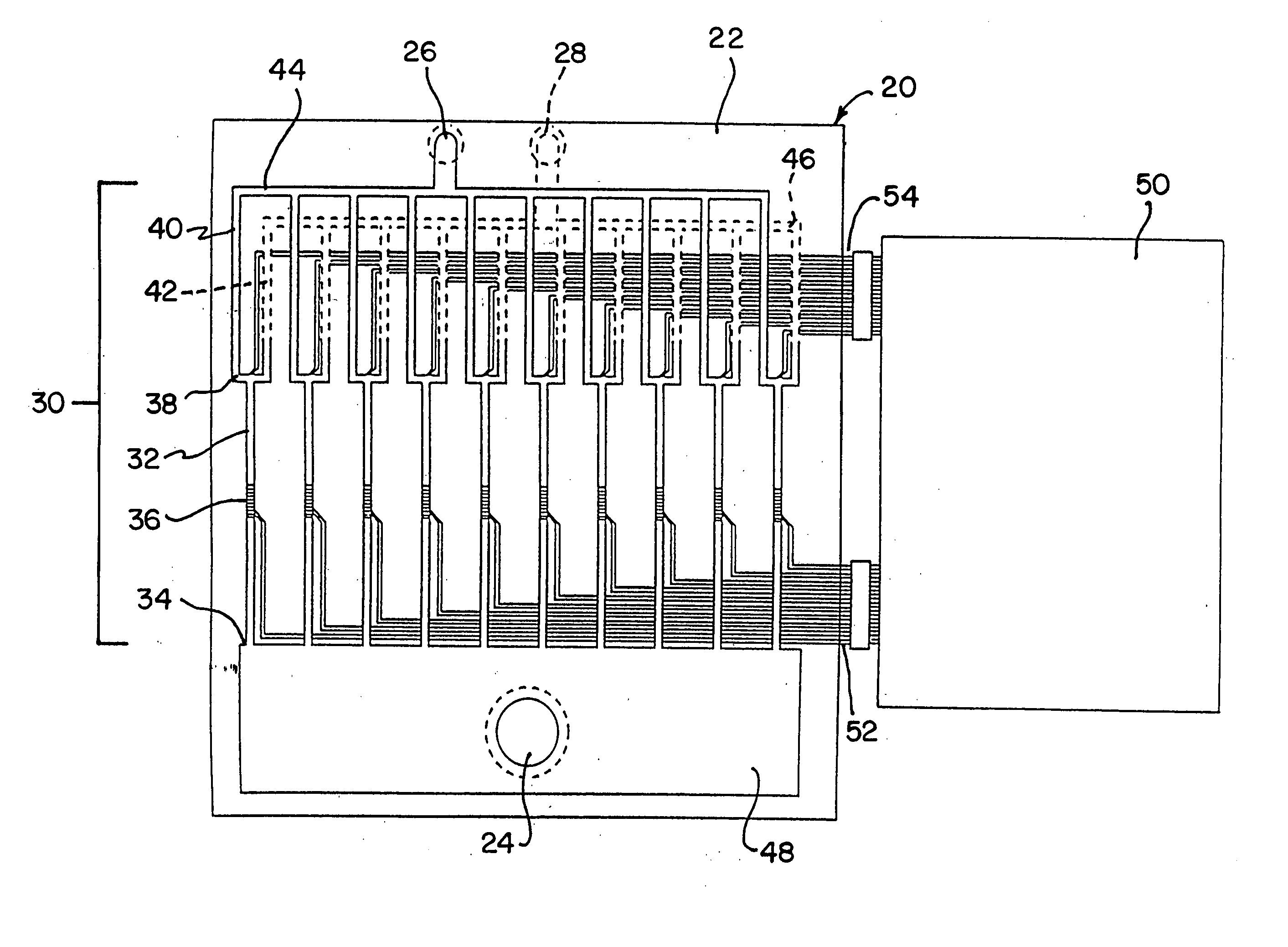
Figure 1 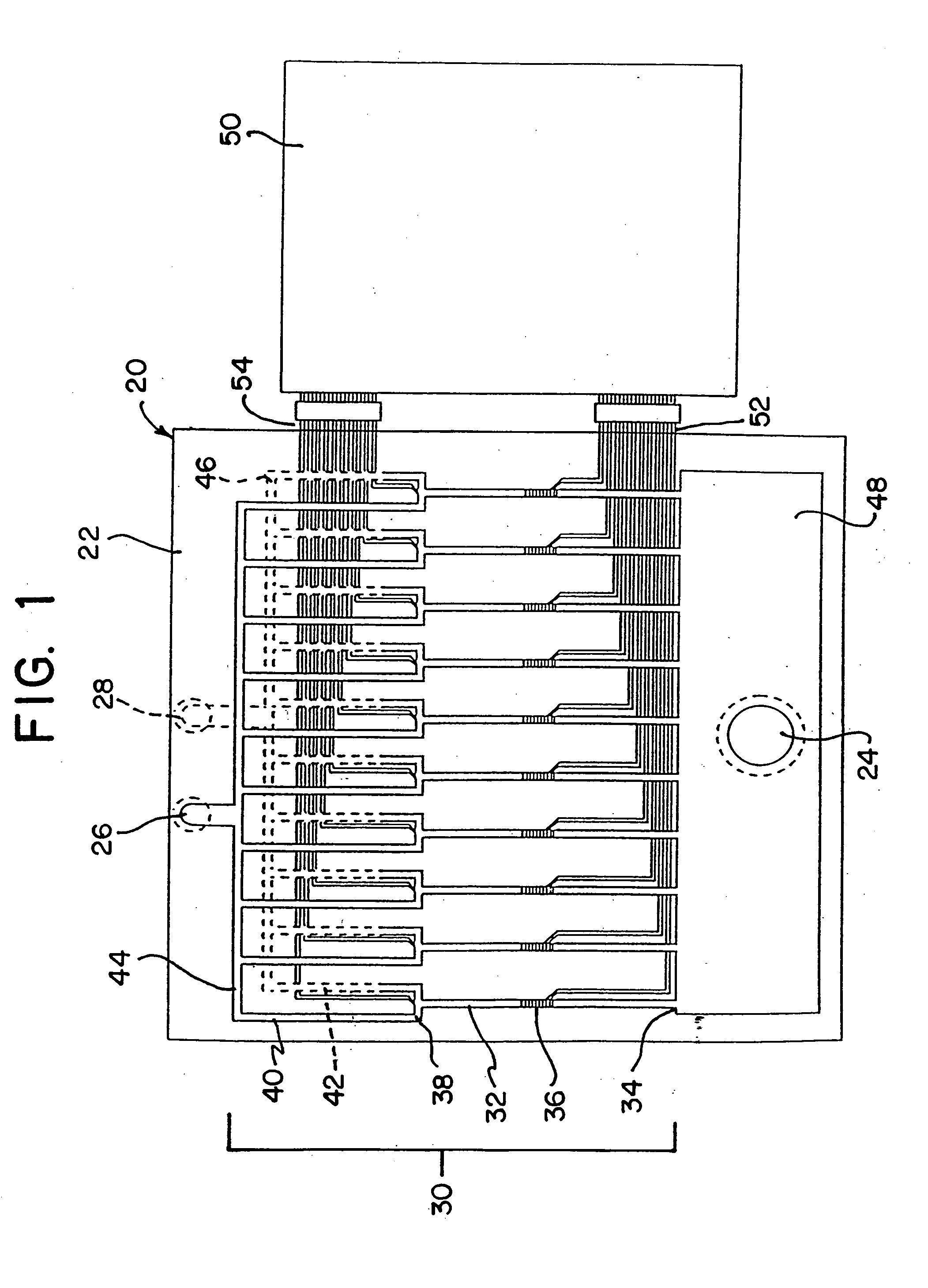
Figure 2 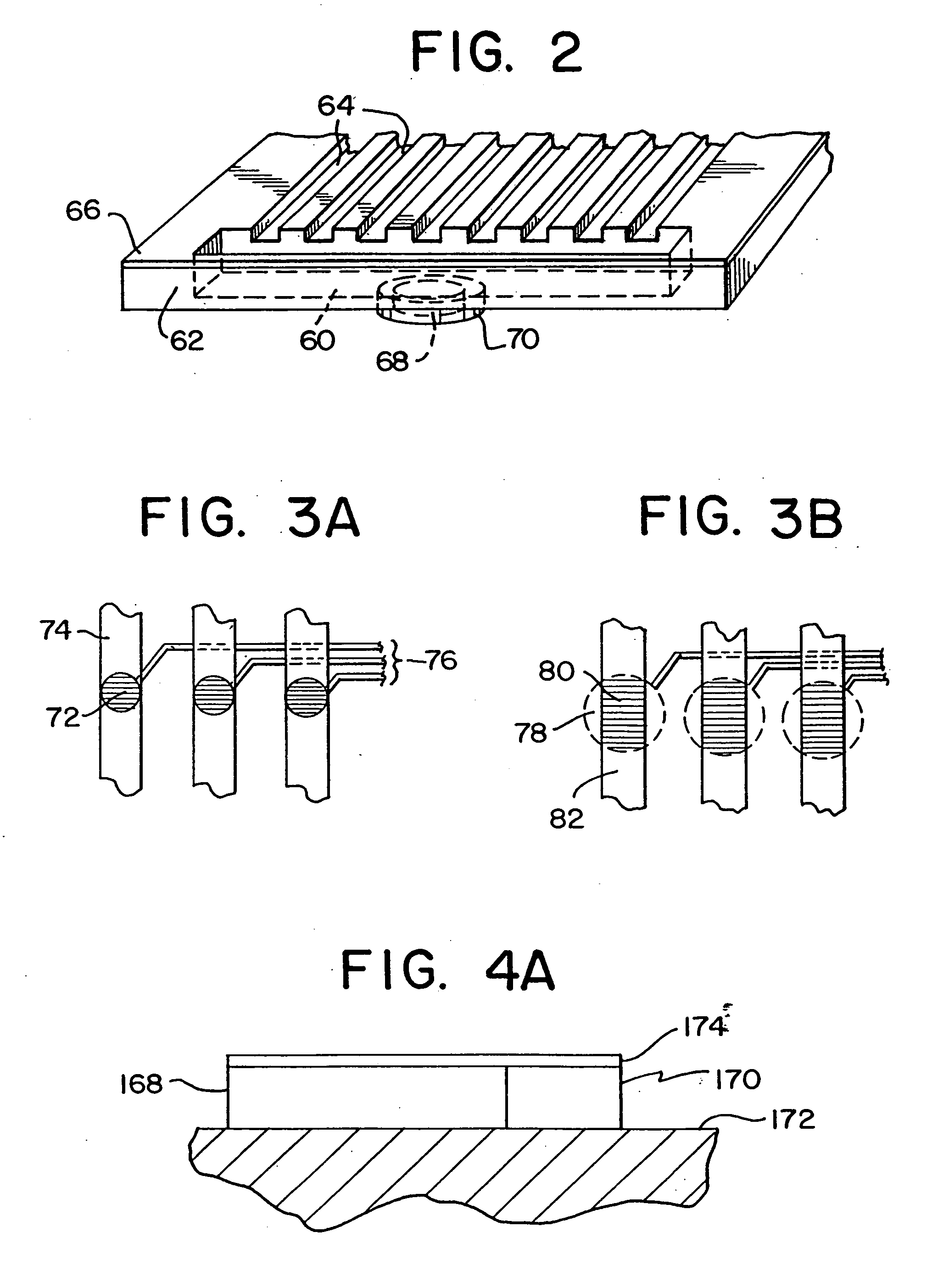
Figure 3
Abstract
Description
PRIORITY APPLICATIONS
[0001] This is a continuation-in-part of copending U.S. patent application Ser. No. 09 / 724,548 filed on Nov. 28, 2000. U.S. patent application Ser. No. 09 / 724,548 claims priority under 35 U.S.C. .sctn. 119(e) to copending U.S. provisional patent application serial Nos. 60 / 209,243; 60 / 211,309; and 60 / 249,360 filed on Jun. 5, 2000; Jun. 13, 2000; and Nov. 16, 2000, respectively. Each of these priority applications hereby incorporated, by reference, in its entirety.1. FIELD OF THE INVENTION
[0003] This invention relates to microfluidic devices and methods, including microfabricated multilayer elastomeric devices with active pumps and valves. More particularly, the devices and methods of the invention comprise a loop channel that is selectively open or closed to at least one input or output, and which actively circulates a fluid received in the loop. The loop can be closed by microvalves, for example elastomeric microvalves interposed between an inlet or outlet chann...
Examples
Embodiment Construction
5.1. Definitions
[0097] The terms used in this specification generally have their ordinary meanings in the art, within the context of the invention, and in the specific context where each term is used. For example, conventional techniques of molecular biology, microbiology and recombinant DNA techniques may be employed in accordance with the present invention. Such techniques and the meanings of terms associated therewith are explained fully in the literature. See, for example, Sambrook, Fitsch & Maniatis, Molecular Cloning: A Laboratory Manual, Second Edition (1989) Cold Spring Harbor Laboratory Press, Cold Spring Harbor, N.Y. (referred to herein as "Sambrook et al., 1989"); DNA Cloning: A Practical Approach, Volumes I and II (D. N. Glover ed. 1985); Oligonucleotide Synthesis (M. J. Gait ed. 1984); Nucleic Acid Hybridization (B. D. Hames & S. J. Higgins, eds. 1984); Animal Cell Culture (R. I. Freshney, ed. 1986); Immobilized Cells and Enzymes (IRL Press, 1986); B. E. Perbal, A Pract...