
Afinity domain for analyte sensor
a sensor and analyte technology, applied in the field of systems and methods involving the detection or measurement of analytes, can solve the problems of increasing signal strength, acetaminophen interfering species, and other electroactive species, and achieve the effect of reducing the effects of all interfering species
Patent Information
- Authority / Receiving Office
- US · United States
- Patent Type
- Applications(United States)
- Current Assignee / Owner
- Publication Date
- 2005-08-11
- Estimated Expiration
- Not applicable · inactive patent
Smart Images
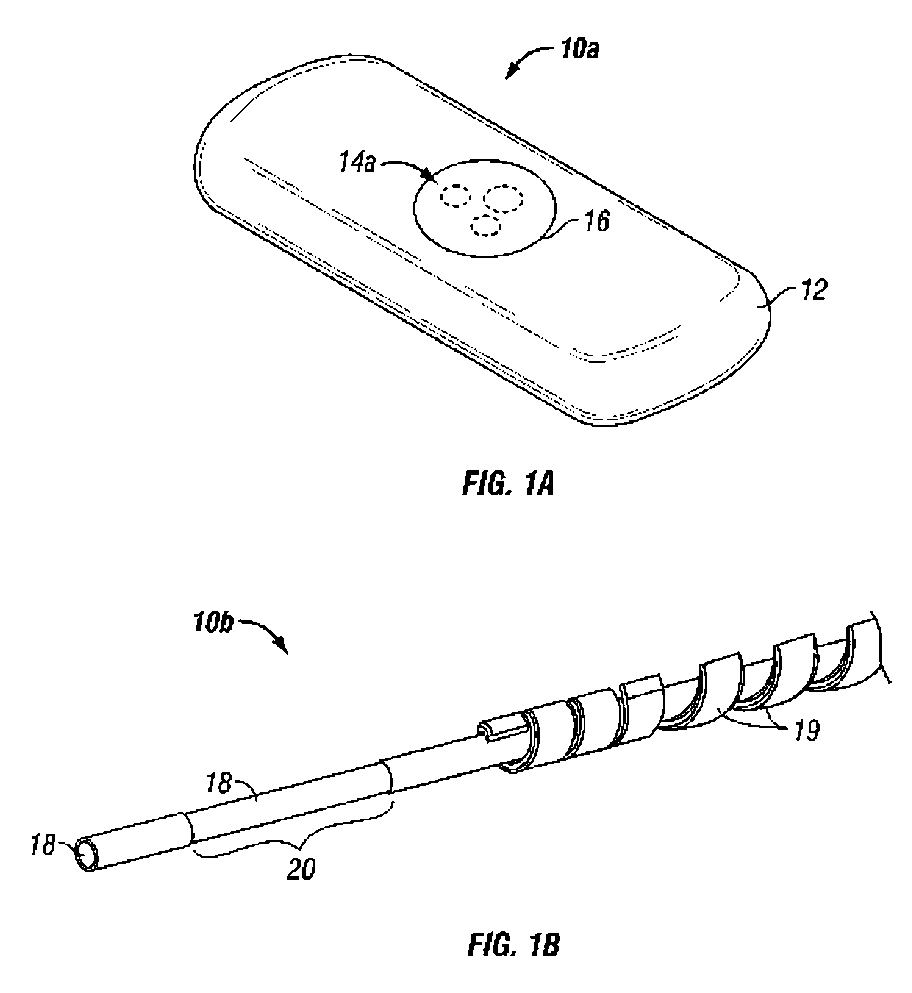
Figure 1 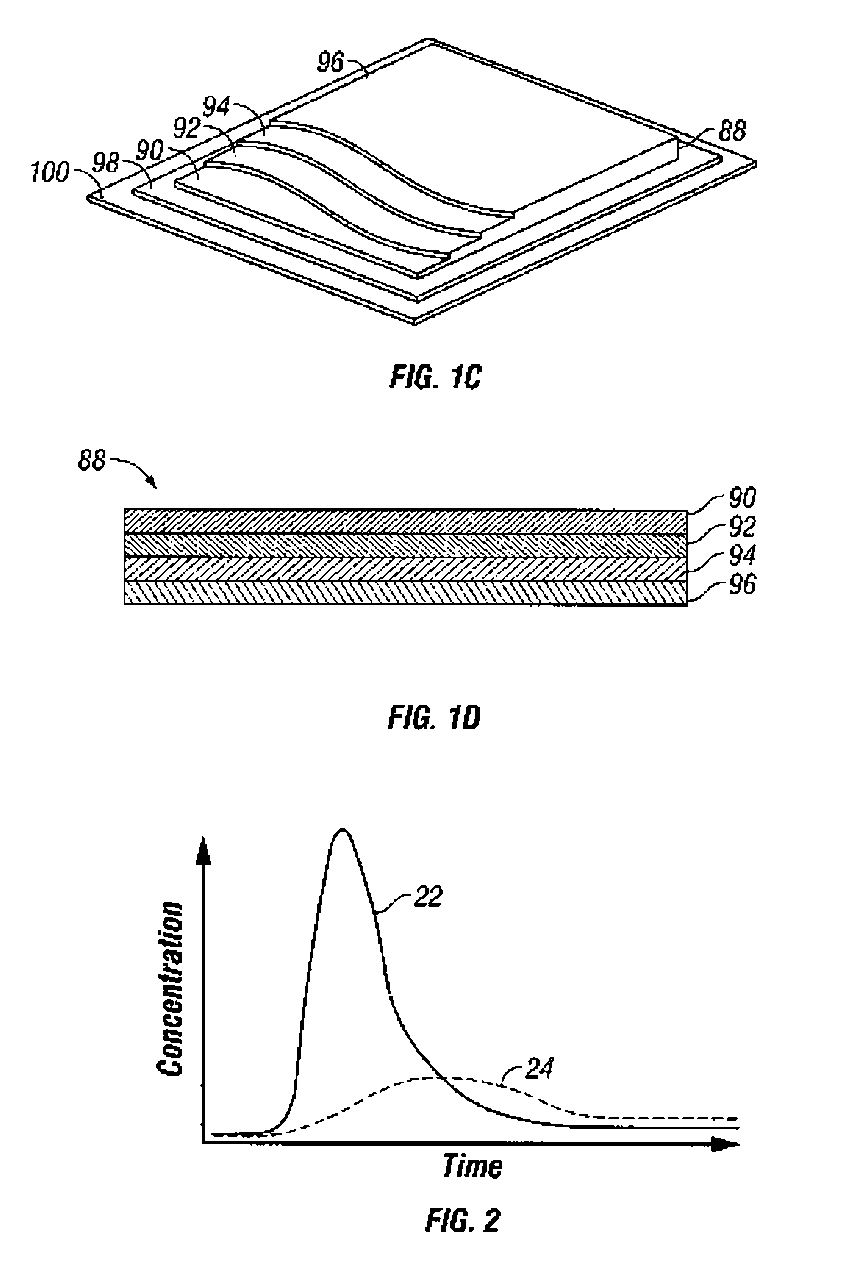
Figure 2 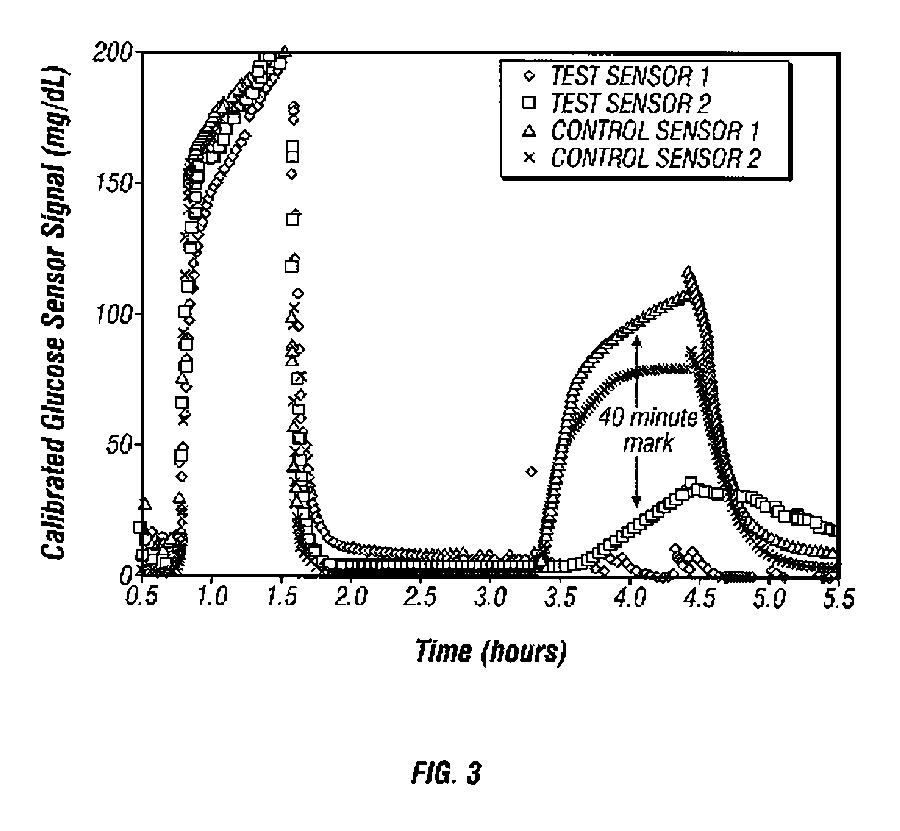
Figure 3
Abstract
Description
Detailed Description of the InventionRELATED APPLICATIONS
[0001] This application claims the benefit of priority under 35 U.S.C. § 119(e) to U.S. Provisional Application No. 60 / 523,832 filed November 19, 2003, U.S. Provisional Application No. 60 / 587,787, filed July 13, 2004, and U.S. Provisional Application No. 60 / 614,683, filed September 30, 2004. Each above-referenced prior application is incorporated by reference herein in its entirety.FIELD OF THE INVENTION
[0002] The present invention relates generally to systems and methods involving the detection or measurement of analytes. More particularly, the present invention relates to reducing the effects of interfering species on a signal obtained from a glucose sensor.BACKGROUND OF THE INVENTION
[0003] A variety of sensors are known that use an electrochemical cell to provide output signals by which the presence or absence of an analyte in a sample can be determined. For example in an electrochemical cell, an analyte (or a species de...
Examples
first embodiment
[0007] Accordingly, in a first embodiment, a membrane suitable for use with an analyte sensor is provided, the membrane comprising an affinity domain, wherein the affinity domain comprises a sorbent having an affinity for an interfering species.
[0008] In an aspect of the first embodiment, the sorbent has an affinity for a phenol-containing species.
[0009] In an aspect of the first embodiment, the sorbent has an affinity for acetaminophen.
[0010] In an aspect of the first embodiment, the sorbent comprises an adsorbent substance.
[0011] In an aspect of the first embodiment, the adsorbent substance comprises a chromatography-packing material.
[0012] In an aspect of the first embodiment, the sorbent comprises a molecularly imprinted surface adapted to bind with the interfering species by covalent adherence.
[0013] In an aspect of the first embodiment, the sorbent comprises a molecular structure that has a geometric structure and hydrogen binding capability, wherein the molecular structure is...
fifth embodiment
[0017] In a fifth embodiment, an analyte sensor for measuring the concentration of an analyte in a host is provided, the sensor comprising a sensing region for sensing the analyte; and a membrane system comprising an affinity domain, the affinity domain having an affinity for an interfering species, wherein the membrane system is disposed adjacent to the sensing region.
[0018] In an aspect of the fifth embodiment, the sensing region comprises an electroactive surface and wherein the membrane system comprises an enzyme capable of reacting with the analyte.
[0019] In an aspect of the fifth embodiment, the affinity domain comprises a sorbent, wherein the sorbent is configured to slow the diffusion of the interfering species through the membrane system to the sensing region.
[0020] In an aspect of the fifth embodiment, the sorbent has an affinity for a phenol-containing species.
[0021] In an aspect of the fifth embodiment, the sorbent has an affinity for acetaminophen.
[0022] In an aspect of...