
Fused bicycloheterocycle substituted quinuclidine derivatives
a technology of cycloheterocycle and quinuclidine, which is applied in the direction of biocide, drug composition, cardiovascular disorder, etc., can solve the problem that not all the effects mediated by nicotine are desirabl
Patent Information
- Authority / Receiving Office
- US · United States
- Patent Type
- Applications(United States)
- Current Assignee / Owner
- Publication Date
- 2005-11-03
- Estimated Expiration
- Not applicable · inactive patent
Smart Images
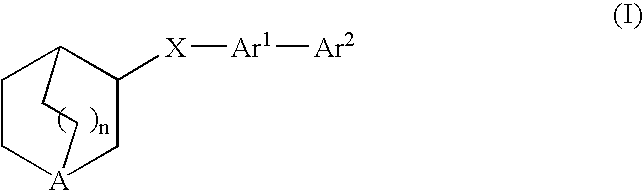
Figure 1 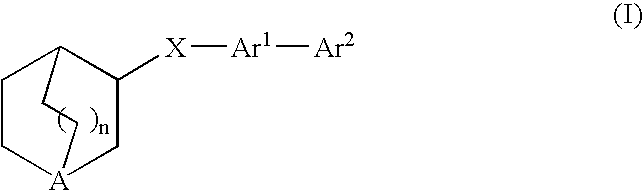
Figure 2 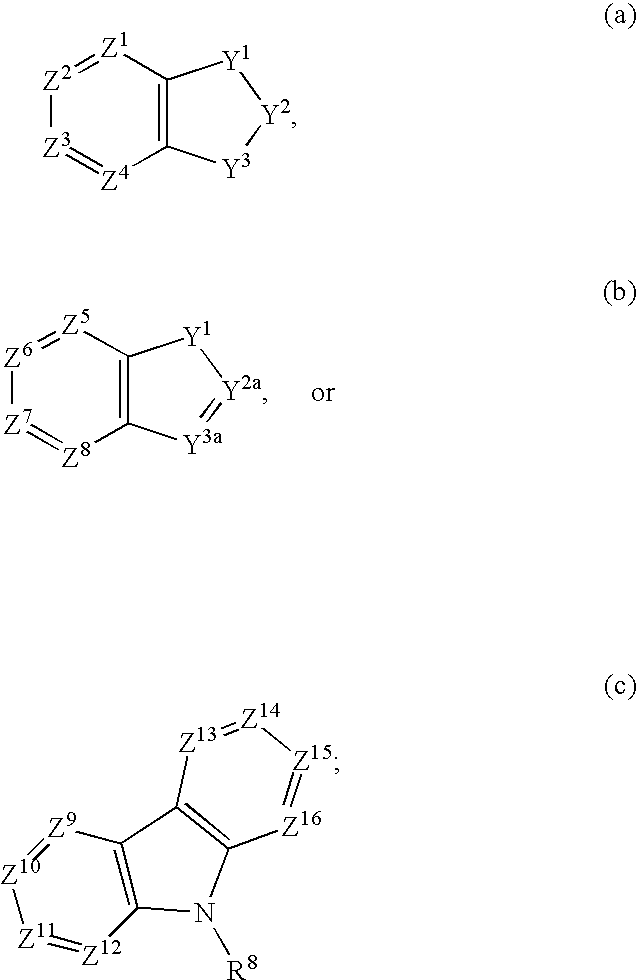
Figure 3
Abstract
Description
[0001] This application claims priority from U.S. patent application Ser. No. 11 / 015,236, filed on Dec. 17, 2004, which claims the benefit of U.S. Provisional Patent Application Ser. No. 60 / 531,864, filed Dec. 22, 2003, incorporated herein by reference.TECHNICAL FIELD
[0002] The invention relates to fused bicycloheterocycle substituted quinuclidine derivatives, compositions comprising such compounds, and methods of treating conditions and disorders using such compounds and compositions. DESCRIPTION OF RELATED TECHNOLOGY
[0003] Nicotinic acetylcholine receptors (nAChRs) are widely distributed throughout the central (CNS) and peripheral (PNS) nervous systems. Such receptors play an important role in regulating CNS function, particularly by modulating release of a wide range of neurotransmitters, including, but not necessarily limited to acetylcholine, norepinephrine, dopamine, serotonin and GABA. Consequently, nicotinic receptors mediate a very wide range of physiological effects, and...
Examples
example 1
3-[4-(1-Azabicyclo[2.2.2]oct-3-yloxy)phenyl]-1H-indole
example 1a
3-(4-Iodophenoxy)quinuclidine
[0228] Under N2, the mixture of 3-hydroxy quinuclidine (Aldrich, 2.54 g, 20 mmol), 1,4-diiodobenzene (Aldrich, 7.9 g, 24 mmol), CuI (Strem Chemicals, 0.38 g, 2 mmol) and 1,10-phenanthroline (Aldrich, 0.72 g, 4 mmol) in toluene (anhydrous, Aldrich, 50 mL) was stirred at 110° C. for 40 h. After the reaction went to completion, the reaction mixture was diluted with chloroform (100 mL) and washed with water (2×10 mL). The organic solution was concentrated and the title compound was purified by chromatography (SiO2, CH2Cl2: MeOH:NH3.H2O, 90:10:1, Rf. 0.20) as oil (3.7 g, yield, 56%). 1H NMR (300 MHz, CD3OD) δ 1.40-1.56 (m, 1H), 1.64-1.80 (m, 2H), 1.90-2.08 (m, 1H), 2.10-2.21 (m, 1H), 2.60-3.00 (m, 5H), 3.34-3.40 (m, 1H), 4.46 (m, 1H), 6.73 (d, J=8.8 Hz, 2H), 7.56 (d, J=8.8, Hz, 2H), ppm. MS (DCI / NH3) m / z 330 (M+H)+.
example 1b
3-[4-(1-Azabicyclo[2.2.2]oct-3-yloxy)phenyl]-1H-indole
[0229] The mixture of the product of Example 1A (330 mg, 1 mmol), N-(2-ethynyl-phenyl)-2,2,2-trifluoro-acetamide (ref. Tetrahedron Lett. 1992, 33, 3915.; 280 mg, 1.3 mmol), Pd2(dba)3 (Aldrich, 19 mg, 0.02 mmol) and K2CO3 (180 mg, 1.3 mmol) in DMSO (3 mL) was stirred at 40 ° C. under N2 for 2 hours. The reaction was monitored with TLC. After the reaction was complete, it was cooled down to room temperature and diluted with EtOAc (50 mL). It was then washed with brine (3×5 mL). The organic solution was concentrated and the title product was purified by preparative HPLC (Gilson, column, Symmetry® C-8 7 μm, 40×100 mm. Eluting Solvent, MeCN / H2O (with 0.2% v. TFA) (v. 90 / 10 to 10 / 90 over 20 min.) Flow rate, 75 mL / min., uv, 250 nm) as solid (113 mg, yield, 36%). 1H NMR (300 MHz, CD3OD) δ 1.43-1.57 (m, 1H), 1.62-1.89 (m, 2H), 2.01-2.15 (m, 1H), 2.16-2.23 (m, 1H), 2.73-3.03 (m, 5H), 3.28-3.40 (m, 1H), 4.51-4.58 (m, 1H), 6.97 (dt, J=8.8, ...