
Heterodyning time resolution boosting method and system
Patent Information
- Authority / Receiving Office
- US · United States
- Current Assignee / Owner
- Publication Date
- 2006-03-23
- Estimated Expiration
- Not applicable · inactive patent
Smart Images
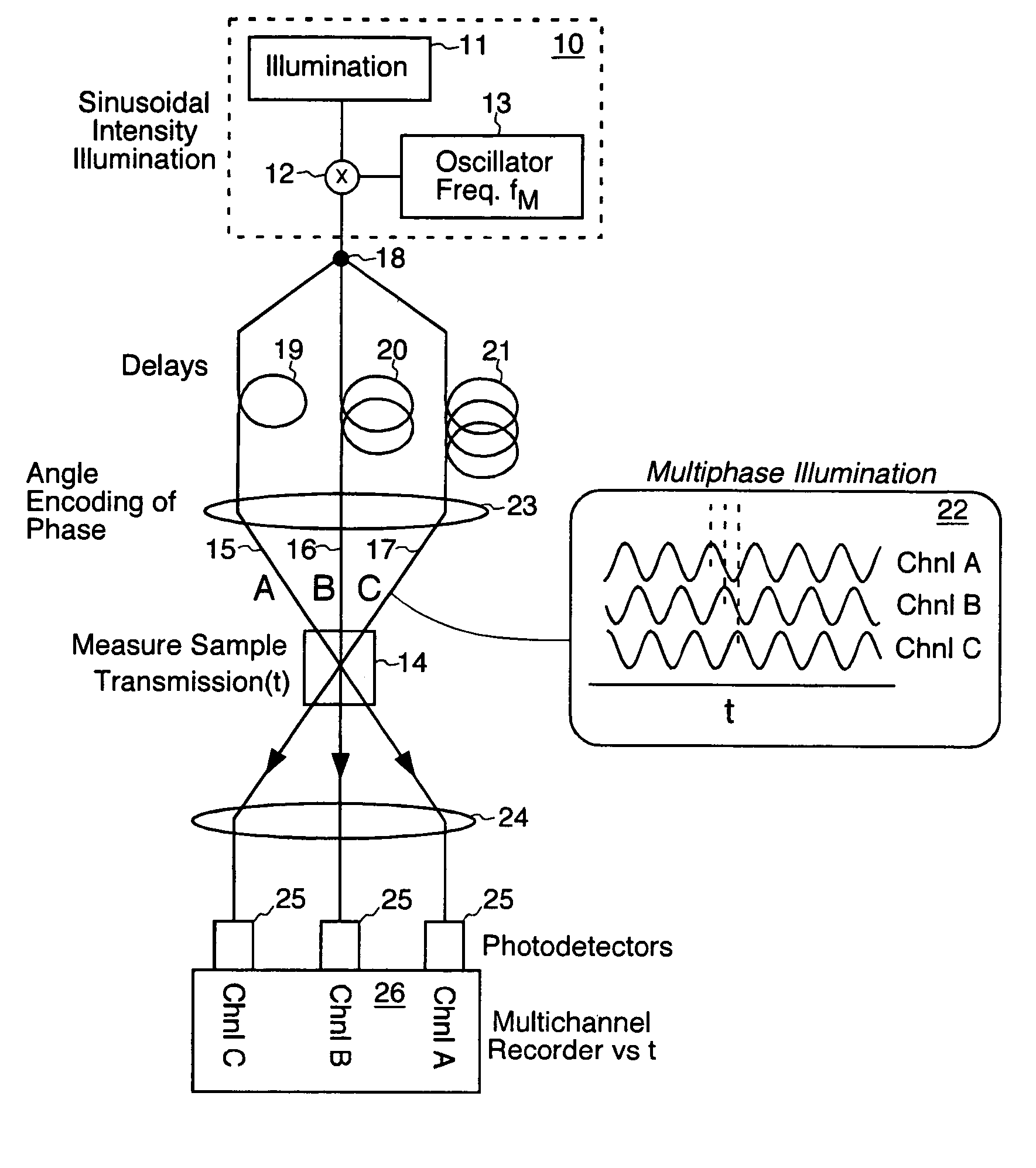
Figure 1 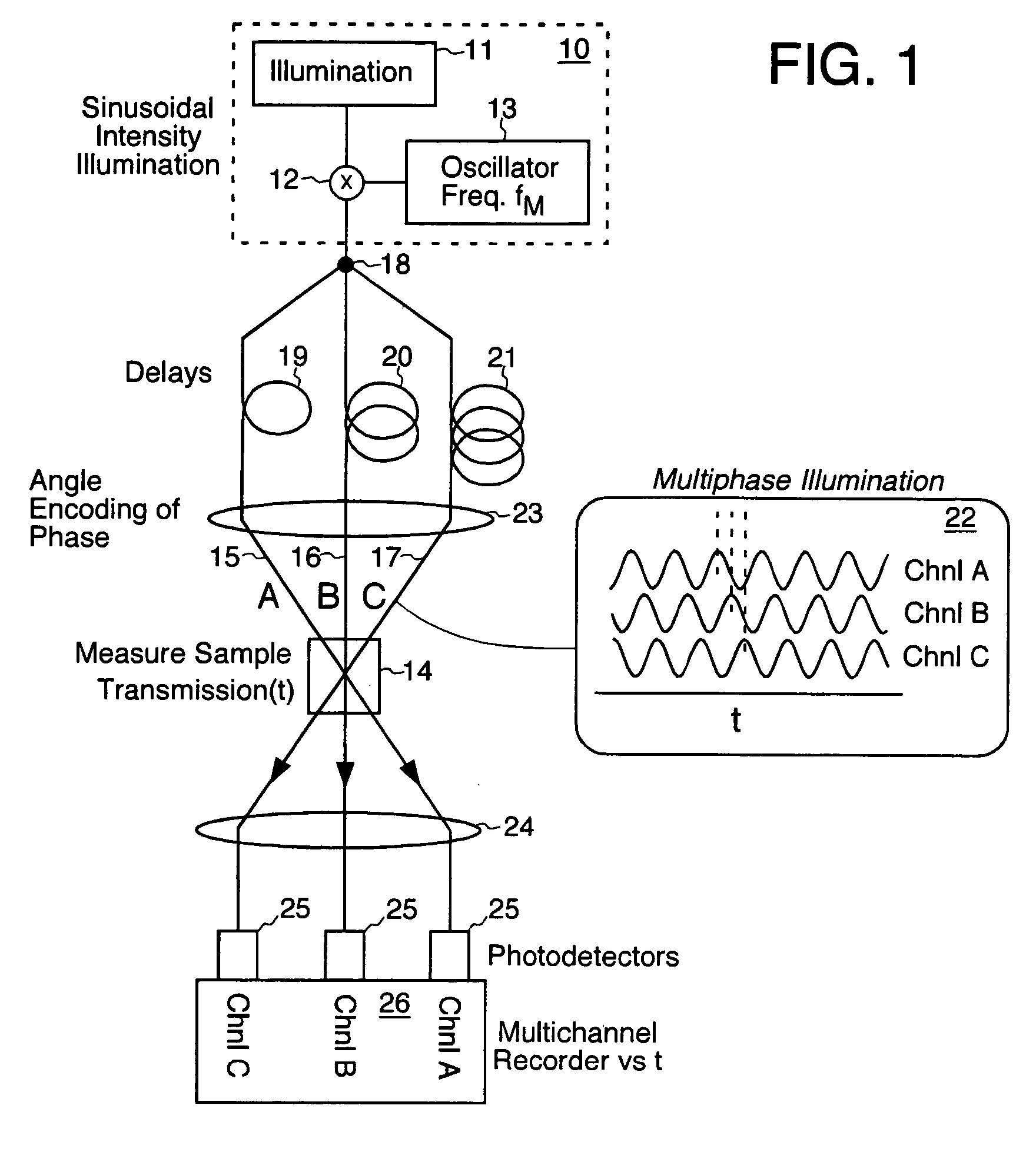
Figure 2 
Figure 3
Abstract
Description
I. CLAIM OF PRIORITY IN PROVISIONAL APPLICATION
[0001] This application claims priority in provisional application No. 60 / 612,441, filed on Sep. 22, 2004, entitled “Heterodyning Time Resolution Boosting” by David John Erskine.
[0002] The United States Government has rights in this invention pursuant to Contract No. W-7405-ENG-48 between the United States Department of Energy and the University of California for the operation of Lawrence Livermore National Laboratory.II. FIELD OF THE INVENTION
[0003] The present invention relates to the high speed recording of signals, and more specifically the use of modulation to produce heterodyned beats in optical signals, the detection of which enhances signal measurement at high resolution. The present invention also relates to the high resolution recording of optical spectra, and more specifically the use of interferometric modulation to produce heterodyned beats, the detection of which enhances spectral measurement at high resolution. Furtherm...
Examples
Embodiment Construction
Encoding Phase-Differentiated Illumination Channels by Angle
[0067] Turning now to the drawings, FIG. 1 shows an embodiment of the invention that uses multiple phase-differentiated illumination channels, e.g. 15, 16, and 17, encoded by angle to measure a sample 14 transmission (or reflectivity) versus time. A light source 10 which has a sinusoidal variation of intensity versus time at frequency fM illuminates the sample. This could be created for example from a constant illumination source 11 by modulating light at an intensity modulator 12 controlled by a local oscillator signal 13 having frequency fM. This fM is referred to as a modulating or heterodyning frequency. The intensity modulator 12 could be implemented by an acousto-optical device commonly used in the laser sciences, which uses sound waves traveling in a crystal to diffract a beam of light away from a non-diffracted output into a diffracted output. Applying an oscillating voltage at frequency fM to the acousto-optic el...