
Soft paper sheet with improved mucus removal
a soft paper and mucus technology, applied in the field of soft paper sheets with improved mucus removal, can solve the problems that untreated tissue treated with polysiloxane may have a reduced cleaning ability relative to untreated tissue, and achieve the effects of reducing the amount of mucus, and high degree of softness
Patent Information
- Authority / Receiving Office
- US · United States
- Patent Type
- Applications(United States)
- Current Assignee / Owner
- Publication Date
- 2006-11-02
- Estimated Expiration
- Not applicable · inactive patent
Smart Images
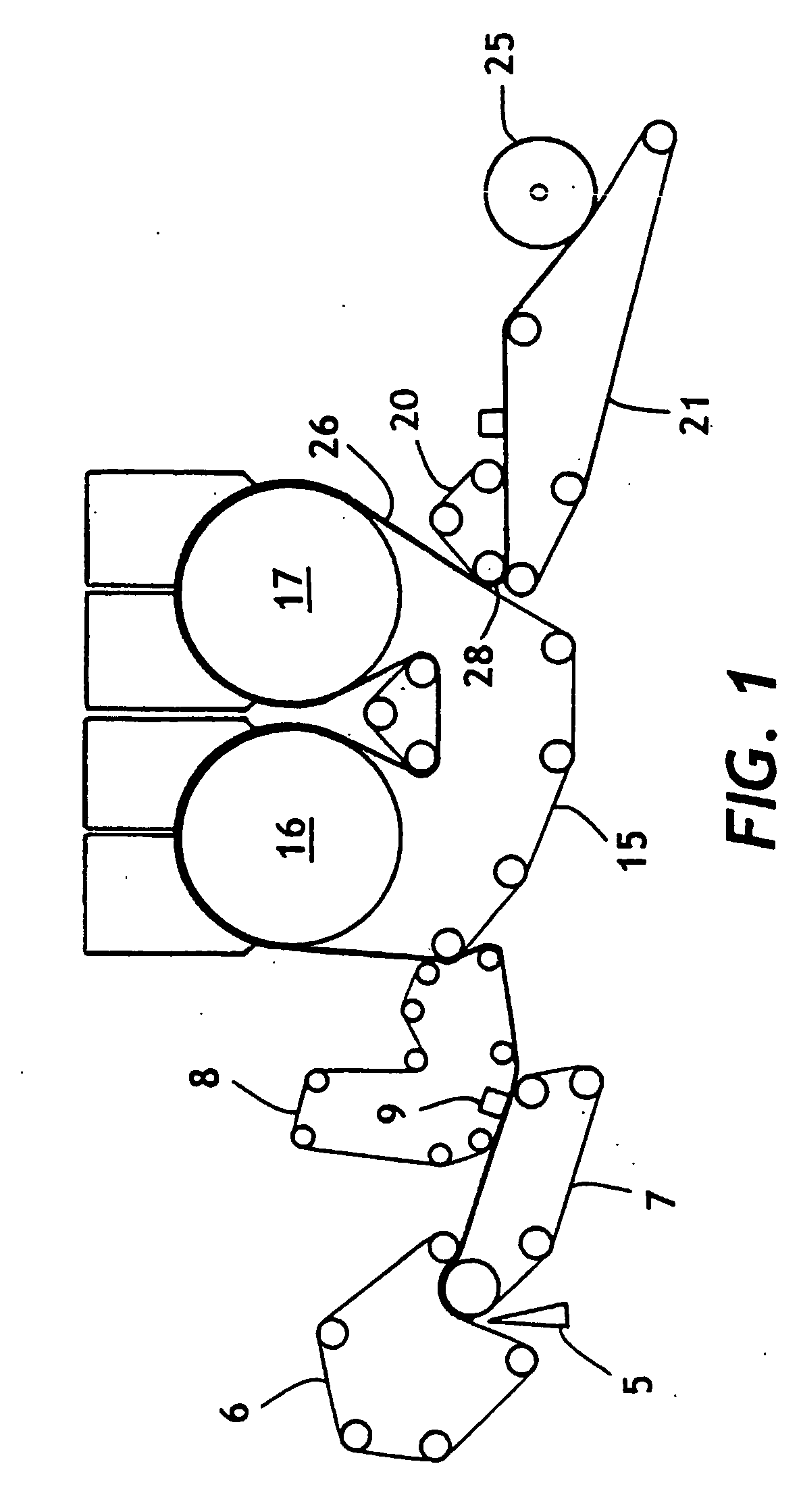
Figure 1 
Figure 2 
Figure 3
Abstract
Description
BACKGROUND OF THE INVENTION
[0001] Softness is a key consumer attribute of facial tissue. It is known that enhanced softness can be developed with the topical application of a polysiloxane. For nose care applications, an additional benefit to polysiloxanes can be the hydrophobicity that the polysiloxane imparts to the tissue sheet. While hydrophobicity, in general, can be an undesirable attribute for an absorbent tissue for nose care applications, such hydrophobicity can be perceived as a consumer benefit in preventing the passage of nasal secretions through the tissue and onto the users hand.
[0002] While polysiloxanes can greatly enhance the softness attributes of the tissue, as well as the ability of the tissue to protect the user's hand, the ability of the tissue sheet to remove mucus and similar high viscosity materials can be reduced by application of the polysiloxane. As such, tissues treated with polysiloxane may have a reduced cleaning capability relative to an untreated ti...
Examples
example 1
[0145] A pilot tissue machine was used to produce a layered, uncreped throughdried facial tissue web with a basis weight of 21.8 grams per square meter per ply, as described in FIG. 1. A furnish of 1000 lbs of bleached northern softwood kraft fiber was dispersed in a pulper for 30 minutes at a consistency of 4 to 5 percent. The stock was sent to a dump chest and diluted to a consistency of 2 to 3 percent and then transferred to a machine chest. The machine chest stock was then passed through a refiner and refined to approximately 550-600 ml Canadian Standard Freeness. This furnish consisted of approximately 20 percent of the sheet, which was placed in the center-layer of the sheet and not in direct contact with user's hands.
[0146] A furnish of 2200 lbs of bleached hardwood kraft fiber was dispersed in a pulper for 20 minutes at a consistency of 10 percent. The stock slurry was sent to a holding chest and mixed with a cationic quaternary imidazoline debonder (Prosoft TQ1003 is comme...
example 2
[0153] Example 2 was produced using the same machine settings as described in the Example 1, except with the following changes:
[0154] The tissue web consisted of approximately 32 percent of bleached northern softwood kraft fiber, approximately 48 percent of debonder treated bleached hardwood kraft fiber, and approximately 20 percent broke. The broke fiber, of a similar composition to the above furnish, was dispersed in a pulper for 30 minutes at a consistency of 3 to 4 percent. Following the addition of the wet strength resin Kymene, a glyoxylated polyacrylamide dry strength addition (PAREZ 631 NC, commercially available from Cytec Industries, New Jersey) was added to achieve the required tissue web strength. The PAREZ was diluted to approximately 0.86 percent active solids, and was pumped into the stock outlet from the stuffbox by a chemical addition pump at an addition level of 2 kg / MT of dry fiber. The PAREZ addition point was located such that the addition occurred only a few s...
example 3
[0156] Example 3 was produced using the same machine settings as described in Example 2, except with the following changes:
[0157] The tissue web consisted of approximately 36 percent of bleached northern softwood kraft fiber and approximately 64 percent of debonder treated bleached hardwood kraft fiber. In which, approximately 44 percent of the hardwood was placed in the fabric-layer of the tissue web and in direct contact with user's hands. The rest of the approximately 20 percent of the hardwood was placed in the air-layer of the tissue web and not in contact with user's hands. The debonder addition rate was 4.2 kg / MT of dry fiber. The wet strength resin Kymene was diluted to 6.25 percent active solid and supplied at an addition level of 4 kg / MT of dry fiber. The dry strength additive PAREZ was diluted to 3 percent active solid and at an addition level of 1 kg / MT of dry fiber. The tissue was made at a forming speed of approximately 2,880 feet per minute, at a transfer shoe vacuum...