
Condensation dryer fabric
a dryer fabric and fabric technology, applied in the field of condensation dryer fabric, can solve the problems of inability to incorporate seams, inability to wet, fine and coarse fabrics, etc., and achieve the effect of low capillary force and large pores
Patent Information
- Authority / Receiving Office
- US · United States
- Current Assignee / Owner
- Publication Date
- 2007-05-17
- Estimated Expiration
- Not applicable · inactive patent
Smart Images
Figure 1 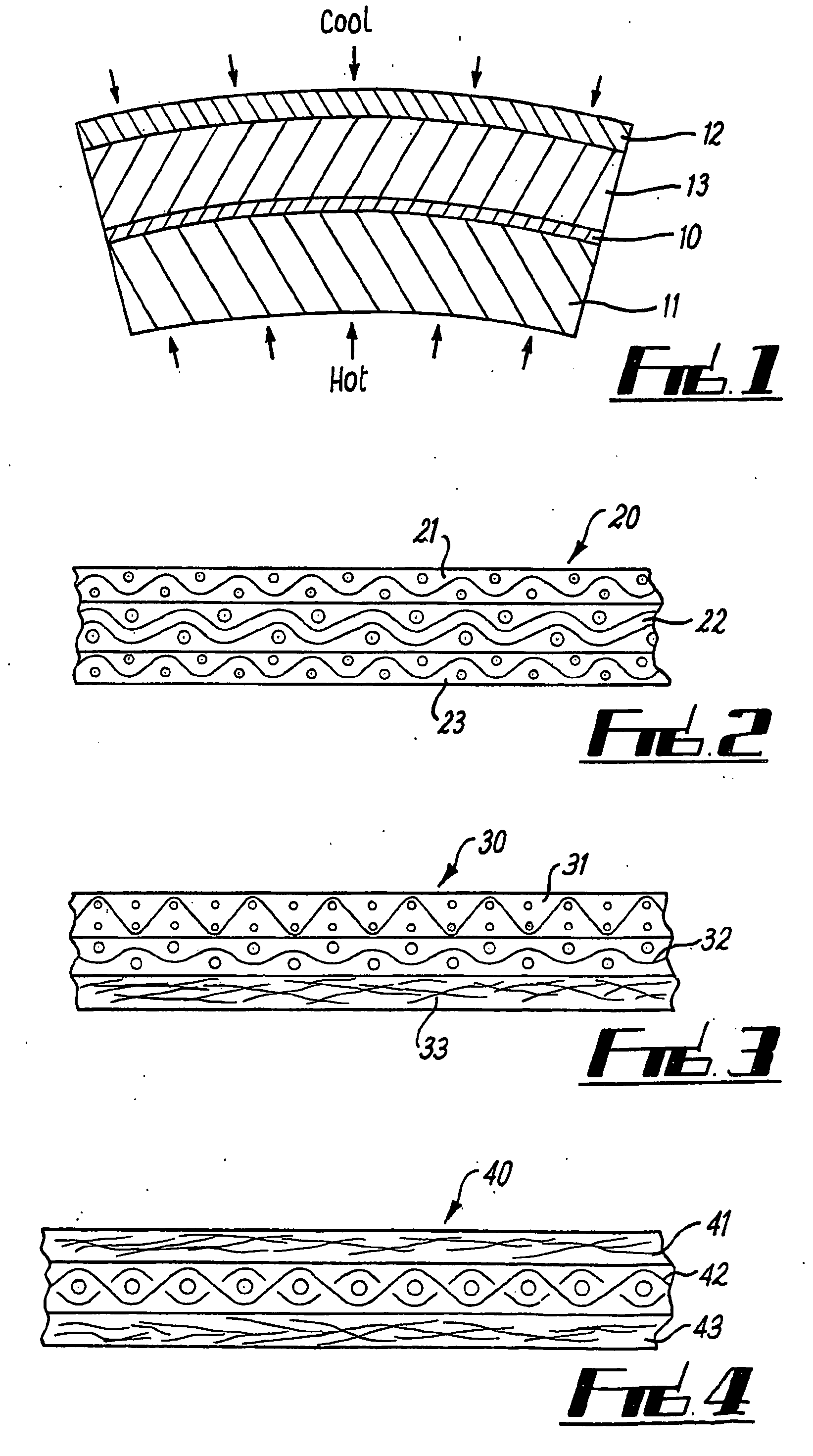
Figure 2 
Figure 3
Abstract
Description
CROSS-REFERENCE TO RELATED APPLICATIONS
[0001] The present application is a U.S. National Stage of International Patent Application No. PCT / GB2003 / 004585 filed Oct. 24, 2003, and claims priority of Great Britain Patent Application No. 0224749.2 filed Oct. 24, 2002 and Great Britain Patent Application No. 0230211.5 filed Dec. 27, 2002.BACKGROUND OF THE INVENTION
[0002] 1. Field of the Invention
[0003] This invention relates to a fabric for use in a so-called dynamic condensation drying apparatus or other similar condensation drying processes in the manufacture of paper and board.
[0004] 2. Discussion of Background Information
[0005] A dynamic condensation drying apparatus involves the utilization of a heat source to generate water vapor within the wet web. This leads to an increase in vapor pressure and a thermodynamic drive for such moisture to leave the web.
[0006] The moisture is then condensed by cooling, the water then being retained by the fabric to avoid re-wetting of the web....
Examples
Embodiment Construction
[0050]FIG. 1 is a diagrammatic sectional view of a roll in a dynamic condensation drying apparatus. This is a magnified view of part of the shell of the roll with superposed dryer and carrier belts, with the curvature exaggerated. The outer wall of the roll comprises a shell or steel surface 11, which is heated from within the roll. A paper web 10 is passed over the roll in contact with the heated shell 11, with a drier fabric 13 pressing if thereon. The dryer fabric also serves to transport the paper web 10, and to absorb moisture driven from the web 10. Belt 12 is exposed to lower temperatures on its outer-side. This may be by contact with ambient air, forced ventilation, or actively refrigerated air, or more preferably a reservoir of cooled water, which is sealed by belt 12. The heated surface of cylinder 11 is between the range 120° C.-180° C., whilst the belt 12 is maintained in the range 20° C.-90° C., that is below boiling point so that condensation can take place.
[0051] In ...