
Dynamic channel allocation method and dynamic channel allocation apparatus
a dynamic channel and allocation method technology, applied in the direction of electrical devices, network planning, selection arrangements, etc., can solve the problems of not being able to effectively use, not being able to achieve effective use, not only affecting the availability of channels, but also affecting the time delay of exchanging messages. , to achieve the effect of ensuring fairness among base stations and uniqueness of channel availability
Patent Information
- Authority / Receiving Office
- US · United States
- Patent Type
- Applications(United States)
- Current Assignee / Owner
- Publication Date
- 2007-06-07
- Estimated Expiration
- Not applicable · inactive patent
Smart Images
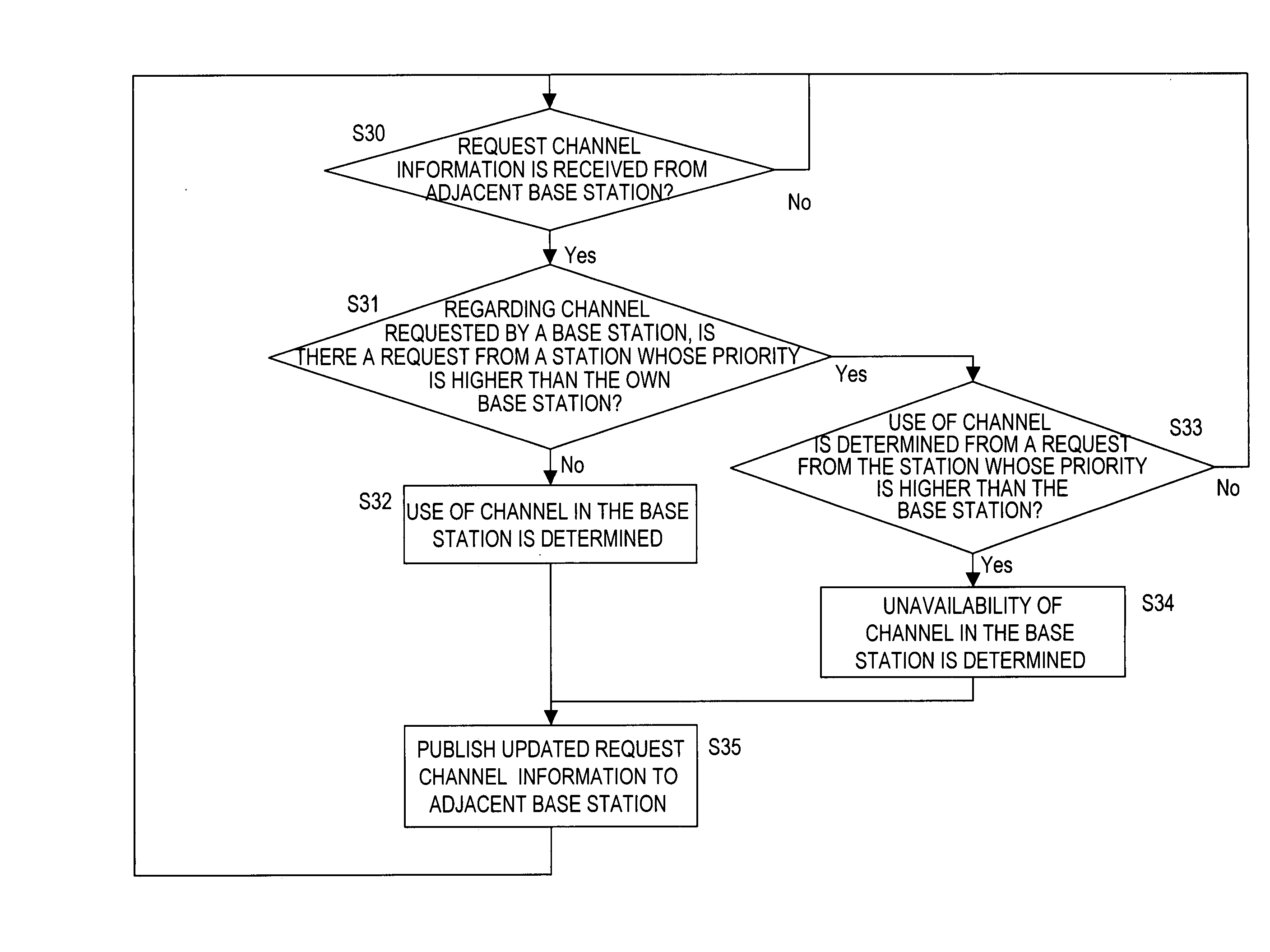
Figure 1 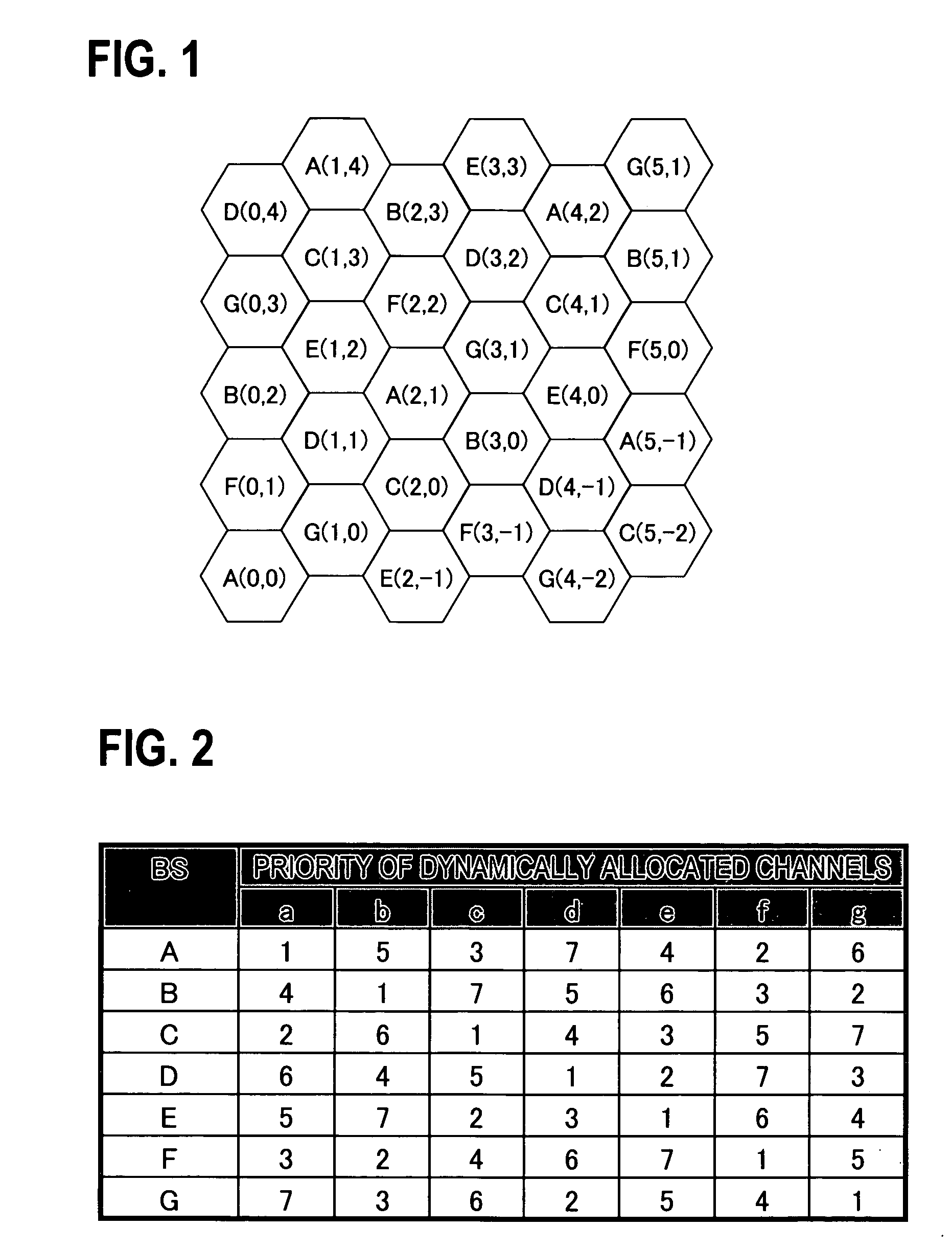
Figure 2 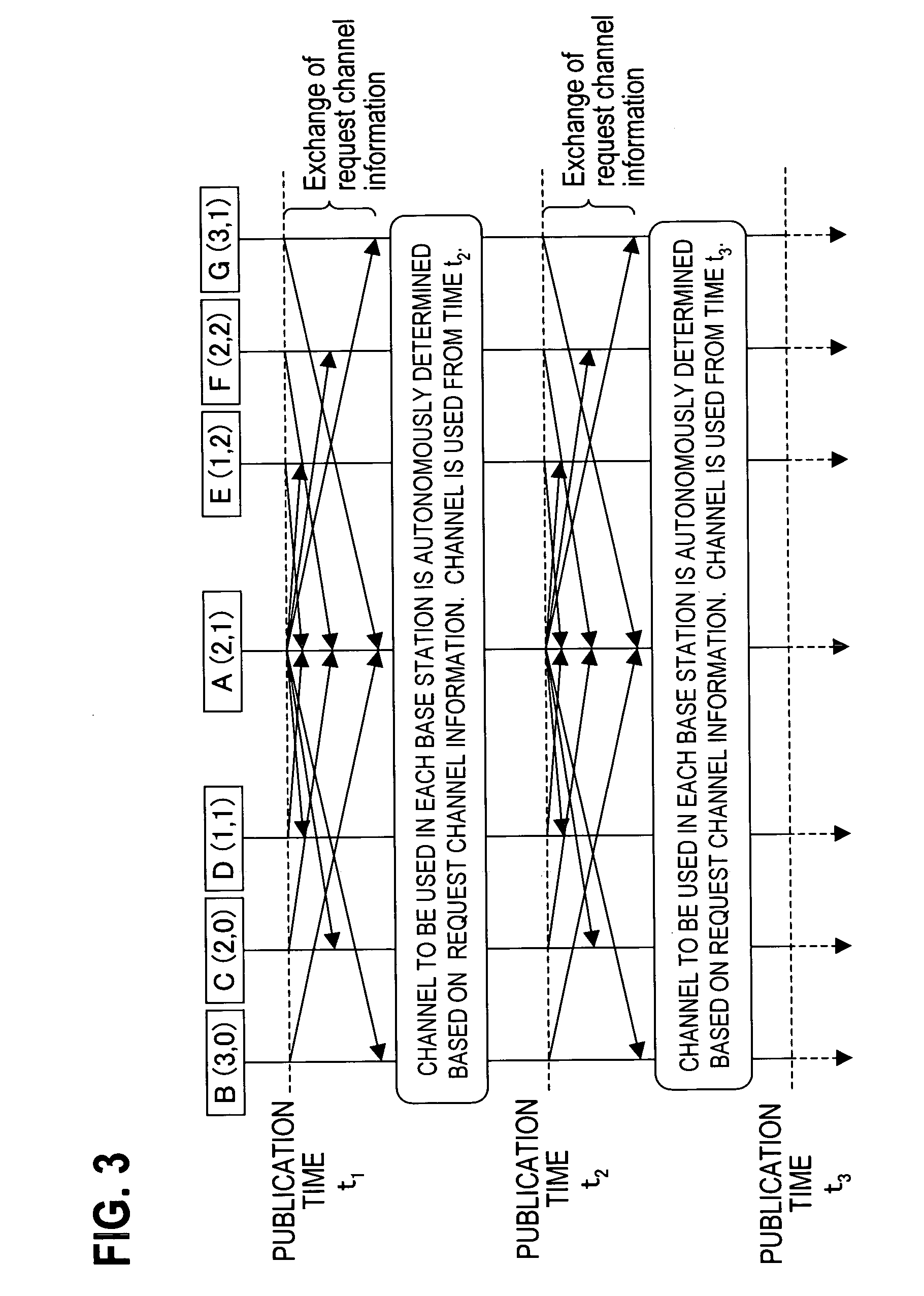
Figure 3
Abstract
Description
CROSS-REFERENCE TO RELATED APPLICATIONS
[0001] This application is based upon and claims the benefit of priority from the prior Japanese Patent Application No.2005-348858, filed on Dec. 2, 2005, the entire contents of which are incorporated herein by reference. BACKGROUND OF THE INVENTION
[0002] 1. Field of the Invention
[0003] The present invention relates to a channel allocation method and apparatus in a wireless communication system, and particularly to a dynamic channel allocation method and a dynamic channel allocation apparatus for dynamically allocating channels in response to increase / decrease of traffic.
[0004] 2. Description of the Related Art
[0005] Effective allocation of channels is carried out in order to effectively use a wireless resource. Here, “channel” is defined by time, frequency, or a combination thereof. It is defined by a code in the CDMA technology.
[0006] “Channel Assignment Schemes for Cellular Mobile Telecommunication Systems: A Comprehensive Survey” (I. K...
Examples
first embodiment
Basic Pattern
[0068]FIG. 1 is a figure showing an example of a wireless communication network. In FIG. 1, X(v, u) (X=A, B, . . . , G, v, u are coordinate axes) is an identifier of a base station, and a hexagon indicates a cover area of the base station. A through G indicate a base station group comprising base stations which do not mutually interfere with one another. For example, for a base station A(2, 1), adjacent base stations interfering with the base station A(2, 1) are base stations B(3, 0), C(2, 0), D(1, 1), E(1, 2), F(2, 2), and G(3, 1) surrounding the base station A(2, 1). The base station A(2, 1) is not placed adjacent to other base stations A(0, 0), A(5, 1), A(4, 2), and A(1, 4) that are in the base station A group, and the base stations in the base station A group are placed in position where they do not interfere with one another. It should be noted here that “BS” means a base station.
[0069]FIG. 2 is a figure showing an example of a priority table defining the priorit...
second embodiment
Repetition of Publication
[0094] In FIG. 3, exchange of the request channel information is carried out once. However, this exchange performance cannot respond to a situation in which an available channel to an adjacent base station changes depending on the request channel information of an adjacent base station of the adjacent base station.
[0095] For example, the wireless communication network configured in FIG. 1 and FIG. 2 is considered as an example. FIG. 12 is a figure showing an example of the wireless communication network, and is same as FIG. 1, except that the base station A(2, 1) is colored in FIG. 12.
[0096] In FIG. 12, when the base station A(2, 1) is in an idle state (no traffic) and an adjacent base station uses a channel a (high-priority channel for the base station A), it is considered whether G(3, 1), which takes this channel as the lowest priority, can use this channel. For example, the priority on the channel is higher for B(3, 0) than G(3, 1), thus, when B(3, 0) ...
third embodiment
[0107] In the above first and second embodiments, availability / unavailability of channels is judged on the basis of the publication time in which the base stations synchronize. Therefore, if transmission of a traffic is completed by the next publication time, new channel allocation is not performed, thus channels cannot be used effectively. Moreover, in the second embodiment, even when the request channel information, which indicates that the channel is determined to be unavailable, is informed to the adjacent base stations after the channel is used, when another base station starts using the channel the request channel information needs to be exchanged again with the adjacent base stations.
[0108] In the third embodiment, therefore, time information such as a channel starting time and time in which the channel is used is contained in the request channel information, and the request channel information is informed to the adjacent base stations.
[0109]FIG. 16 is a fi...