
Pyrimidine-2,4-diamines and Their Uses
a technology of diamine and pyrimidine, which is applied in the field of diaryl pyrimidine2, 4diamines, can solve the problems of low selectivity of potent inhibitors that have been discovered, and achieve the high selectivity that would be required
Patent Information
- Authority / Receiving Office
- US · United States
- Current Assignee / Owner
- Publication Date
- 2007-06-07
- Estimated Expiration
- Not applicable · inactive patent
Smart Images
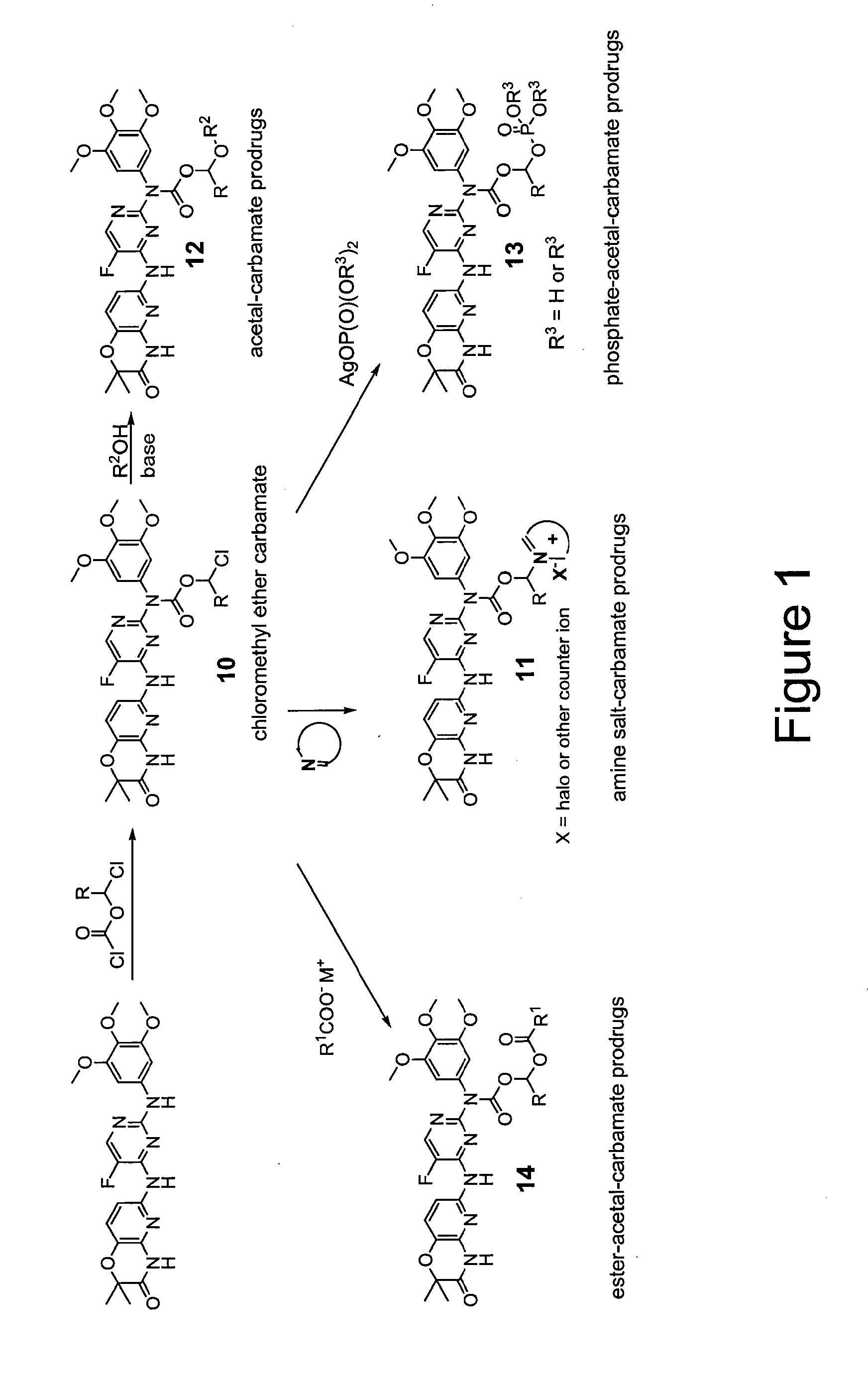
Figure 1 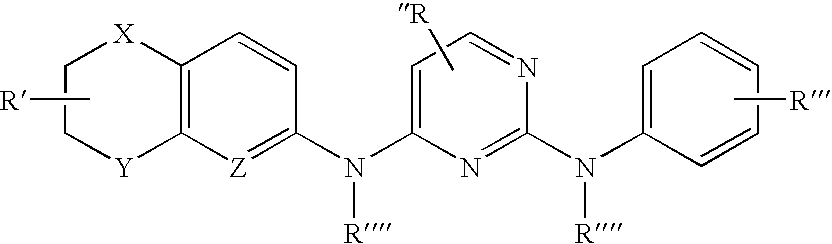
Figure 2 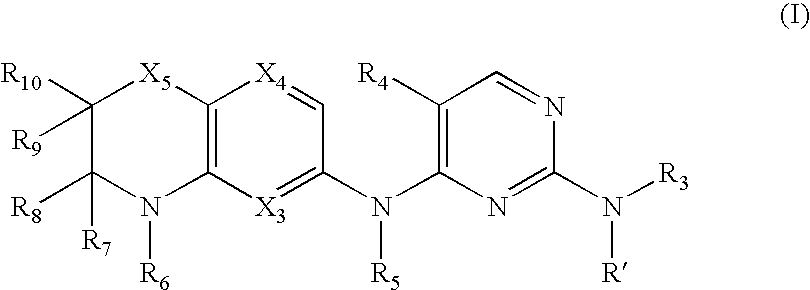
Figure 3
Abstract
Description
CROSS-REFERENCE TO RELATED APPLICATION
[0001] This application is a continuation of U.S. patent application Ser. No. 11 / 295,752 filed Dec. 6, 2005, from which priority is claimed and which application is incorporated herein by reference in its entirety.FIELD OF INVENTION
[0002] The invention relates to compounds containing the pyrimidine-2,4-diamine moiety, particularly diaryl pyrimidine-2,4-diamines, compositions comprising the compounds, and methods of using the compounds and compositions for the inhibition of kinases. The compounds and compositions are useful for treating or modulating disease in which kinases may be involved, symptoms of such disease, or the effect of other physiological events mediated by kinases. BACKGROUND OF THE INVENTION
[0003] The protein kinases constitute a large family of structurally related enzymes that are responsible for the control of a wide variety of signal transduction processes within the cell. (Hardie and Hanks (1995) The Protein Kinase Facts ...
Examples
example 1
Synthesis of N2-Chlorocarbonyl-N4-(2,2-dimethyl-3-oxo-4H-5-pyrido[1,4]oxazin-6-yl)-5-fluoro-N2-(3,4,5-trimethoxyphenyl)-2,4-pyrimidinediamine
[0119]
[0120] To pale yellow stirring mixture of N4-(2,2-dimethyl-3-oxo-4H-5-pyrido[1,4]oxazin-6-yl)-5-fluoro-N2-(3,4,5-trimethoxyphenyl)-2,4-pyrimidinediamine (2.5 g, 5.31 mmol) and triphosgene (1.67 g, 5.62 mmol) in dicholoroethane (20 mL) at 0 0C, NEt3 (1.08 g, 1.5 mL, 10.76 mmol) in dichloroethane (10 mL) was added dropwise under nitrogen atmosphere for 10 min. The orange reaction mixture was allowed to stir for 15 min at 0 0C followed by refluxing at 90 0C overnight. The heterogeneous tan orange reaction mixture was cooled to room temperature. The reaction mixture was diluted with EtOAc (75 mL). Precipitated white solid formed was filtered. The white solid was collected, treated with water, filtered and dried to provide N2-chlorocarbonyl-N4-(2,2-dimethyl-3-oxo-4H-5-pyrido[1,4]oxazin-6-yl)-5-fluoro-N2-(3,4,5-trimethoxyphenyl)-2,4-pyrimidine...
example 2
Synthesis of N4-(2,2-Dimethyl-3-oxo-4H-5-pyrido[1,4]oxazin-6-yl)-5-fluoro-N2-[[2-(morpholin-4-yl)ethoxy]carbonyl]-N2-(3,4,5-trimethoxyphenyl)-2,4-pyrimidinediamine
[0122]
[0123] N4-(2,2-Dimethyl-3-oxo-4H-5-pyrido[1,4]oxazin-6-yl)-5-fluoro-N2-[[2-(morpholin-4-yl)ethoxy]carbonyl]-N2-(3,4,5-trimethoxyphenyl)-2,4-pyrimidinediamine was prepared from 4-(2-hydroxyethyl)morpholine and N2-chlorocarbonyl-N4-(2,2-dimethyl-3-oxo-4H-5-pyrido[1,4]oxazin-6-yl)-5-fluoro-N2-(3,4,5-trimethoxyphenyl)-2,4-pyrimidinediamine. The crude solid, obtained after concentration of the reaction mixture followed by treatment with aq. NaHCO3, was purified by NEt3 treated silica gel column chromatography. 1H NMR (CDCl3): δ 10.32 (s, 2H), 8.89 (s, 1H), 8.18 (d, 1H, J=2.9 Hz), 7.49 (d, 1H, J=8.8 Hz), 7.06 (d, 1H, J=8.8 Hz), 6.52 (s, 2H), 4.29 (m, 2H), 3.81 (s, 3H), 3.74 (s, 6H), 3.57 (m, 4H), 2.56 (m, 2H), 2.33 (m, 4H), 1.48 (s, 6H). LCMS: ret. time: 8.30 min.; purity: 92%; MS (m / e): 628 (MH+).
example 3
Synthesis of 4-(2,2-Dimethyl-3-oxo-4H-5-pyrido[1,4]oxazin-6-yl)-5-fluoro-N2-[[1-methyl-piperidin-2-yl)methoxy]carbonyl]-N2-(3,4,5-trimethoxyphenyl)-2,4-pyrimidinediamine
[0124]
[0125] 4-(2,2-Dimethyl-3-oxo-4H-5-pyrido[1,4]oxazin-6-yl)-5-fluoro-N2-[[1-methyl-piperidin-2-yl)methoxy]carbonyl]-N2-(3,4,5-trimethoxyphenyl)-2,4-pyrimidinediamine was prepared from N2-chlorocarbonyl-N4-(2,2-dimethyl-3-oxo-4H-5-pyrido[1,4]oxazin-6-yl)-5-fluoro-N2-(3,4,5-trimethoxyphenyl)-2,4-pyrimidinediamine and 1-methyl-2-piperidinemethanol in the similar manner as described in the general procedure. The crude off white solid obtained after the general workup was subjected to HPLC purification. 1H NMR (DMSO-d6): δ 11.03 (s, 1H), 9.67 (s, 1H), 8.33 (d, 1H, J=3.0 Hz), 7.41 (d, 1H, J=8.5 Hz), 7.17 (d, 1H, J=8.5 Hz), 6.56 (s, 2H), 4.10 (d, 2H, J=4.7 Hz), 3.80 (s, 6H), 3.64 (s, 3H), 2.70-2.66 (m, 1H), 2.09 (s, 3H), 1.97-1.92 (m, 2H), 1.58-1.07 (m, 12H). LCMS: ret. time: 8.54 min.; purity: 92%; MS (m / e): 627 (MH+)...