

Process for the fluorination of boron hydrides
a technology of boron hydride and fluorination process, which is applied in the field of process for fluorination of boron hydrides, can solve the problems of unfavorable unfavorable boron hydride fluoride conversion, and high temperature utilization of this process, so as to achieve high fluorination of boron hydride anions, high reaction efficiency, and high yield
Patent Information
- Authority / Receiving Office
- US · United States
- Patent Type
- Applications(United States)
- Current Assignee / Owner
- Publication Date
- 2008-06-12
- Estimated Expiration
- Not applicable · inactive patent
Smart Images
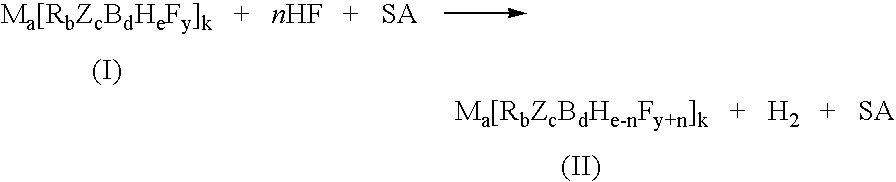
Figure 1
Abstract
Description
CROSS-REFERENCE TO RELATED APPLICATIONS
[0001] The subject matter of this invention is related to U.S. patent application Nos. Ser. 10 / 655476, filed on Sep. 4, 2003; Ser. No. 10 / 924293, filed on Aug. 23, 2004; Ser. No. 11 / 372907, filed on Mar. 10, 2006, and Ser. No. 11 / 197478, filed on Aug. 5, 2005. The disclosure of the previously identified patent applications is hereby incorporated by reference.
[0002] The present invention is directed to methods for fluorinating boron hydride compounds.BACKGROUND OF THE INVENTION
[0003] Fluorinated boron hydride anions are weakly coordinating anions and have been used as electrolytes and as catalytic components, particularly to enhance the catalytic activity of metal cations finding use in a variety of reactions.
[0004] The substitution of borohydrides, including polyhedral closo-boranes and closo-carboranes with fluorine to various degrees has previously been afforded by employing a number of methods. For example, the direct fluorination of these exemp...
Examples
example 1
Reaction of K2B12H12 with HF and BF3 at 20° C. in Stainless Steel
[0037]1.00 g of K2B21H12 (220.02 g / mol, 4.5 mmol) was charged to a 100 mL SS Parr reactor followed by 20 g of HF at −78° C. The reactor was warmed to 20° C. and was allowed to stir for 16 hours. BF3 (ca. 18 mmol, 4 equivalents relative to K2B12H12) was added to the reactor following HF addition. The product was then isolated and found to have 1.95 g (ca. 90% yield) of product (TEA)2B12H12−xFx with 84 mol % where x=4 and 16 mol % where x=5 (MWave=492.28 g / mol).
example 2
Reaction of K2B12H12 with HF and Excess BF3 at 20° C. in Stainless Steel
[0038]Example 1 was repeated except 45 mmol BF3 (ca., 10 equivalents relative to K2B12H12) was added to the reactor following HF addition rather than 18 mmol BF3. The isolated product consisted of 1.95 g (ca. 88% yield) of product (TEA)2B12H12−xFx with 29 mol % where x=4, 70 mol % where x=5, and approximately 1 mol % where x=6 (MWave=510.27 g / mol).
example 3
Reaction of K2B12H12 with HF and BF3 at 60° C. in Stainless Steel
[0039]Example 1 was repeated except at 60° C. as a reaction temperature rather than 20° C. The isolated product consisted of 2.09 g (ca. 90% yield) of product (TEA)2B12H12−xFx with 3 mol % where x=5, 95 mol % where x=6, and 2 mol % where x=7 (MWave=528.26 g / mol).