
Dendritic cell inhibitory proteins from ticks
a technology of dendritic cells and inhibitory proteins, which is applied in the direction of dna/rna fragmentation, peptide/protein ingredients, depsipeptides, etc., can solve the problems of not conferring specific, long-lasting protection against foreign entities, such as invading pathogens, and no evidence that it can inhibit the differentiation and maturation of human dcs, so as to inhibit the differentiation and maturation of dcs
Patent Information
- Authority / Receiving Office
- US · United States
- Patent Type
- Applications(United States)
- Current Assignee / Owner
- Publication Date
- 2013-06-20
- Estimated Expiration
- Not applicable · inactive patent
Smart Images
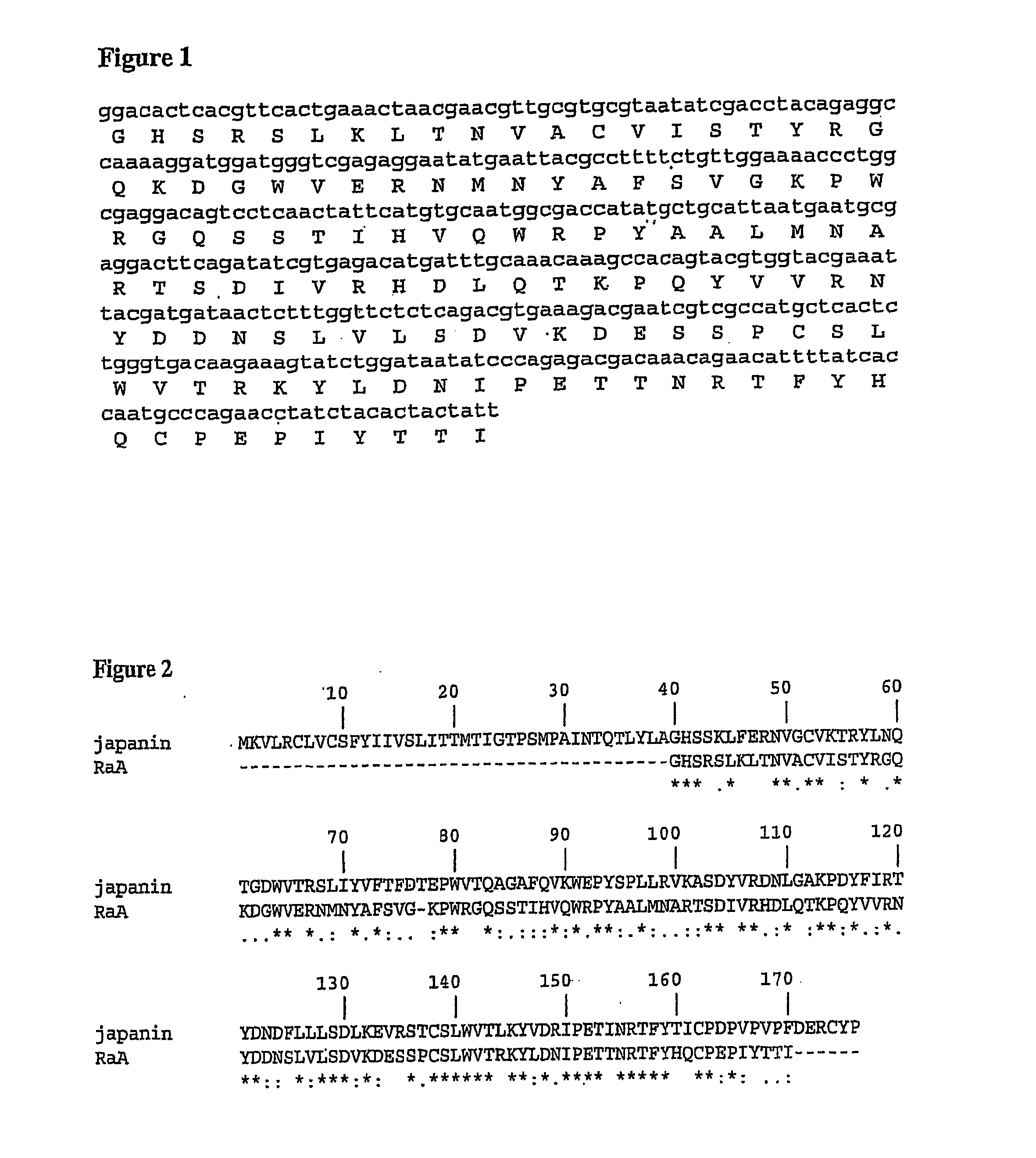
Figure 1 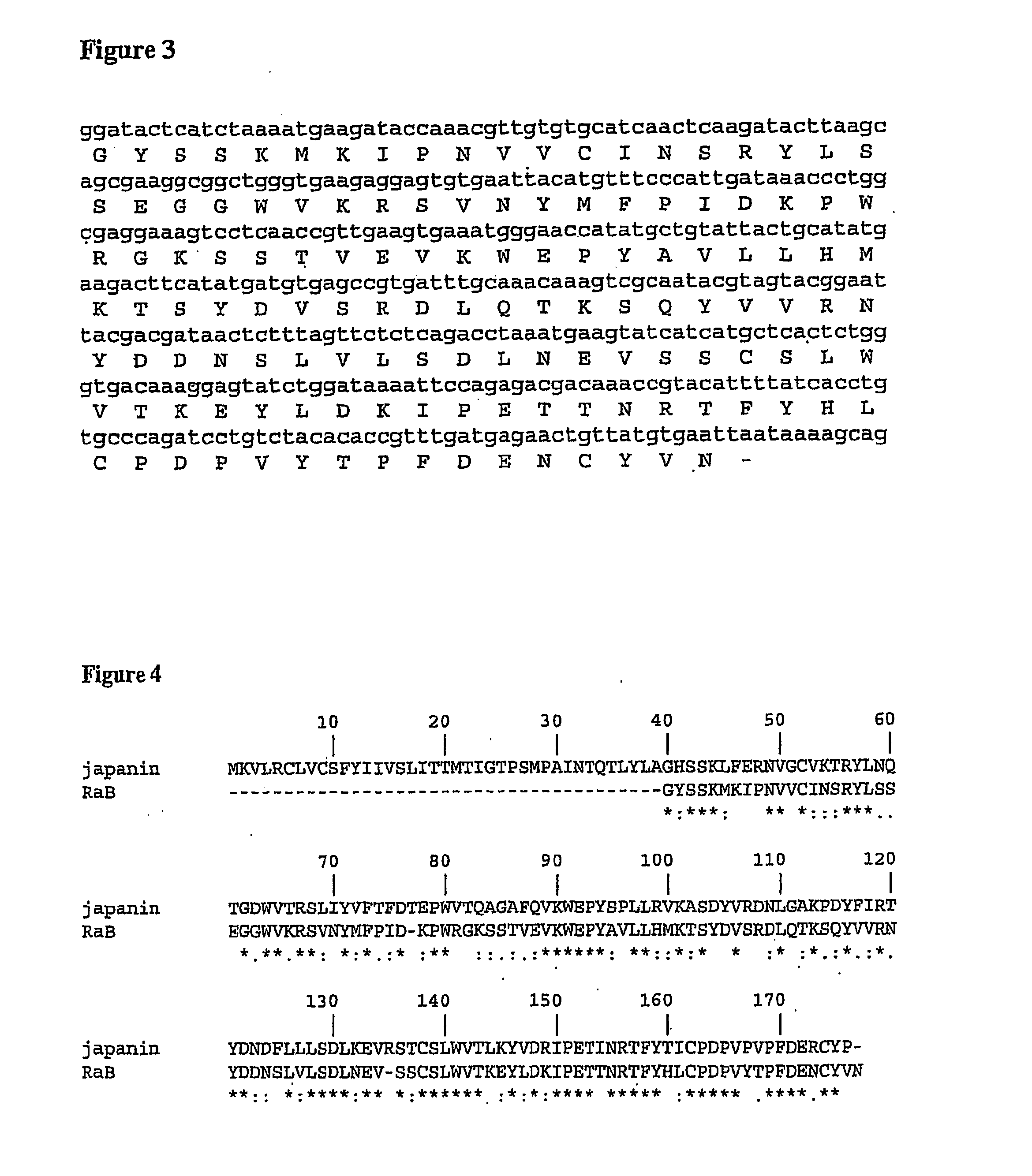
Figure 2 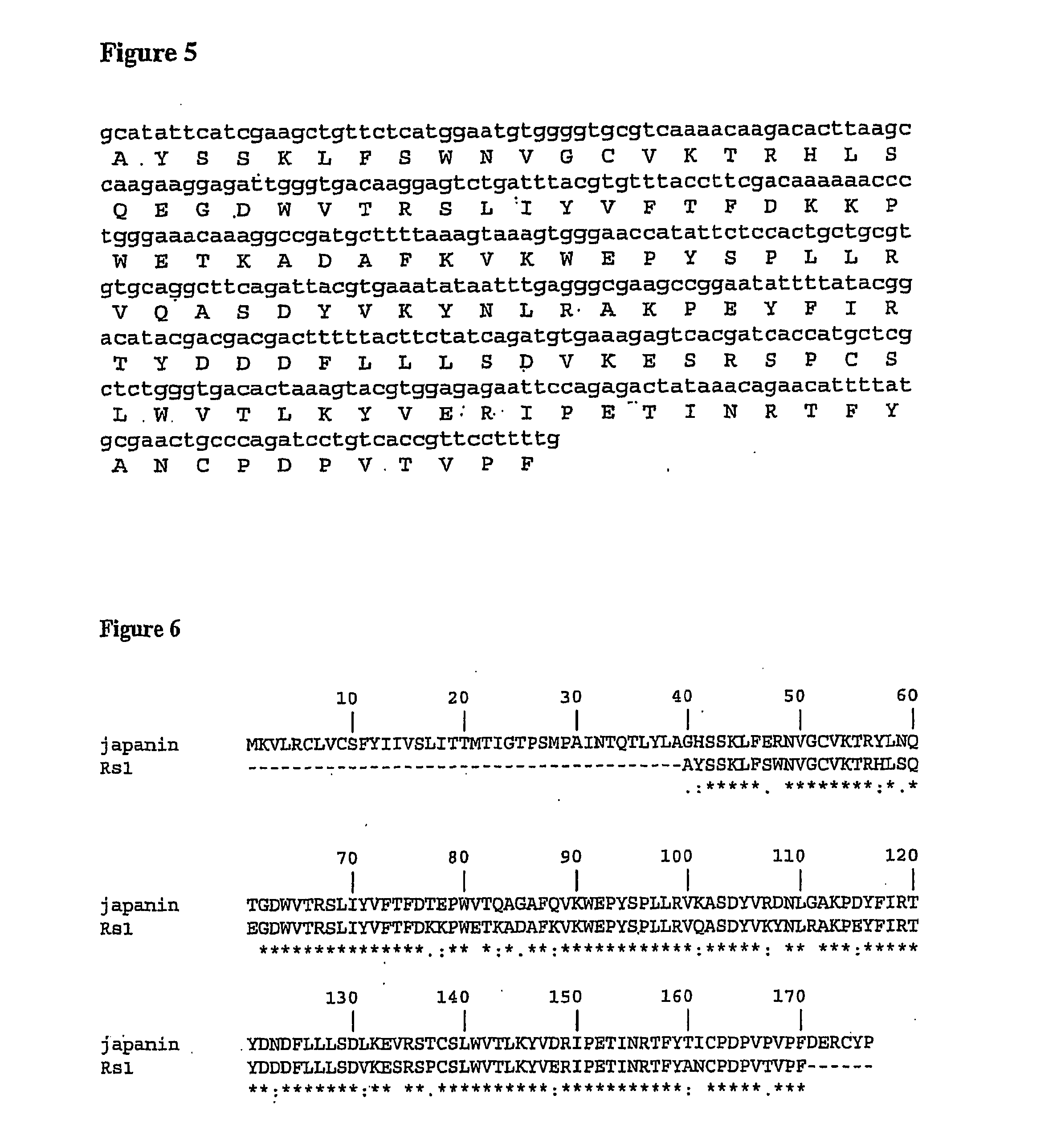
Figure 3
Abstract
Description
FIELD OF THE INVENTION
[0001] The present invention relates to dendritic cell (DC) modulatory proteins. In particular, the invention relates to proteins which modulate, and preferably inhibit, the differentiation and / or maturation of mammalian DCs and to the identification of motifs and features of such proteins which may be important for their structure and function. Such proteins can be isolated from arthropod saliva, and more specifically from tick saliva. The invention also relates to the use of such proteins in therapy, and specifically to the use of such proteins in treating autoimmune disorders, allergies, autoinflammatory diseases and other immune-related sensitivities, also known as hypersensitivity diseases, transplant reactions such as transplant rejection and graft-versus-host disease, infectious diseases including those transmitted by ticks, cancers including haematological malignancies, and acute and chronic inflammatory diseases including inflammation associated with th...
Examples
example 1
Identification of RaA, RaB and Rs1
[0258]The incomplete amino acid sequence of the proteins RaA, RaB and Rs1, which are related to Japanin were obtained by amplifying Rhipicephalus cDNAs in expression libraries which were prepared in Lambda Zap II (Stratagene). Amplification was performed by means of the polymerase chain reaction (PCR) using a degenerate, Japanin-derived forward primer (SEQ ID NO: 17) in combination with either a vector specific reverse primer (SEQ ID NO: 18) in the case of RaB or a Japanin-specific reverse primer (SEQ ID NO: 19) in the case of RaA and Rs1.
example 2
Alignment of Japanin with RaA, RaB and Rs1, Respectively
[0259]The amino acid sequences of RaA (SEQ ID NO: 2), RaB (SEQ ID NO: 4) and Rs1 (SEQ ID NO: 6) were each aligned with Japanin (SEQ ID NO: 8) using clustalW with the following options: gap extension penalty=0.1; gap opening penalty=10.0; hydrophilic residues=GPSNDQERK; matrix=gonnet. The results of these alignments are shown in FIGS. 2, 4 and 6, respectively.
[0260]For RaA, of the 131 residues that form the alignment, 61 (46.56%) are identical, 26 (19.85%) are strongly similar and 22 (16.79%) are weakly similar.
[0261]For RaB, of the 138 residues that form the alignment, 73 (52.9%) are identical, 30 (21.74%) are strongly similar and 12 (8.7%) are weakly similar.
[0262]For Rs1, of the 131 residues that form the alignment, 105 (80.15%) are identical, 12 (9.16%) are strongly similar and 7 (5.34%) are weakly similar.
example 3
Alignment of Japanin, RaA, RaB and Rs1
[0263]The amino acid sequences of RaA (SEQ ID NO: 2), RaB (SEQ ID NO: 4), Rs1 (SEQ ID NO: 6) and Japanin (SEQ ID NO: 8) were aligned using clustalW with the following options: gap extension penalty=0.2; gap opening penalty=10.0; hydrophilic residues=GPSNDQERK; matrix=gonnet. The result of this alignment is shown in FIG. 7.