
Apparatus for hanging a framed picture
a technology for hanging a picture and a frame, which is applied in the field of accessories for hanging a framed picture, can solve the problems of picture not hanging level, picture is often in an incorrect position on the wall, time-consuming trial and error process to achieve the correct position of the picture frame,
Patent Information
- Authority / Receiving Office
- US · United States
- Current Assignee / Owner
- Publication Date
- 2013-11-21
- Estimated Expiration
- Not applicable · inactive patent
Smart Images
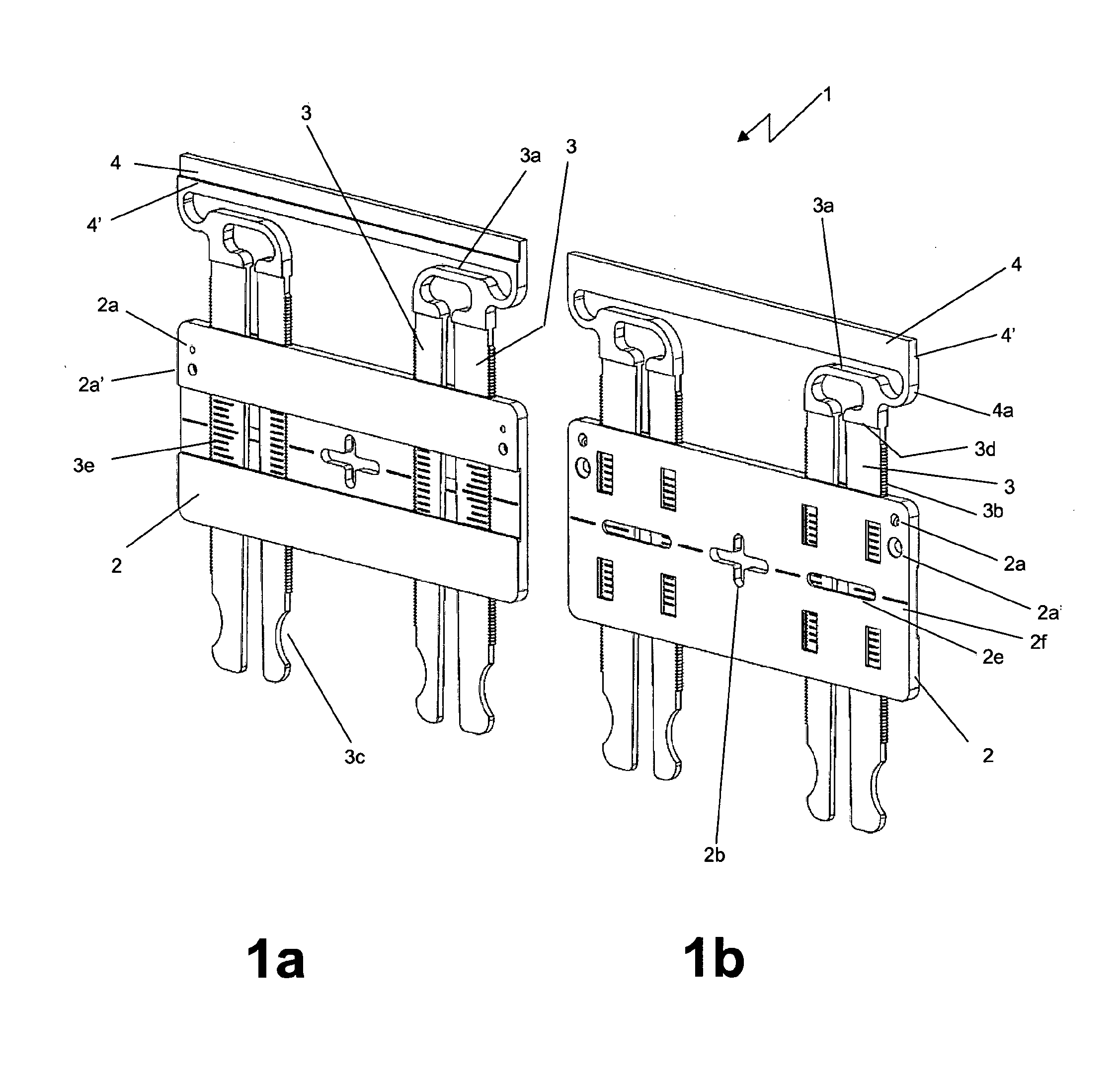
Figure 1 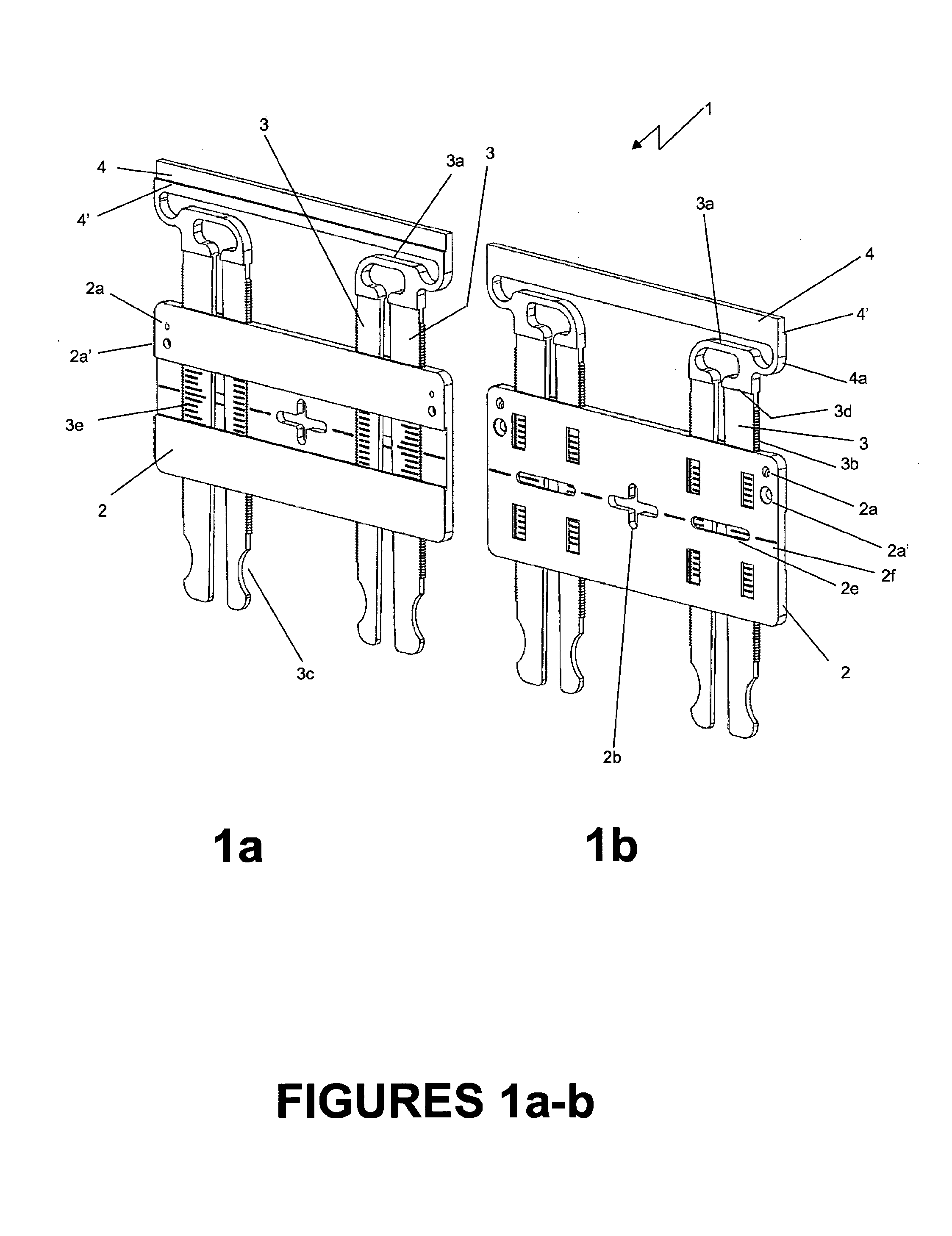
Figure 2 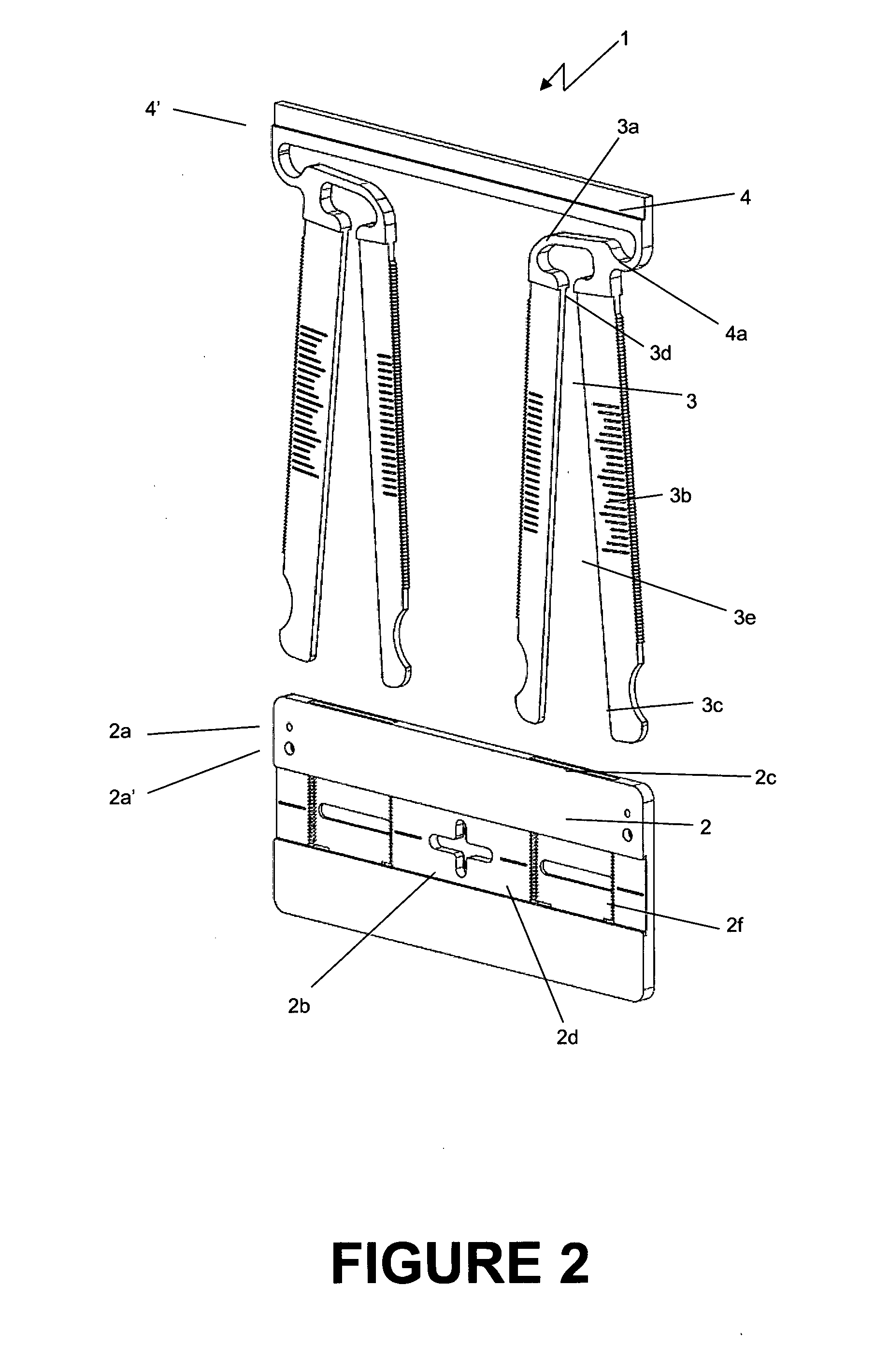
Figure 3
Abstract
Description
STATEMENT OF CORRESPONDING APPLICATIONS
[0001] This application is based on the Complete specifications filed in relation to New Zealand Patent Number 590239 and Australian Patent Number 2010101472, the entire contents of which are incorporated herein by reference.TECHNICAL FIELD
[0002] The present invention relates to an apparatus for hanging a framed picture. Particularly, although not exclusively, the present invention relates to an apparatus for adjusting the height and horizontal angle of inclination of a framed picture after fixing to a support surface.BACKGROUND ART
[0003] Conventional methods of hanging a framed picture or the like on a support surface such as a wall involves the use of attaching a picture hook to the wall and engaging a wire, string or eyelet attached to the back of the picture frame to the hook.
[0004] A disadvantage of this method of attachment is that the framed picture is frequently in an incorrect position on the wall particularly when aligning multiple pictur...
Examples
Embodiment Construction
[0065]In a preferred form of the invention, an apparatus for hanging a framed picture is generally indicated by arrow 1. The apparatus has a housing 2 which is fixed to a support surface such as a wall via a fixing means such as a screw 100 (as shown in FIG. 6a,b) passing through two countersunk screw holes 2a and / or locator slot 2b or nails which pass through nail holes 2a′ and which are angled at 30° to aid in correct location of the nails. Alternatively, the housing 2 may be affixed to the wall with double sided foam tape or the like. The housing has a channel 2c extending through its length. At least one pair of opposing first engagement surfaces (best seen in FIGS. 2 and 4), in the form of teeth 2d, extends along surface of the housing 2 adjacent the channel 2c.
[0066]The apparatus 1 also comprises at least one pair of elongate opposing arms 3 configured to be biased from each other via a hinge in the form of a flexible join 3a and pass through the channel 2c. The arms 3 each h...