
Multi-stranded heat set annuloplasty rings
a technology of annuloplasty rings and heat sets, which is applied in the field of flexible annuloplasty rings, can solve the problems of scarring retraction, tear or fusion of valve leaflets, and the current use of techniques that are attended by significant morbidity and mortality, and achieves the effects of reducing the risk of fracture, and maintaining structural rigidity
Patent Information
- Authority / Receiving Office
- US · United States
- Patent Type
- Applications(United States)
- Current Assignee / Owner
- Publication Date
- 2014-09-18
Smart Images
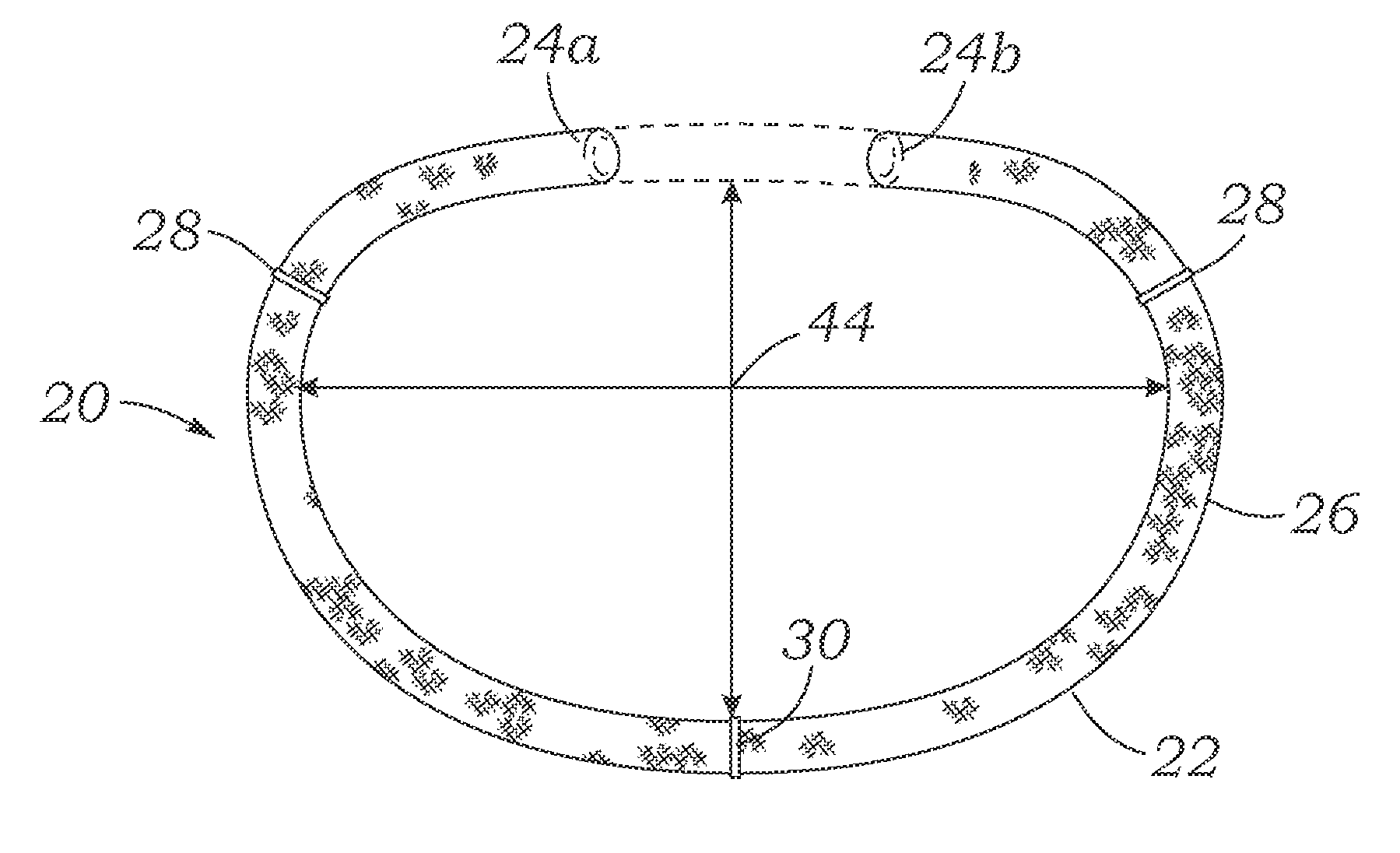
Figure 1 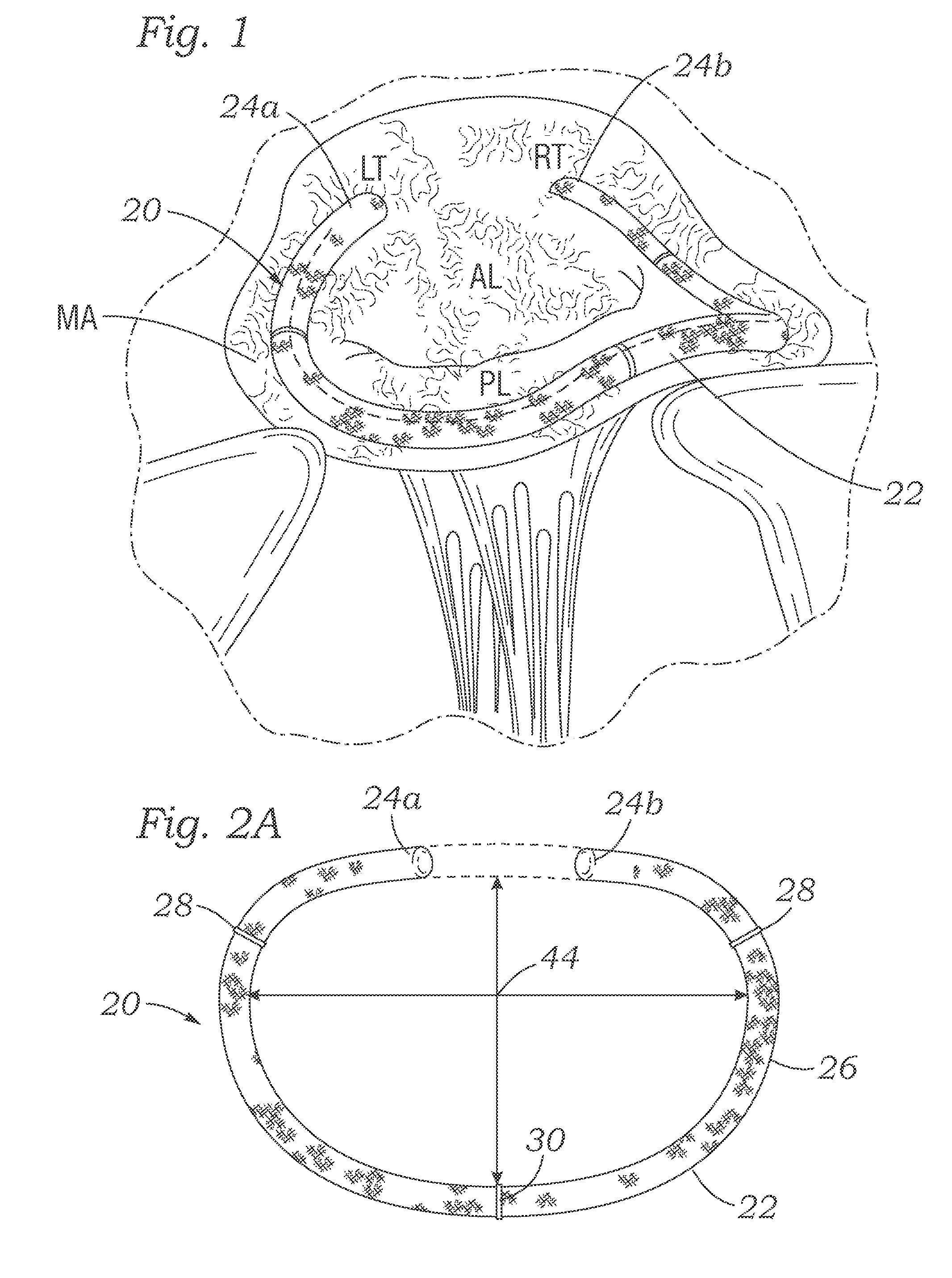
Figure 2 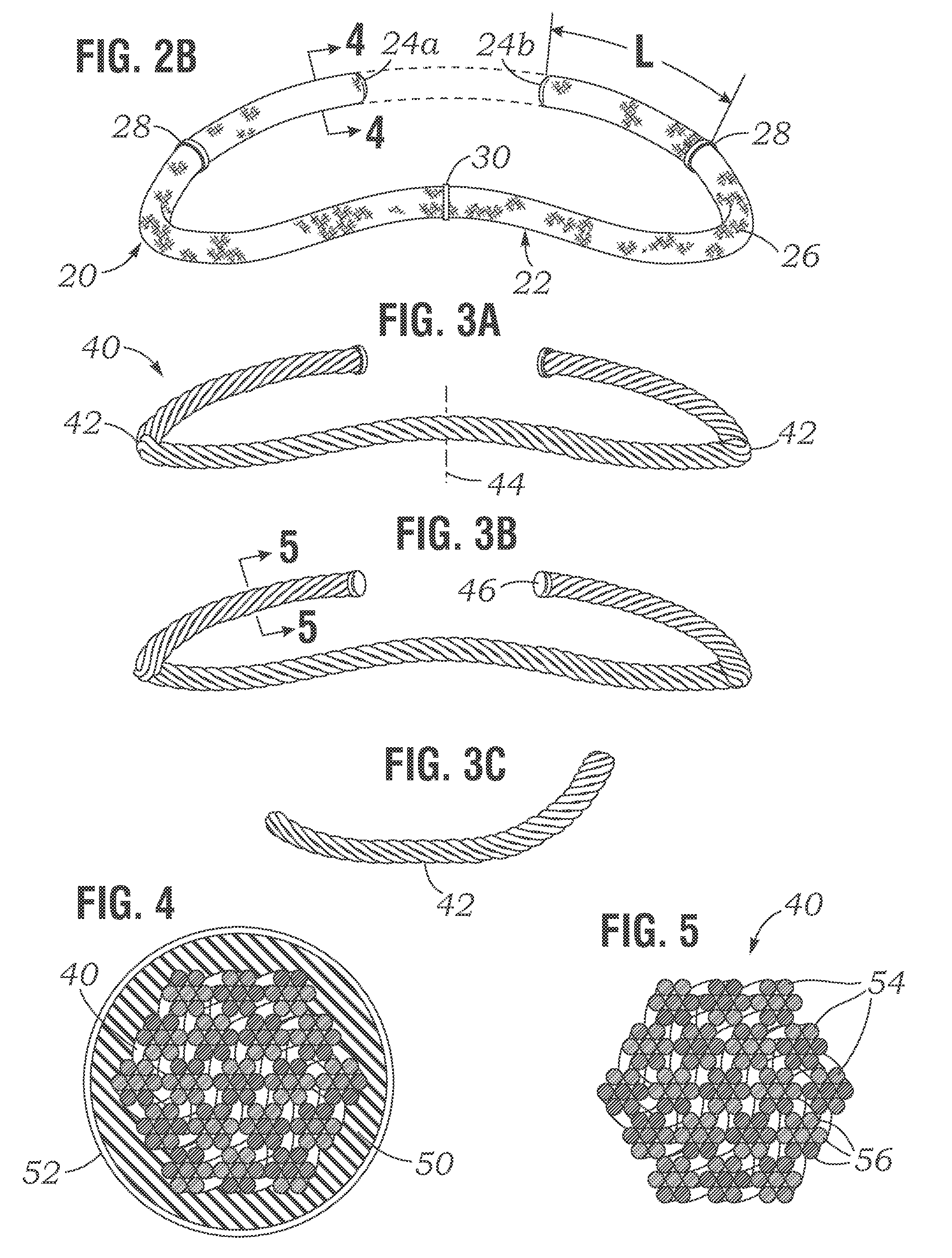
Figure 3
Abstract
Description
RELATED APPLICATIONS
[0001] The present application claims priority under 35 U.S.C. §119(e) to Provisional Application No. 61 / 784,010, filed on Mar. 14, 2013.FIELD OF THE INVENTION
[0002] The present invention relates generally to cardiac implants and particularly to flexible annuloplasty rings having stranded core members heat set into desired shapes.BACKGROUND OF THE INVENTION
[0003] In vertebrate animals, the heart is a hollow muscular organ having four pumping chambers: the left and right atria and the left and right ventricles, each provided with its own one-way valve. The natural heart valves are identified as the aortic, mitral (or bicuspid), tricuspid and pulmonary, and are each mounted in an annulus comprising dense fibrous rings attached either directly or indirectly to the atrial and ventricular muscle fibers. Each annulus defines a flow orifice.
[0004] Prosthetic annuloplasty rings are used to repair or reconstruct damaged or diseased heart valve annuluses. An annuloplasty ring...
Examples
first embodiment
[0031]the present invention is illustrated in FIGS. 1 and 2A-2B in which a mitral annuloplasty ring 20 defines a posterior portion 22 and an anterior portion 24 which has free ends 24a, 24b separated across a gap. Per convention, the annuloplasty ring 20 somewhat resembles an open D-shape with the outwardly convex posterior portion 22 and the free ends 24a, 24b together defining a substantially straight anterior portion extending generally between commissures, or possibly the trigones, of the annulus. The annuloplasty ring 20 typically includes a suture-permeable outer covering 26, described in more detail below, for attaching the ring to the annulus with sutures.
[0032]A word about the mitral valve anatomy is necessary. The mitral valve includes a posterior leaflet PL that surrounds approximately two thirds of the circumference of the mitral valve and an anterior leaflet AL that occupies approximately one third of the annular circumference, both of which attach at their outer periph...
second embodiment
[0040]an annuloplasty ring core member is illustrated in FIGS. 6A and 6B in which the core member 60 for a flexible mitral annuloplasty ring defines a posterior portion 62 and an anterior portion 64. As before, the core member 60 resembles a D-shape with the outwardly convex posterior portion 62 and a substantially straight anterior portion 64. However, in contrast to FIGS. 3A-3C the core member 60 has a closed peripheral shape. An annuloplasty ring that includes the core member 60 may also have a suture-permeable outer covering (not shown), such as a silicone tube surrounding the core member 60 which is then surrounded by a fabric tube, such as seen in FIG. 4. The core member 60 when in its relaxed, unstressed state desirably has the same shape as the Carpentier-Edwards® Physio® Annuloplasty Ring available from Edwards Lifesciences.
[0041]A still further embodiment of the present invention is shown in FIGS. 7A and 7B. A core member 70 for a flexible mitral annuloplasty ring defines ...