
Cis-tetrahydro-spiro(cyclohexane-1, 1' -pyrido[3,4-b]indole)-4-amine Compounds
a technology of cyclohexane and tetrahydrospiro, which is applied in the field of cistetrahydrospiro (cyclohexane1, 1'pyrido3, 4bindole)4amine compounds, can solve the problems of limited long-term treatment of chronic pain, neuropathic pain, and unsatisfactory treatment of pain in the case, and achieve rapid onset of pharmacological effect and uptake of active ingredients
Patent Information
- Authority / Receiving Office
- US · United States
- Patent Type
- Applications(United States)
- Current Assignee / Owner
- Publication Date
- 2016-06-09
- Estimated Expiration
- Not applicable · inactive patent
Smart Images
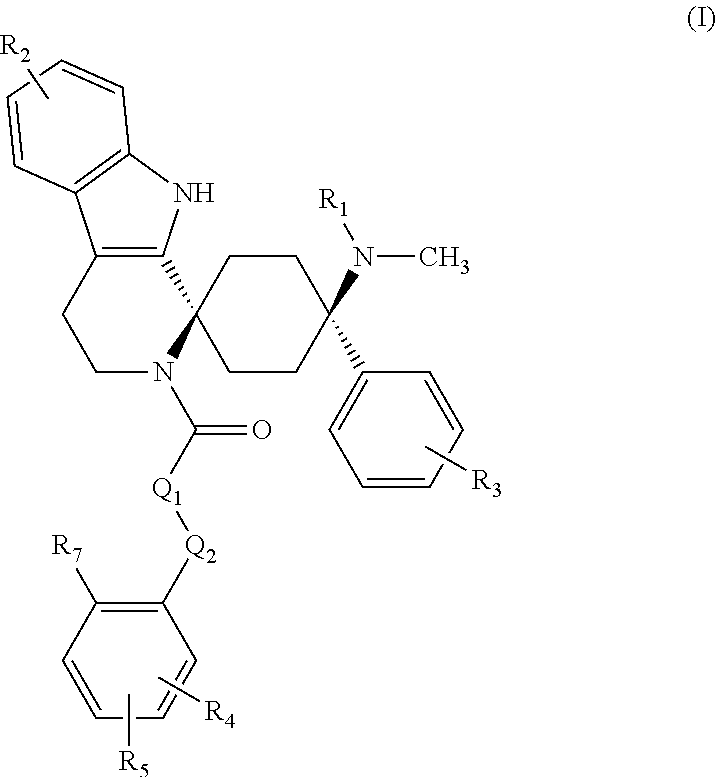
Figure 1 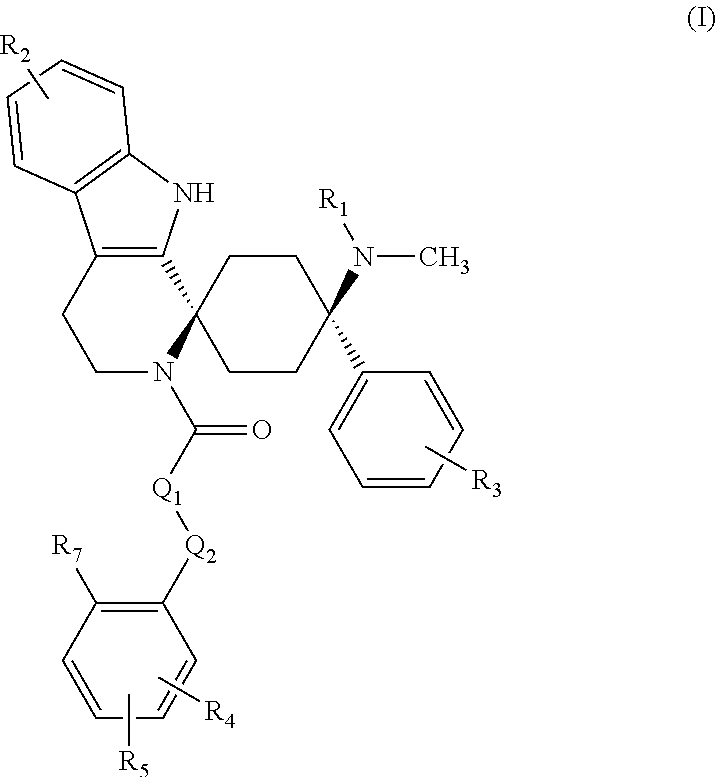
Figure 2 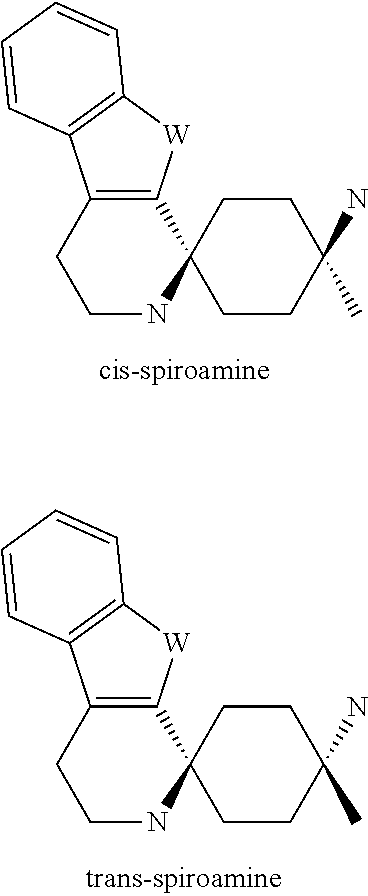
Figure 3
Abstract
Description
CROSS REFERENCE TO RELATED APPLICATIONS
[0001] This application is a continuation of U.S. application Ser. No. 13 / 192,641, filed Jul. 28, 2011, which claims priority from U.S. provisional patent application No. 61 / 368,314, filed Jul. 28, 2010 and European patent application no. EP 10007822.9, also filed Jul. 28, 2010, the entire disclosures of each of which are incorporated herein by reference.BACKGROUND OF THE INVENTION
[0002] The invention relates to compounds which act on the nociceptin / ORL-1 receptor system as well as on the μ-opioid receptor system and which are distinguished in particular by selective effectiveness in the treatment of chronic pain (inter alia inflammatory pain, visceral pain, tumour pain, preferably neuropathic pain) without at the same time developing pronounced effectiveness in the case of acute, nociceptive pain. The compounds according to the invention are cis-tetrahydro-spiro(cyclohexane-1,1′-pyrido[3,4-b]indole)-4-amine derivatives.
[0003] Chronic pain can be ...
Examples
example ether-1cis
EXAMPLE ETHER-1cis
6′-Fluoro-4′,9′-dihydro-N,N-dimethyl-4-(3-thienyl)-spiro[cyclohexane-1,1′(3′H)-pyrano[3,4-b]indole]-4-amine, methanesulfonate (2:5) (cis-diastereoisomer)
[0255]
[0256]The ketone E-5 (446.6 mg, 2 mmol) was dissolved together with 5-fluorotryptophol (2, 394.4 mg, 2 mmol) in absolute 1,2-dichloroethane (30 ml). Methanesulfonic acid (0.13 ml, 2 mmol) was then added to the mixture, whereupon the colour of the reaction solution changed from reddish-brown to dark-grey. After 5 min, a light-grey solid began to precipitate. The batch was stirred for 20 h at RT. Then the methanesulfonate of the cis-spiroether was filtered off with suction and washed with 1,2-dichloroethane (2×10 ml). The light-grey solid was obtained in a yield of 76% (733 mg) and with a melting point of 143-145° C. (ETHER-1cis). 1N NaOH (30 ml) was then added to the filtrate, and stirring was carried out for 2 h at RT. The trans-spiroether thereby precipitated in the form of a colourless solid and was obtain...
example ether-2cis
EXAMPLE ETHER-2cis
4′,9′-Dihydro-N,N-dimethyl-4-(2-thienyl)-spiro[cyclohexane-1,1′(3′H)-pyrano[3,4-b]indole]-4-amine, methanesulfonate (1:2) (cis-diastereoisomer)
[0258]
[0259]The ketone E-4 (223 mg, 1 mmol) was placed together with tryptophol (2, 161 mg, 1 mmol) in absolute dichloromethane (40 ml). Methanesulfonic acid (0.071 ml, 1.1 mmol) was then added. The mixture was stirred for 16 h at RT, whereupon the methanesulfonate of the spiroether precipitated. The light-grey solid (ETHER-2cis) was filtered off with suction, washed with dichloromethane (2×10 ml) and obtained in a yield of 25% (117 mg) with a melting point of 132° C. 1N NaOH (20 ml) was added to the filtrate, and stirring was carried out for 16 h at RT. The organic phase was separated off and the aqueous phase was extracted with dichloromethane (2×20 ml). The organic phases were combined, dried and concentrated. A substance mixture (274 mg) was obtained and was separated by chromatography [silica gel G (20 g); ethyl acetat...