
Method and system for additive-ablative fabrication
a technology of additiveablative and manufacturing method, applied in the field of solid free form fabrication (sff), can solve the problems of oxygen inhibition, difficulty in reducing the resolution of viscous material with a resolution below 40 m, and difficulty in reducing the resolution of viscous material, so as to achieve the effect of preventing oxygen inhibition, preventing oxygen inhibition, and preventing the curing process
Patent Information
- Authority / Receiving Office
- US · United States
- Patent Type
- Applications(United States)
- Current Assignee / Owner
- Publication Date
- 2018-03-15
Smart Images
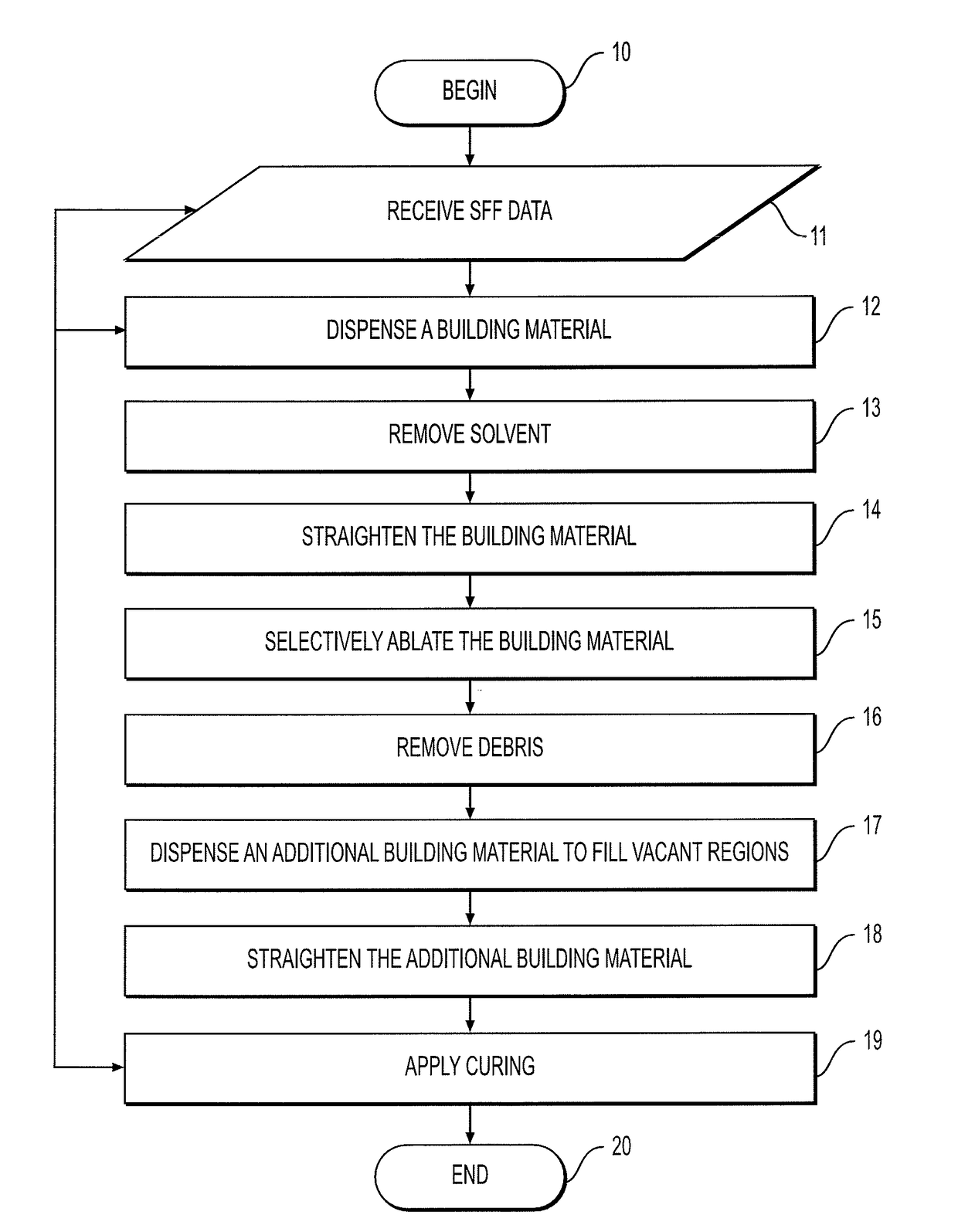
Figure 1 
Figure 2 
Figure 3
Abstract
Description
CROSS REFERENCE TO RELATED APPLICATION
[0001] The present application claims the benefit of U.S. Provisional Application No. 67 / 194,849 filed on Sep. 15 20l6. the disclosure of which is expressly incorporated by reference herein in its entirety.FIELD OF THE INVENTION
[0002] The present disclosure, in some embodiments thereof, relates to solid free form fabrication (SFF) and, more particularly, but not exclusively, to a method, system and apparatus for SFF by an additive-ablative process.BACKGROUND OF THE INVENTION
[0003] SFF is typically used in design-related fields where it is used for visualization, demonstration and mechanical prototyping. Thus, in three-dimensional fabrication facilitates rapid fabrication of functioning prototypes with minimal investment in tooling and labor may be employed. Such rapid prototyping shortens the product development cycle and improves the design process by providing rapid and effective feedback to the designer. Three-dimensional fabrication can also be...
Examples
examples
[0181]Reference is now made to the following examples, which together with the above descriptions illustrate some embodiments of the present disclosure in a non limiting fashion.
Exemplified SFF Process
[0182]FIG. 6 is a flow chart diagram describing a representative example of an SFF process, according to some embodiments of the present disclosure. A layer thickness is defined by vertical drive 94. Then, a material is dispensed, following by an optional drying operation. Stagnating is then applied, for example, by a blade squeegee. Thereafter, the leveled (or straightened) material is ablated to form a two-dimensional pattern. Optionally, the material is then cured or sintered. An additional straightening operation can optionally executed following the curing or sintering. The process then loops to the first block for defining the next layer.
Exemplified Placement of Foreign Element
[0183]FIG. 7 is a flow chart diagram describing a representative example of a process for combining a fo...