
Golf ball
a technology of golf balls and balls, applied in the field of golf balls, can solve the problems of turbulent flow separation, small dimples are not sufficiently responsible for the dimple effect, so as to improve the control performance, reduce drag, and improve flight performan
Patent Information
- Authority / Receiving Office
- US · United States
- Patent Type
- Patents(United States)
- Current Assignee / Owner
- Publication Date
- 2008-06-24
- Estimated Expiration
- Not applicable · inactive patent
Smart Images
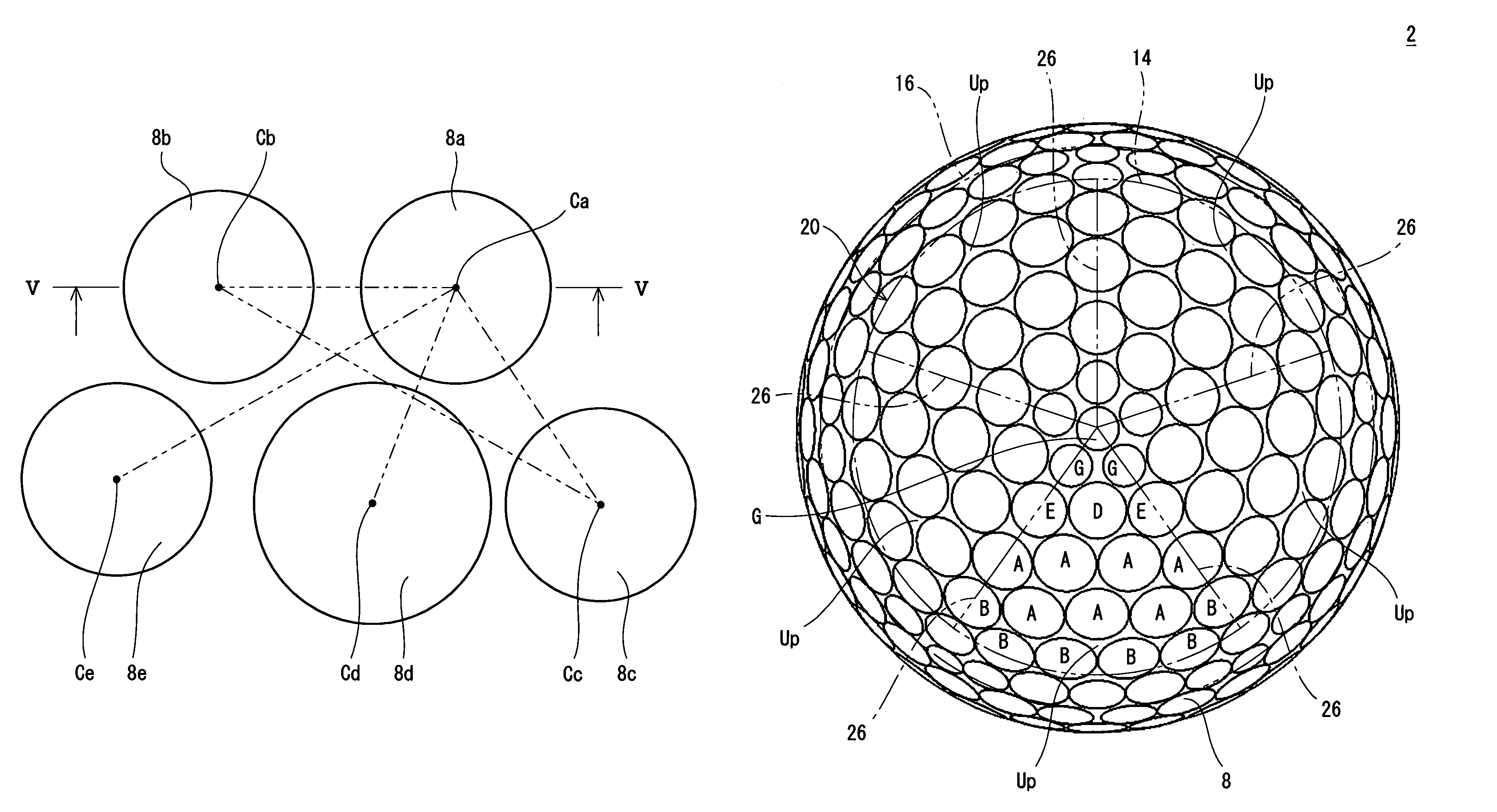
Figure 1 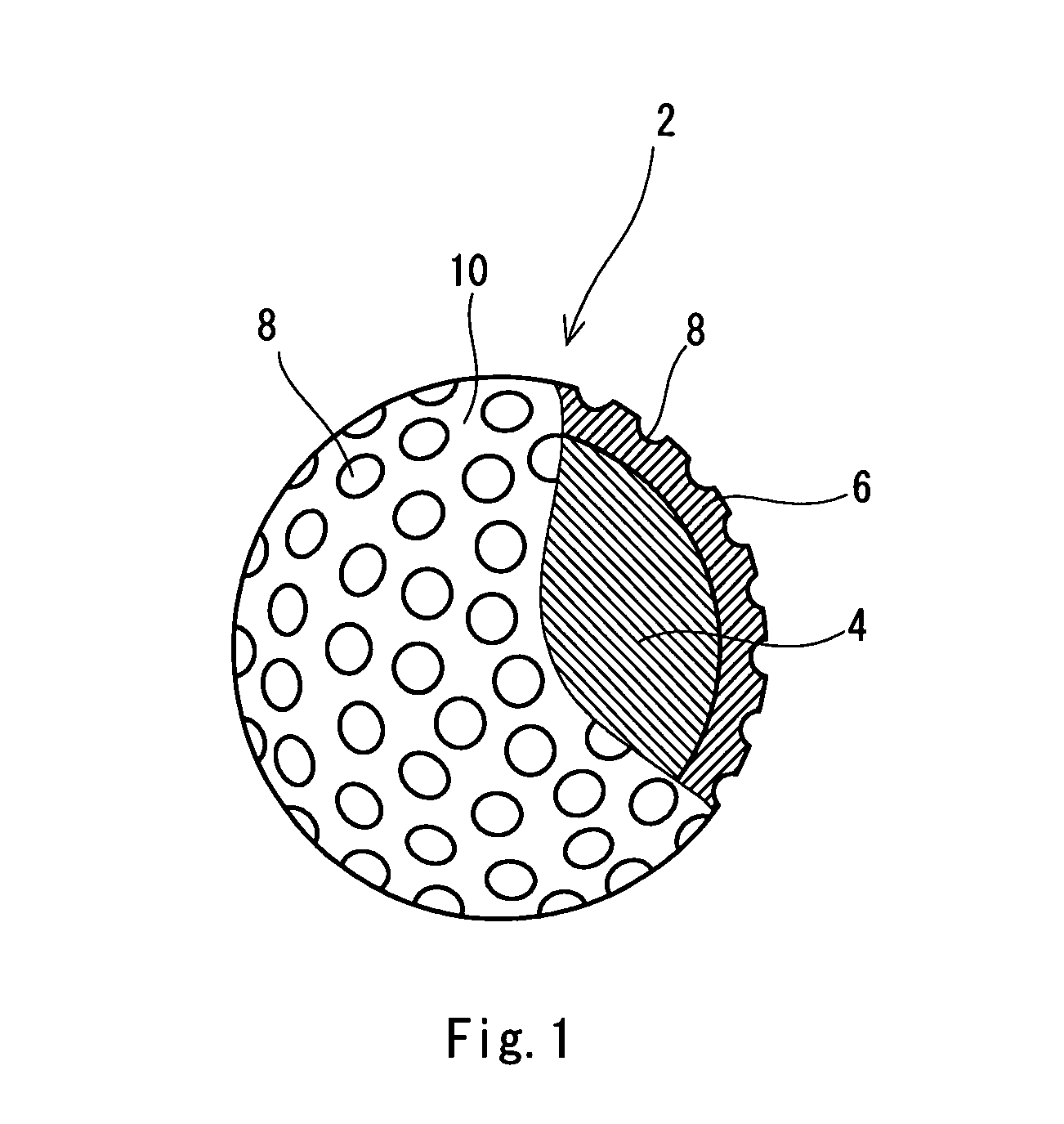
Figure 2 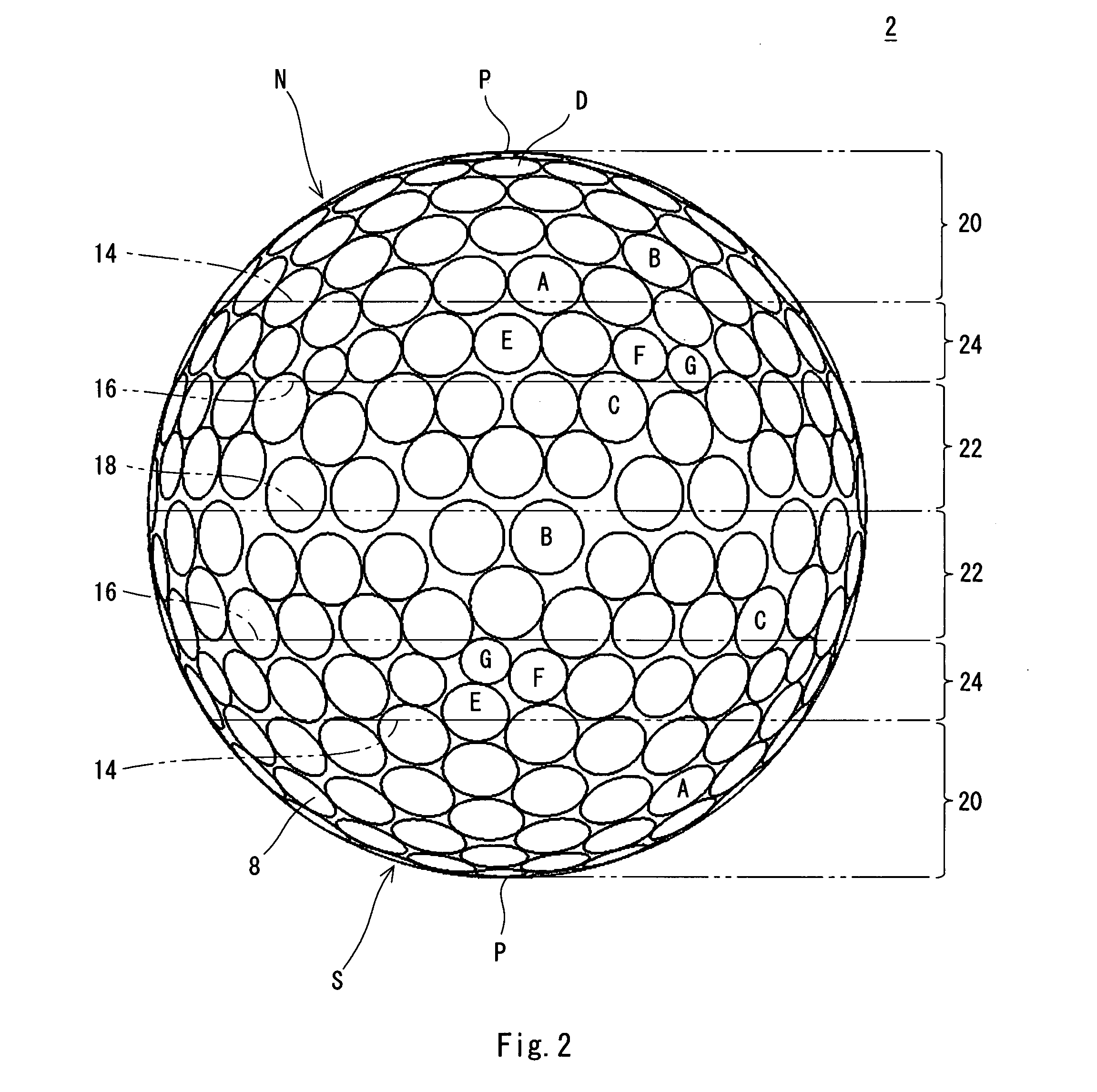
Figure 3
Abstract
Description
[0001] This application claims priorities on Patent Application No. 2006-221753 and Patent Application No. 2006-221766 filed in JAPAN on Aug. 16, 2006. The entire contents of these Japanese Patent Applications are hereby incorporated by reference.BACKGROUND OF THE INVENTION
[0002] 1. Field of the Invention
[0003] The present invention relates to golf balls having a core, a cover and dimples.
[0004] 2. Description of the Related Art
[0005] For golf balls, flight performance is important. Flight performance depends on aerodynamic characteristic of the golf ball. Aerodynamic characteristic heavily depends on specifications of dimples. The dimples disrupt the air flow around the golf ball during flight to cause turbulent flow separation. By causing the turbulent flow separation, separating points of the air from the golf ball shift backwards leading to the reduction of drag. The turbulent flow separation prolongs the gap between the separating point on the upper side and the separating point on ...
Examples
experiment 1
Example 1
[0177]A rubber composition was obtained by kneading 100 parts by weight of polybutadiene (trade name “BR-730”, available from JSR Corporation) which is synthesized using a rare earth element catalyst, 26 parts by weight of zinc diacrylate, 10 parts by weight of zinc oxide, an adequate amount of barium sulfate, 0.5 part by weight of diphenyl disulfide and 0.5 part by weight of dicumyl peroxide (manufactured by NOF Corporation). This rubber composition was placed into a mold having upper and lower mold half each having a hemispherical cavity, and heated at 170° C. for 20 minutes to obtain a core. The core had a diameter of 39.2 mm. On the other hand, a resin composition was obtained by kneading 57 parts by weight of ionomer resin (the aforementioned “Himilan 1605”), 40 parts by weight of another ionomer resin (the aforementioned “Himilan 1706”), 3 parts by weight of styrene block-containing thermoplastic elastomer (the aforementioned “Rabalon® T3221C”) and 3 parts by weight o...
experiment 2
Example 9
[0199]A rubber composition was obtained by kneading 100 parts by weight of polybutadiene (trade name “BR-730”, available from JSR Corporation) which is synthesized using a rare earth element catalyst, 29 parts by weight of zinc diacrylate, 10 parts by weight of zinc oxide, an adequate amount of barium sulfate, 0.5 part by weight of diphenyl disulfide and 0.5 part by weight of dicumyl peroxide (manufactured by NOF Corporation). This rubber composition was placed into a mold having upper and lower mold half each having a hemispherical cavity, and heated at 170° C. for 20 minutes to obtain a core. The core had a diameter of 39.2 mm. On the other hand, a resin composition was obtained by kneading 45 parts by weight of ionomer resin (the aforementioned “Himilan 1605”), 40 parts by weight of another ionomer resin (the aforementioned “Himilan 1706”), 15 parts by weight of styrene block-containing thermoplastic elastomer (the aforementioned “Rabalon® T3221C”) and 3 parts by weight ...