
Process for the preparation of calcipotriol
a technology of calcipotriol and cholecalciferol, which is applied in the field of preparation of cholecalciferol derivatives, can solve the problems of calverley's synthetic pathway disadvantages, loss of over a half of the obtained product, and formation of triphenylphosphine oxide, so as to avoid separation of diastereomeric mixtures, avoid separation, and easy purification
Patent Information
- Authority / Receiving Office
- US · United States
- Patent Type
- Patents(United States)
- Current Assignee / Owner
- Publication Date
- 2010-11-09
- Estimated Expiration
- Not applicable · inactive patent
Smart Images
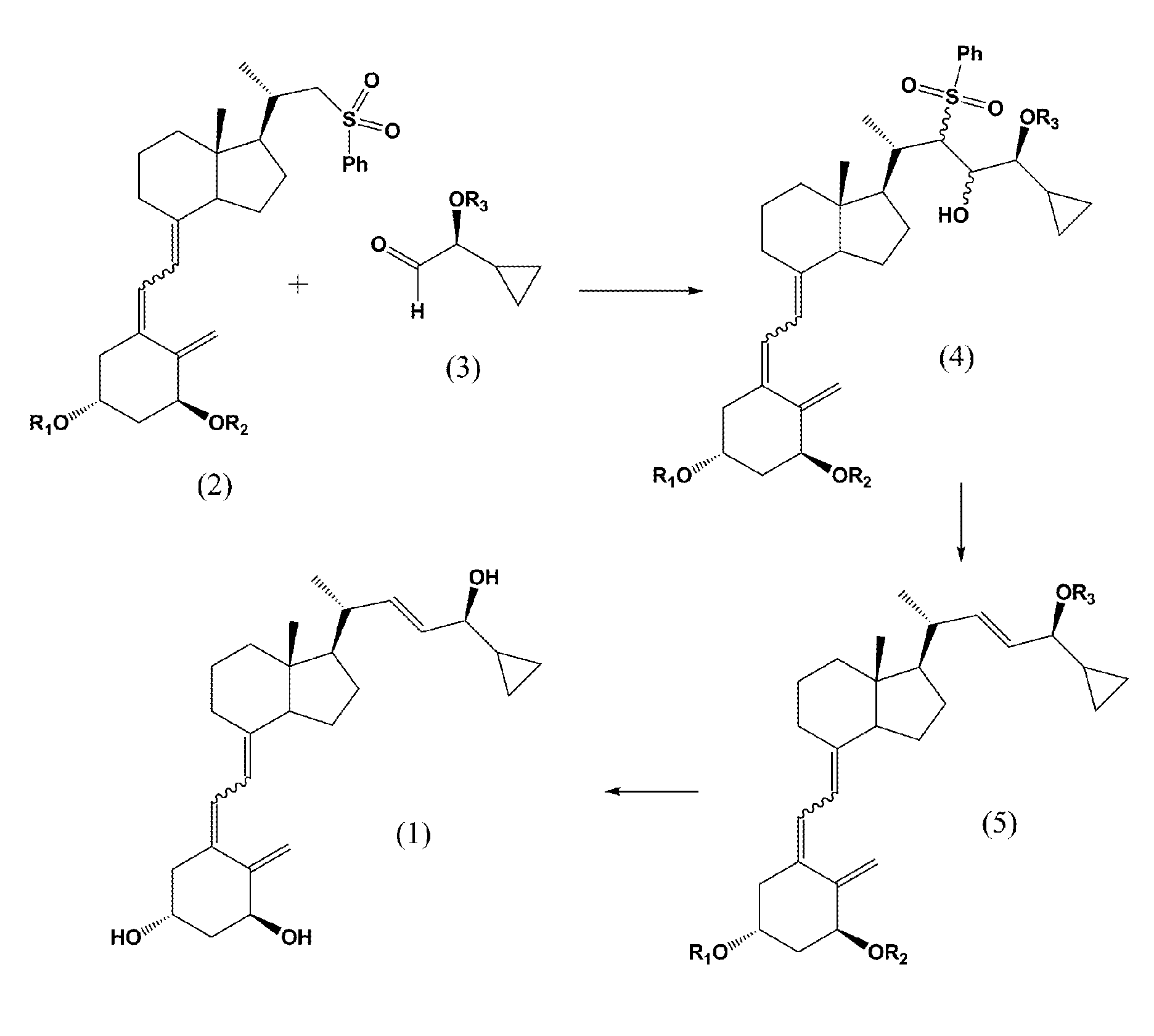
Figure 1 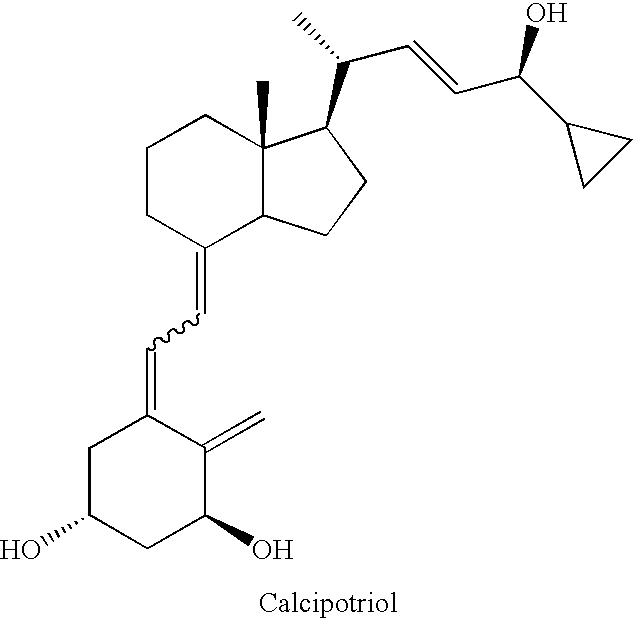
Figure 2 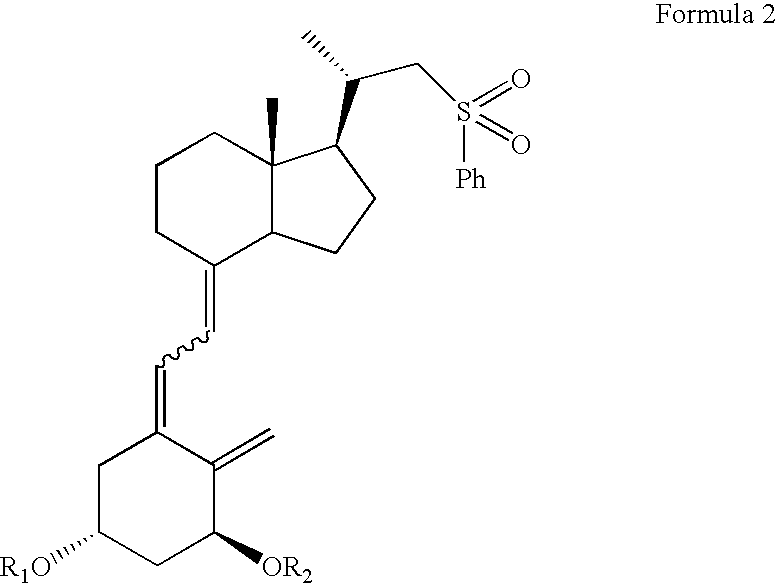
Figure 3
Abstract
Description
CROSS-REFERENCE TO RELATED APPLICATIONS
[0001] This is a continuation of International Patent Application No. PCT / PL2008 / 000051, with an international filing date of Jul. 11, 2008, and claims priority benefits to Polish Patent Application No. P-382912, filed Jul. 12, 2007. The contents of these specifications including any intervening amendments thereto are incorporated herein by reference. In addition, this is a continuation in part of U.S. application Ser. No. 10 / 962,873, filed on Oct. 8, 2004, now pending, which is a national phase application of International Patent Application No. PCT / PL2003 / 000037, with an international filing date of Apr. 10, 2003, designating the United States, now pending, which is based upon Polish Application No. 353328 filed on Apr. 11, 2002 and Polish Application No. 353832 filed on May 12, 2002.BACKGROUND OF THE INVENTION
[0002] 1. Field of the Invention
[0003] This invention relates to a process for preparation of cholecalciferol derivatives having a double...
Examples
example 1
(5Z,7E)-(1S,3R,24S)-1,3-bis(t-butyldimethylsilyloxy)-(22R,23R / 22R,23S / 22S,23R / 22S,23S)-22-sulfonylphenyl-23-hydroxy-24-cyclopropyl-24-t-butyldiphenylsilyloxy-9,10-secochola-5,7,10(19)-trienes (4)
[0044](5Z,7E)-(1S,3R)-1,3-bis(t-butyldimethylsilyloxy)-22-sulfonylphenyl-23,24-dinor-9,10-secochola-5,7,10(19)-triene (Formula 2, R1=R2=TBDMS) (384 mg, 0.55 mmol) was dissolved in THF (2 mL). The flask was placed in a cooling bath (−68° C.) on a magnetic stirrer under Ar. While stirring, n-butyl lithium (1.6 M in THF, 350 μL, 0.56 mmol)) was added drop-wise with a syringe. Stirring was continued for 30 min. at −68° C. Next, (2S)-2,2-cyclopropyl-t-butyldiphenylsilyloxyetanal (Formula 3, R3=TBDPS) (200 mg, 0.59 mmol) was slowly added drop-wise. Cooling bath was removed after 30 min. and the reaction mixture was stirred for additional 2 h. at ambient temp. Brine (1 mL) was added, organic phase was separated and dried over Na2SO4 (100 mg). After filtration, solvents were removed under reduced pr...
example 2
(5Z,7E,22E)-(1S,3R,24S)-1,3-bis(t-butyldimethylsilyloxy)-24-cyclopropyl-24-t-butyldiphenylsilyloxy-9,10-secochola-5,7,10(19),22-tetraen (5)
[0045]The mixture of (5Z,7E)-(1S,3R,24S)-1,3-bis(t-butyldimethylsilyloxy)-(22R,23R / 22R,23S / 22S,23R / 22S,23S)-22-sulfonylphenyl-23-hydroxy-24-cyclopropyl-24-t-butyldiphenylsilyloxy-9,10-secochola-5,7,10(19)-trienes (Formula 4, R1=R2=TBDMS, R3=TBDPS) (500 mg, 0.45 mmol) was dissolved in THF (1 mL), in a round-bottom flask of 10 mL capacity. The flask was placed on a magnetic stirrer and saturated methanolic Na2HPO4 solution (2 mL), followed by sodium amalgam Na / Hg (1.2 g) were added. The reaction mixture was vigorously stirred at ambient temp. for 2 h. The solution was decanted and the solvents were removed under reduced pressure. The product was extracted with hexane (3×5 mL) from dry residue. Hexane was evaporated and the residue was filtered through silica gel (2 g). (5Z,7E,22E)-(1S,3R,24S)-1,3-bis(t-butyldimethyldimethylsilyloxy)-24-cyclopropyl-...
example 3
(5Z,7E,22E)-(1S,3R,24S)-24-cyclopropyl-9,10-secochola-5,7,10(19),22-tetraen-1,3,24-triol (1)
[0046](5Z,7E,22E)-(1S,3R,24S)-1,3-bis(t-butyldimethylsilyloxy)-24-cyclopropyl-24-t-butyldiphenylsilyloxy-9,10-secochola-5,7,10(19),22-tetraene (Formula 5, (R1=R2=TBDMS, R3=TBDPS) (276 mg, 031 mmol) was dissolved in THF (2 mL) under Ar. The solution was warmed in a heating bath (+60° C.) on a magnetic stirrer. Tetrabutylammonium fluoride solution (1 M in THF, 1.0 mL, 1.0 mmol) was added drop-wise and stirring was continued for 1.5 h (+60° C.). After removal of a heating bath, the solution was cooled down to 20° C. and 1 mL of brine was added. Organic phase was separated, dried over Na2SO4 (200 mg), filtered and condensed under the vacuum. The crude product was contaminated with 2.2% of (22Z)-isomer of calcipotriol (HPLC). The residue was filtered through silica gel (2 g). After removal of solvents, the resulting solid was crystallized from ethyl acetate (500 μL). (5Z,7E,22E)-(1S,3R,24S)-24-cyc...