
Anti-rotation fixation element for spinal prostheses
a technology of spinal prosthesis and fixation element, which is applied in the field of spinal prosthesis attachment to spinal vertebrae, can solve the problems of severe limitations on the functional ability and quality of life of people, damage to spinous process, articular process, and vertebrae no longer articulating or properly aligning with each other, so as to relieve the compression or impingement of the source nerve, and lessen or alleviate spinal pain.
Patent Information
- Authority / Receiving Office
- US · United States
- Patent Type
- Patents(United States)
- Current Assignee / Owner
- Publication Date
- 2012-05-29
Smart Images
Figure 1 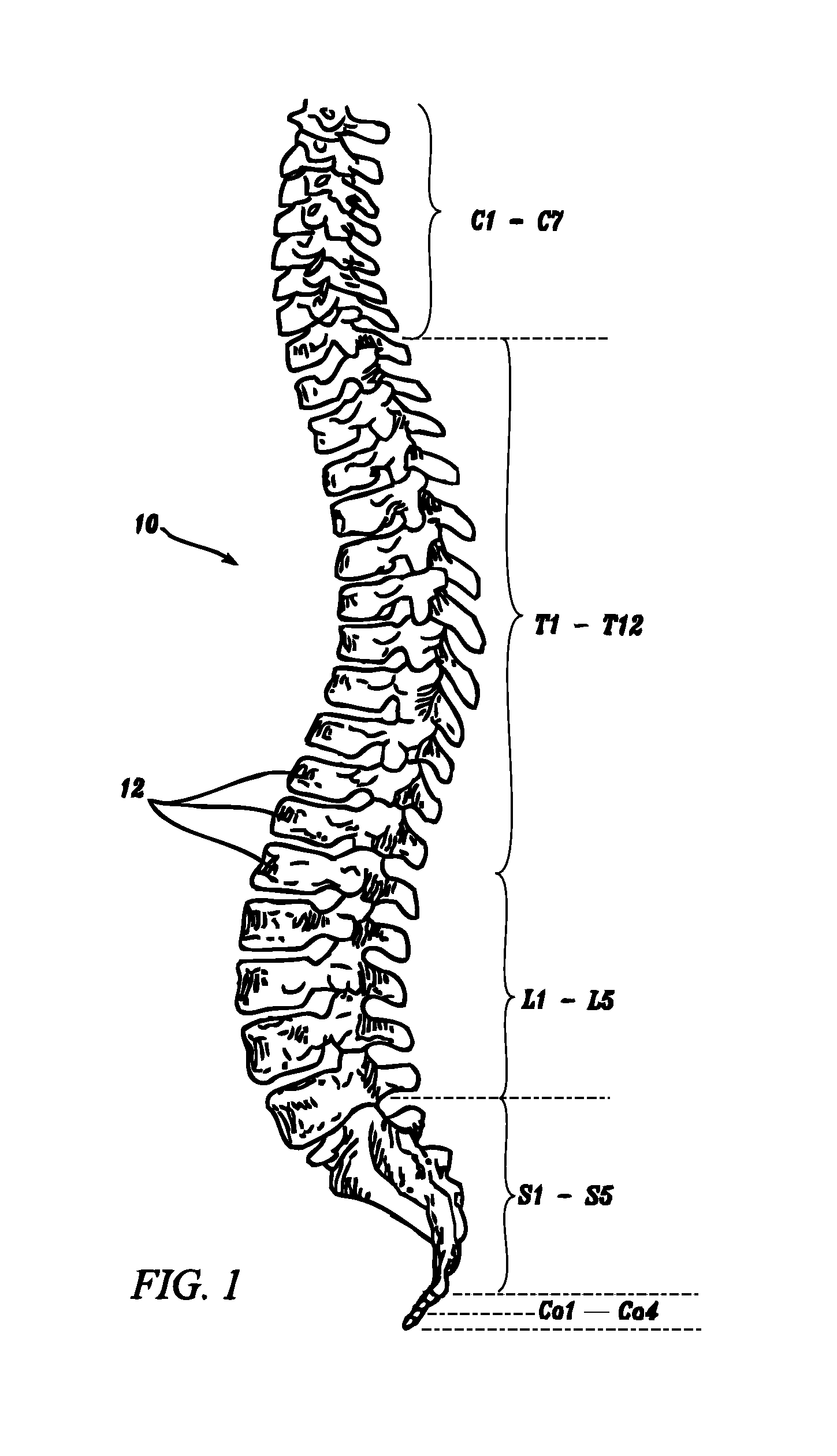
Figure 2 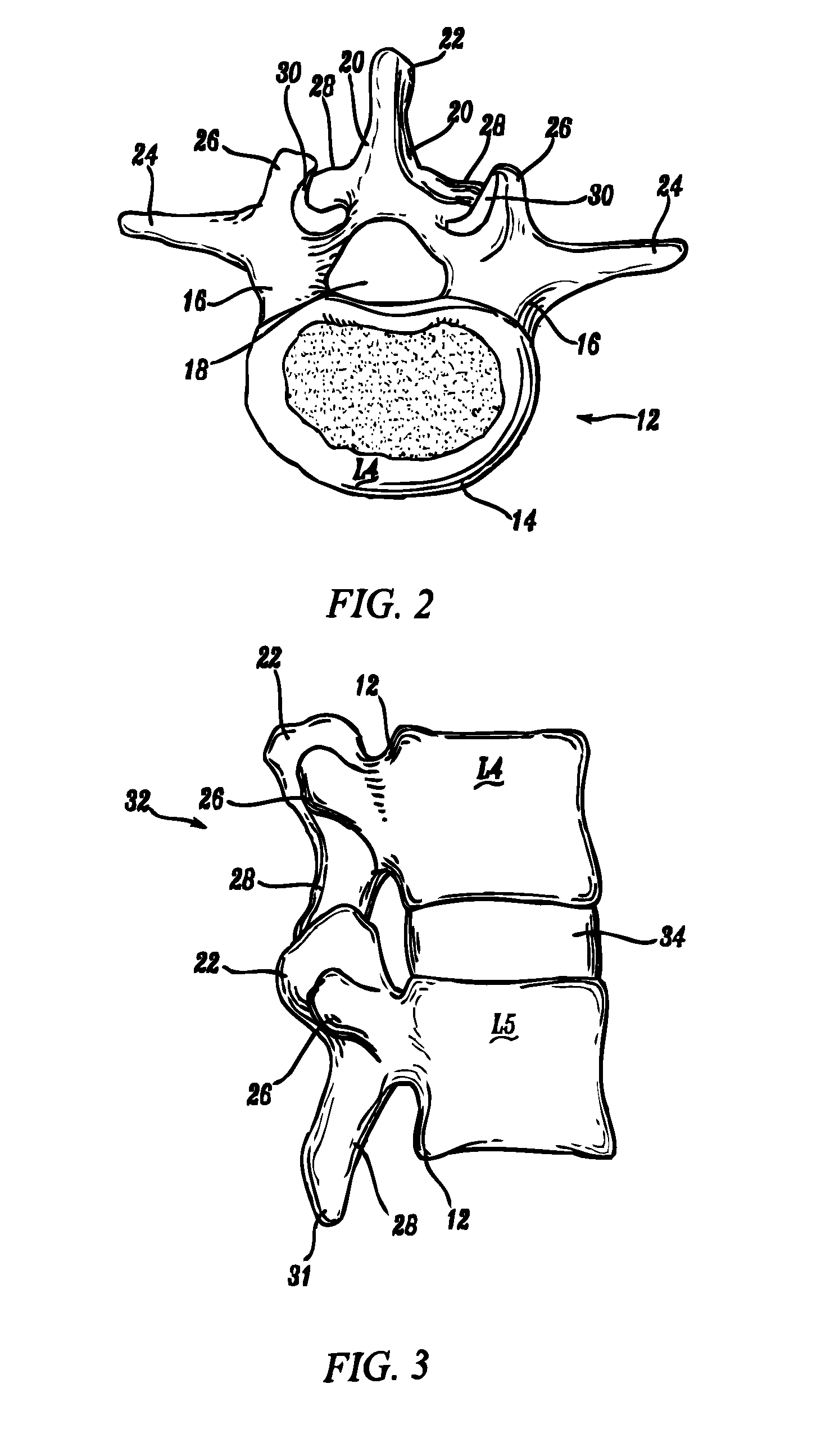
Figure 3
Abstract
Description
FIELD OF THE INVENTION
[0001] This invention relates to prostheses, systems, and methods for treating various types of spinal pathologies, and in particular relates to attachment of prostheses to spinal vertebrae.BACKGROUND OF THE INVENTION
[0002] The human spinal column 10, as shown in FIG. 1, is comprised of a series of thirty-three stacked vertebrae 12 divided into five regions. The cervical region includes seven vertebrae, known as C1-C7. The thoracic region includes twelve vertebrae, known as T1-T12. The lumbar region contains five vertebrae, known as L1-L5. The sacral region is comprised of five vertebrae, known as S1-S5, while the coccygeal region contains four vertebrae, known as Co1-Co4.
[0003] FIG. 2 depicts a superior plan view of a normal human lumbar vertebra 12. Although human lumbar vertebrae vary somewhat according to location, they share many common features. Each vertebra 12 includes a vertebral body 14. Two short bones, the pedicles 16, extend backward from each side of...
Examples
Embodiment Construction
[0078]Although the disclosure presented herein provides details to enable those skilled in the art to practice various embodiments of the invention, the physical embodiments disclosed herein merely exemplify the invention, which may be embodied in other specific structure. Accordingly, while preferred embodiments of the invention are described below, details of the preferred embodiments may be altered without departing from the invention. All embodiments that fall within the meaning and scope of the appended claims, and equivalents thereto, are intended to be embraced by the claims.
[0079]Embodiments of the present invention may be used, with advantage, on a wide variety of prosthesis devices, particularly spinal prostheses. Some of these prostheses, systems, and methods are discussed in the following applications entitled: “Facet Arthroplasty Devices And Methods”, by Mark A. Reiley, Ser. No. 09 / 693,272, filed Oct. 20, 2000, now U.S. Pat. No. 6,610,091, issued Aug. 26, 2003; “Prosthe...