
Method for establishing a secret key between two nodes in a communication network
a communication network and secret key technology, applied in the field of secret key establishment between two nodes in a communication network, can solve the problems of gaining information itself, i.e. without that the attacker has to invest (considerable) further efforts, and is deemed useless, so as to avoid unnecessary data traffic and increase security
Patent Information
- Authority / Receiving Office
- US · United States
- Patent Type
- Patents(United States)
- Current Assignee / Owner
- Publication Date
- 2012-12-25
Smart Images
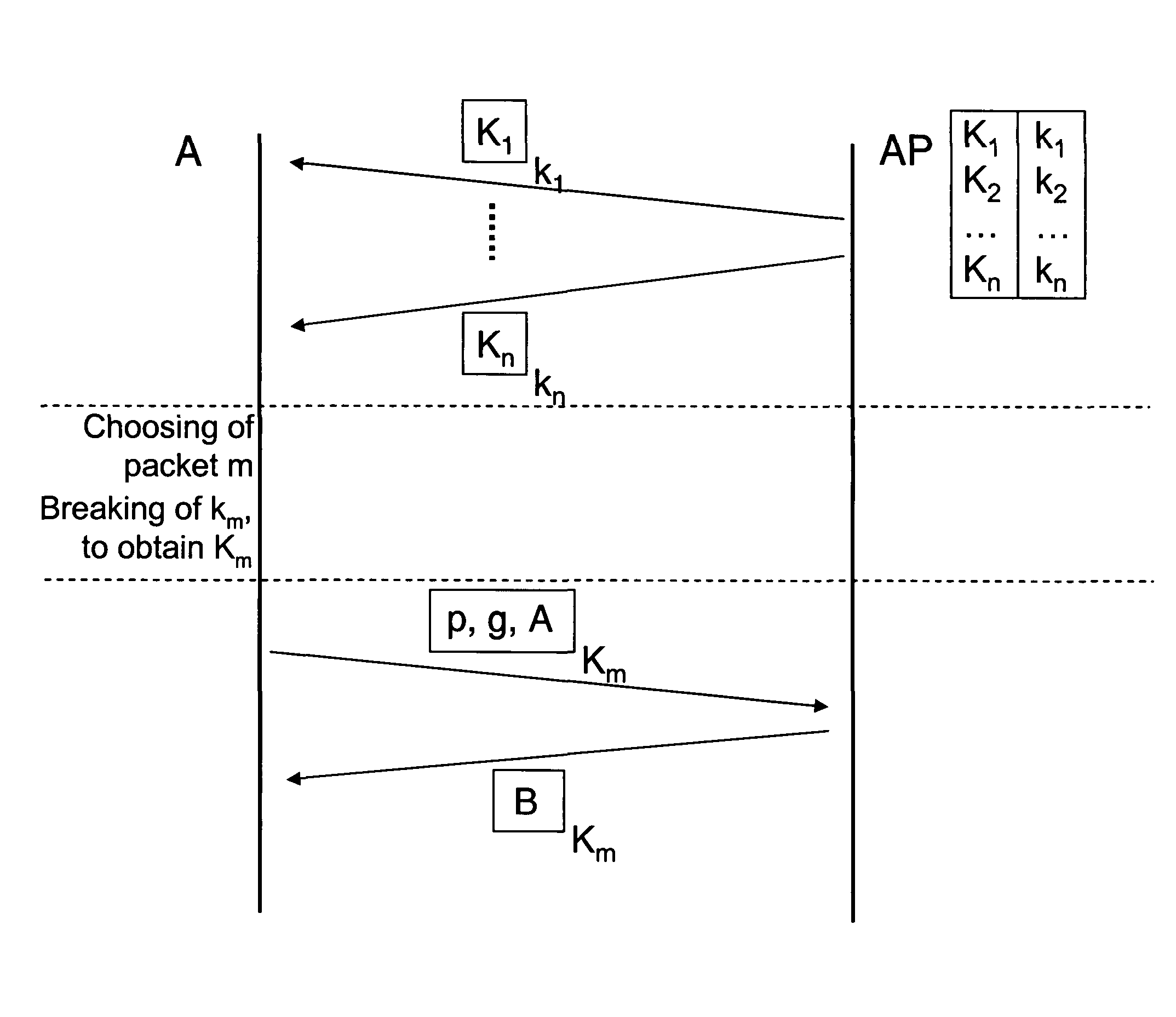
Figure 1 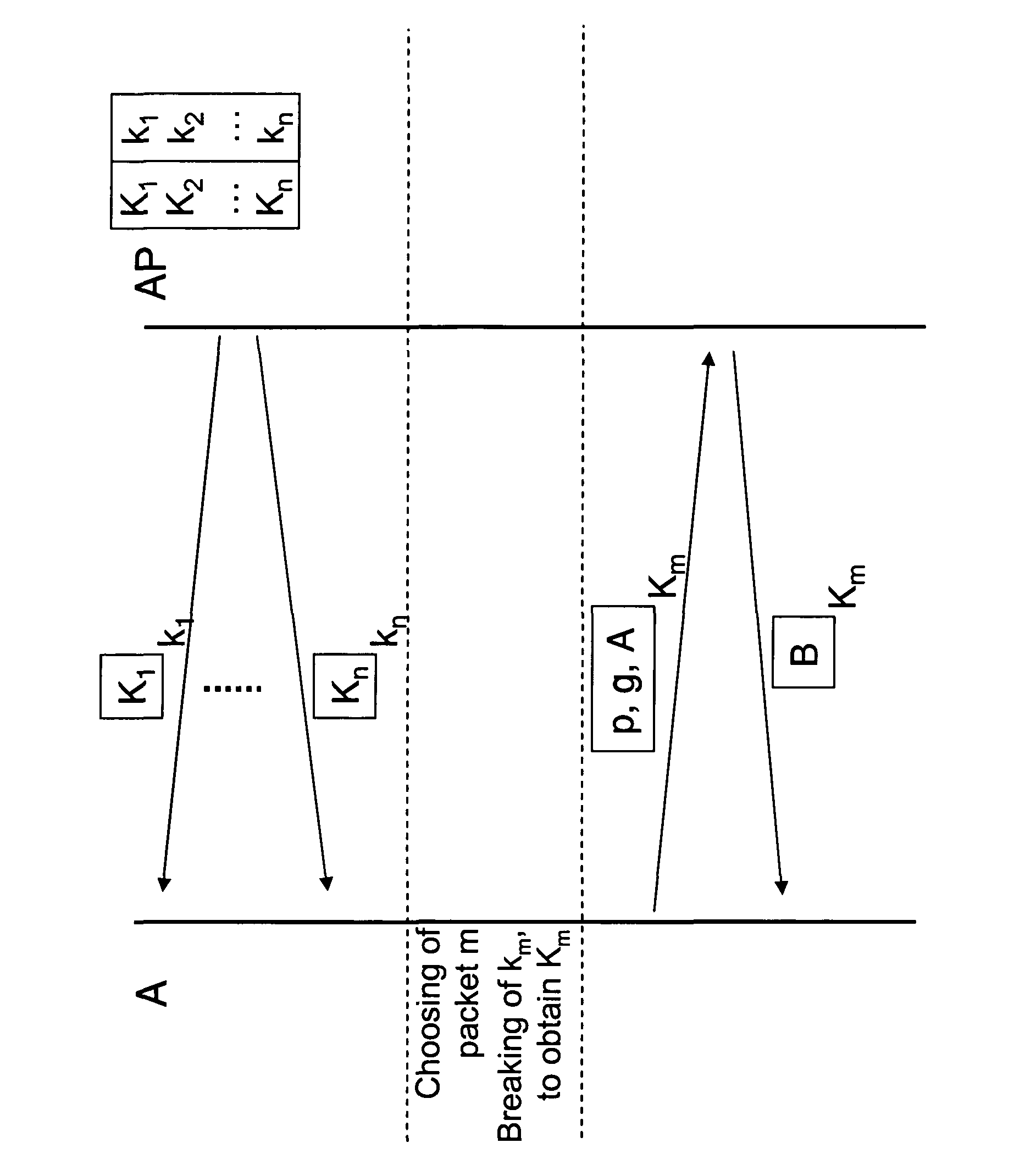
Figure 2
Abstract
Description
BACKGROUND OF THE INVENTION
[0001] The present invention relates to a method for establishing a secret key between two nodes in a communication network, in particular in a wireless local area network (WLAN).
[0002] In order to establish a secret key between two nodes in a communication network key exchange protocols are commonly used. Known key exchange protocols are, for example, the Diffie-Hellman algorithm, in particular Diffie-Hellman on elliptic curves, or RSA based methods. The security of the known methods is based on the application of so-called one-way functions. In this sense, the Diffie-Hellman algorithm uses the fact the raising to a power operation is a very simple computation operation, but that in contrast the computation of the discrete logarithm of a number is only possible with extremely high effort.
[0003] After having performed the known methods, the parties A and B involved in the algorithm dispose of a secret key K which only they will know. But in case of the known ...
Examples
Embodiment Construction
[0023]In a first step the access pint AP generates a multitude of packets Pi. The packets Pi contain each a first key Ki. The access point AP encrypts each of the packets Pi with a second key ki and sends the packets Pi encrypted in such a way over the wireless link, so the packets Pi can be received by the node A. In the concretely shown embodiment the packets Pi are encrypted with the block cipher RC5.
[0024]In a next step the node A chooses from the multitude of received packets Pi randomly a packet Pm. By running a brute force attack the node A breaks the encryption of the chosen packet Pm to thereby obtain the key Km. The brute force attack can be performed with reasonable efforts because the packets Pi have been encrypted by the access point AP with a relatively weak encryption.
[0025]In a third step the node A uses the found key Km to initiate a key exchange protocol with the access point AP. In the depicted embodiment, the key exchange protocol follows the known Diffie-Hellman...