
Conductive coating based on polymer-carbon nanotube composite
a technology of carbon nanotubes and composites, which is applied in the direction of instruments, optical elements, optics, etc., can solve the problems of reducing the service life of the portion, so as to achieve long service life, improve service life, and improve service life.
Patent Information
- Authority / Receiving Office
- US · United States
- Patent Type
- Patents(United States)
- Current Assignee / Owner
- Publication Date
- 2013-02-19
- Estimated Expiration
- Not applicable · inactive patent
Smart Images
Figure 1 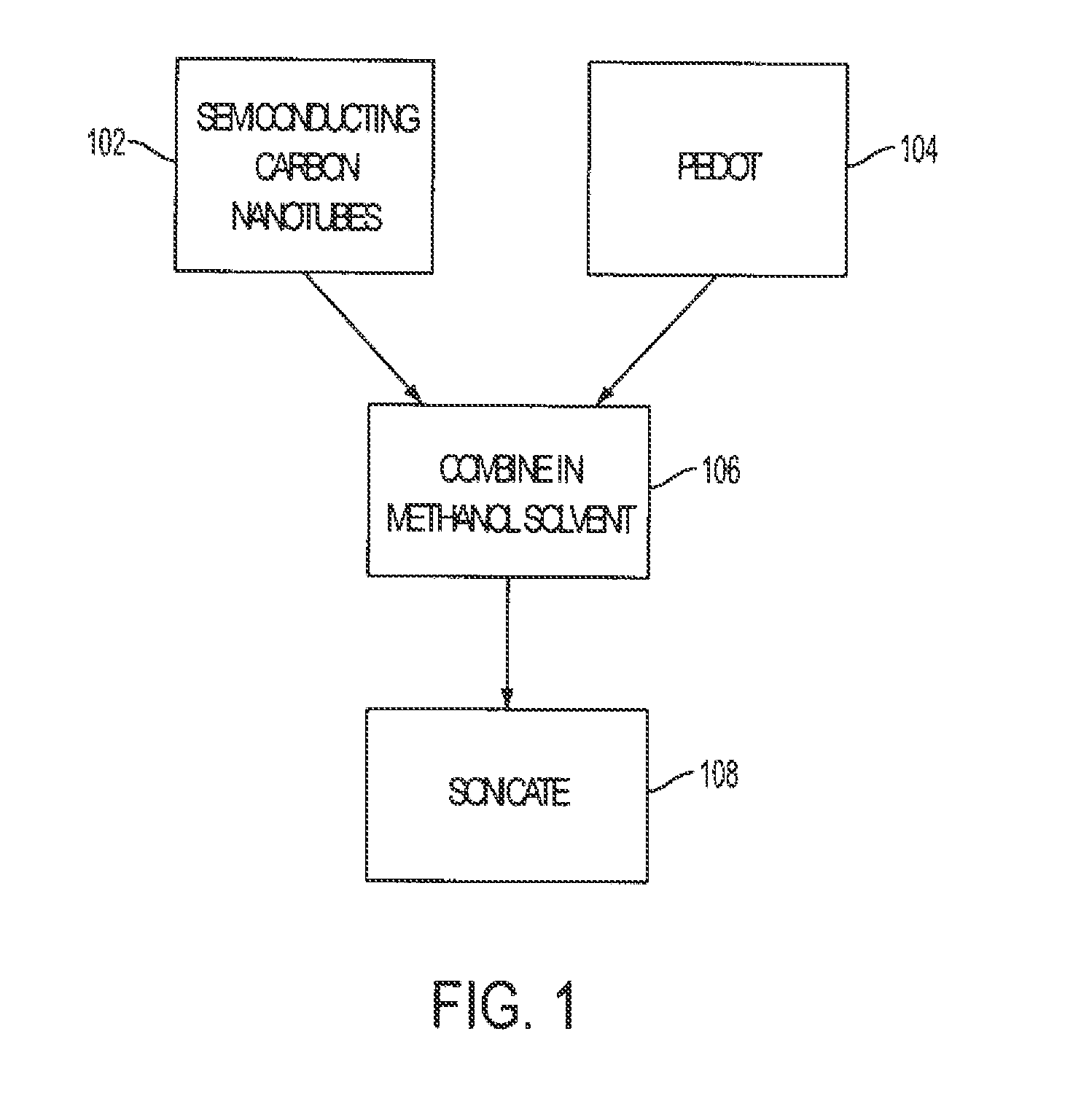
Figure 2 
Figure 3
Abstract
Description
REFERENCE TO RELATED APPLICATION
[0001] The present application is a divisional of U.S. patent application Ser. No. 12 / 153,177, filed on May 14, 2008, currently pending, which claims the benefit of U.S. Provisional Patent Application No. 60 / 924,407, filed on May 14, 2007, whose disclosures are hereby incorporated by reference in their entireties into the present disclosure.FIELD OF THE INVENTION
[0002] The present invention is directed to a conductive coating based on a composite of a conducting polymer and a carbon nanotube material.DESCRIPTION OF RELATED ART
[0003] With the increased use of composite materials in aircraft construction, the electrical shielding properties of conventional aluminum or metal skin are becoming lost. Another major problem is that maintaining sound electrical shielding after years of service is extremely problematic with conventional metal based shields, due to corrosion effects, which tend to electrically isolate portions of the shield, rendering those portio...
Examples
Embodiment Construction
[0031]Preferred embodiments of the present invention will be set forth in detail with reference to the drawings, in which like reference numerals refer to like elements or steps throughout.
[0032]FIG. 1 is a flow chart showing a preferred process of forming the conducting film.
[0033]Semiconducting carbon nanotubes are provided in step 102, and PEDOT or another suitable polymer is provided in step 104. They are mixed in methanol or another suitable solvent in step 106 and sonicated in step 108. As noted above, a highly conductive film results.
[0034]Films such as the type described above would find numerous applications that will have commercial value. One such application is the creation of a film that would have the properties of providing an image of the light or ionizing radiation that impinges the film. This would have enormous application is the areas of Homeland Security to detect radiation from nuclear materials or in the area of night vision where an effective night vision gog...